
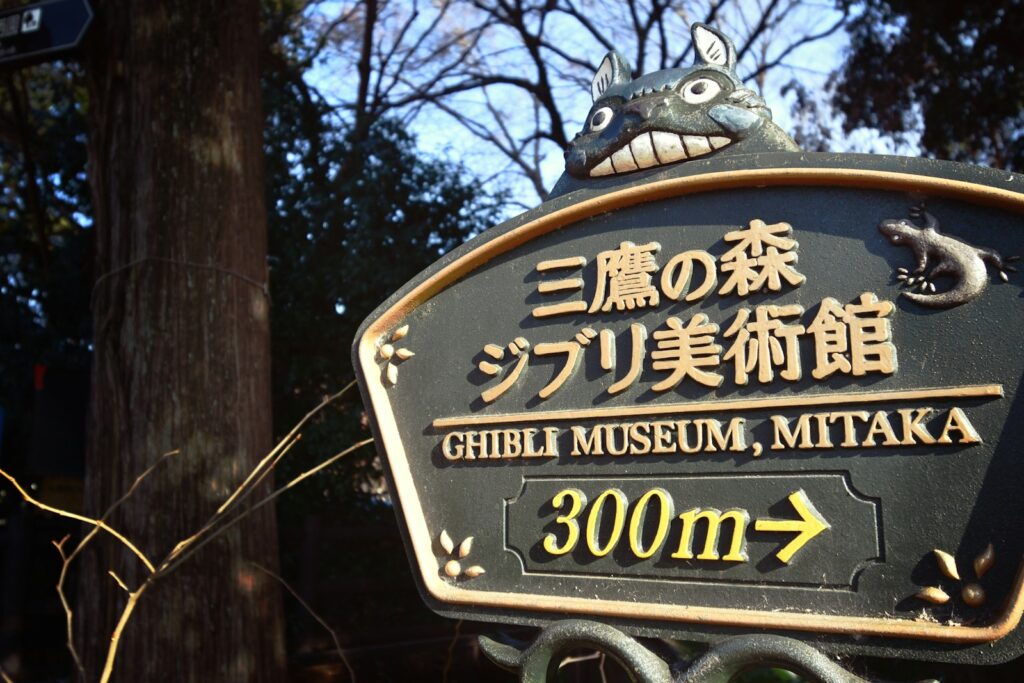
TL;DR
-
The Ghibli Museum is unlike any other museum in Tokyo, but it requires knowing Ghibli films first to get the most from it; children who can name the characters will have a very different experience from those who can’t
-
No tickets are sold at the museum. Advance booking is mandatory; tickets go on sale on the 10th of each month for the following month at 10 AM JST
-
Overseas visitors can buy through Lawson Ticket’s English platform or Sunrise Tours JTB, no Japanese required
-
Admission prices (2026): Adults ¥1,000 / Ages 13–18 ¥700 / Ages 7–12 ¥400 / Ages 4–6 ¥100 / Under 4 free
-
Photography is not allowed inside. The museum’s own explanation is that it wants visitors to experience the exhibits directly, not through a screen
-
Getting there: community bus from Mitaka Station (5 min, ¥200) is easiest; the walk back through Inokashira Park to Kichijoji is the nicer option on the return
Before You Go: The One Thing Most Guides Miss
Every guide to the Ghibli Museum leads with tickets. Fair enough; the ticketing system is genuinely complicated, and getting it wrong means missing the visit entirely. We’ll get to that.
But the single most important thing you can do before visiting with children is this: watch Ghibli films together first.
This sounds obvious, but many families assume the museum is like a theme park, that the visuals will be engaging regardless of context. That’s not entirely wrong. The architecture is beautiful. The exhibits are handcrafted and detailed. Even adults unfamiliar with Ghibli films find things to appreciate.
But a child who can look up at the robot soldier on the rooftop and shout “Laputa!”, or who gasps when they see the Catbus for the first time, is having a completely different experience. The museum is built on the assumption that you already love these films. It rewards that love rather than trying to create it.
Which films, and from what age?
Totoro is the natural starting point. Children as young as 3 can connect with the characters; Mei and Satsuki are children themselves, and the film’s pace is gentle enough for very young viewers. By around 4 or 5, many children are ready for Kiki’s Delivery Service and Ponyo. Spirited Away can wait until children are a little older; the imagery is intense for children under 6 or 7.
The key isn’t the number of films; it’s whether characters and names register. The difference between “I know who the Catbus is” and “that’s a large fluffy thing to climb on” is the difference between a magical moment and a fun, unremarkable one.
Practical note: You don’t need to have watched every Ghibli film. Two or three is enough for most children to feel the recognition that makes the museum come alive.
How to Get Tickets
The Ghibli Museum does not sell tickets at the door. Every visitor needs an advance reservation for a specific date and time. Without a valid ticket, you cannot enter.
When Tickets Go on Sale
Tickets for any given month go on sale on the 10th of the previous month at 10:00 AM JST. If you want to visit in July, you need to book on June 10th. If you want to visit in October, you need to book on September 10th.
This means planning at least three to four weeks ahead, and more realistically, being ready the moment tickets open on that 10th.
Weekend and holiday slots fill quickly. During school holiday periods, Golden Week (late April–early May), Obon (mid-August), or the New Year period, the most popular time slots disappear within minutes of going on sale.
Summer Visits (July–August): Advance Lottery
July and August are the exception to the standard monthly sales system. Because demand during the summer school holiday period is far higher than any other time of year, the museum operates a separate advance lottery for these two months, run through Lawson Ticket before regular sales even open.
How it works:
-
Applications open roughly 5–6 weeks before the target month via Lawson Ticket (the same platform as regular sales, English interface available)
-
A free Lawson web membership is required to enter
-
Each applicant can submit up to 5 different date/time combinations, with up to 6 tickets per combination
-
Entry times available: 10:00, 11:00, 12:00, 13:00, 14:00, 15:00, 16:00
-
Results are announced approximately 9 days after the application window closes; payment must be completed within 4 days of results
Typical annual schedule (confirm each year on the museum’s Japanese news page):
| Entry month | Application window | Results | Payment deadline |
|---|---|---|---|
| July | Late May (~25th–31st) | ~June 8th | ~June 12th |
| August | Late June (~25th–30th) | ~July 8th | ~July 12th |
Any slots not won in the lottery flow into the standard sales on the 10th of the preceding month, but during peak summer, those remaining slots sell out almost immediately.
For overseas visitors: The lottery runs through Lawson Ticket’s standard system, which has an English interface. The challenge is awareness: the lottery is announced on the Japanese-language museum site, not prominently on the English pages. If you’re planning a July or August visit, check ghibli-museum.jp/news/ in spring for that year’s lottery dates.
For Overseas Visitors: Lawson Ticket
The primary ticket system is Lawson Ticket, which has an English-language interface. Overseas visitors can purchase tickets at l-tike.com; search for Ghibli Museum and follow the English booking flow.
Payment is by credit card. You’ll receive a booking confirmation that you exchange for your physical ticket at a Lawson convenience store in Japan.
Step-by-step:
1. Mark the 10th of the month in your calendar; set an alarm for 10:00 AM JST
2. Go to the Lawson Ticket English page and search for the Ghibli Museum
3. Select your preferred date and entry time slot
4. Complete payment by credit card
5. Collect your physical ticket at any Lawson convenience store in Japan before your visit
Time zone note: 10:00 AM JST is 1:00 AM in London (GMT), 8:00 PM in New York (EST the previous evening), and 5:00 PM in Los Angeles (PST the previous day). If you’re targeting a popular weekend slot, you may need to set an alarm.
Through a Tour Package: Sunrise Tours JTB
For travellers who prefer a pre-arranged option, Sunrise Tours JTB offers packages that include the museum. The tickets are managed by the tour operator, less direct logistics, though you’ll be on a group itinerary rather than visiting independently.
This is a reasonable option if you want to pair the museum with other sightseeing and have the logistics handled for you.
Entry Times and Duration
Tickets are for a specific entry time, typically slots at 10:00, 12:00, 14:00, and 16:00 (exact slots vary by day). There is no set exit time: once inside, you can stay until the museum closes.
Most families with children spend 2 to 3 hours inside. The museum isn’t large, but there’s a great deal of detail to absorb, and children tend to want to linger in certain areas.
The Film Strip Ticket
When you collect your physical ticket, look at it closely. Each admission ticket is a piece of 35mm film from an actual Ghibli movie; held to the light, you can see a frame. The specific scene varies; no two people necessarily get the same one.
This is intentional. It’s the museum’s first gift before you walk through the door.
What to Expect Inside
The museum operates on a philosophy stated at the entrance: “Let’s get lost together.” There are no mandatory routes, no signs telling you where to go next. The building, a three-storey Italian-influenced structure designed by Hayao Miyazaki, rewards wandering.
This is liberating for adults. For families with children, it’s worth knowing the highlights in advance so you don’t accidentally miss them.
Saturn Theater: Exclusive Short Films
Every visitor is included in a screening at the Saturn Theater, a small cinema inside the museum. The films shown here are original short works created specifically for the museum; they are not available anywhere else, including online.
Your theater slot is assigned when you receive your ticket at entry. Screenings run throughout the day, and the film showing changes periodically. You won’t know in advance exactly which short film is playing; that’s part of the experience.
For children old enough to sit through 15–20 minutes (roughly from age 3 upward), this is a genuine highlight. The films are typically gentle and visual, accessible without Japanese language ability. Seating is on cushioned steps; children naturally gravitate to the front rows.
The Catbus Room
For children up to around age 12, the Catbus Room is often the peak of the visit.
A full-size, soft, climbable Catbus from My Neighbour Totoro fills a dedicated room. Children can climb in, through, and over it. Adults cannot enter; they watch from the doorway while their children disappear inside and emerge grinning.
For children who know Totoro, this is likely the moment they describe when they get home.
Practical note: There is sometimes a short wait. The room has a capacity limit, but the queue moves reasonably quickly.
Permanent Exhibitions: How Animation Is Made
A significant section of the museum is dedicated to the craft of animation: how individual frames are painted, how movement is created from still images, how a scene is built from background, character, and light.
The exhibits are hands-on and designed to make the process legible to non-specialists, children included. Zoetropes, spinning sculptures that create the illusion of animated figures moving, are a recurring favourite. Children understand intuitively that the figures are moving; the delight of working out why is immediate.
Children 6 and above tend to get more from this section than younger children, though the visual elements engage all ages.
The Rooftop Garden
The top floor gives access to a rooftop garden where a large robot soldier, from Castle in the Sky (Laputa), stands guard, covered in moss and ivy as if it has been there for decades.
Note: The rooftop requires a narrow circular staircase; there is no elevator access. Children who can manage stairs independently will be fine. The garden may close during bad weather.
For children who have seen Laputa, this is a specific and significant sight. For younger children who haven’t, it’s a large and impressive structure, still worth seeing, but the emotional register is different.
Straw Hat Café and MAMMA AIUTO! Shop
The Straw Hat Café (named after the café in Porco Rosso) has terrace seating and serves light meals and drinks. It’s a good spot for a mid-visit break; table service makes it less hectic than a queue-based café.
The MAMMA AIUTO! shop sells merchandise that is largely exclusive to the museum; items here are generally not available at standard Ghibli retail shops. If your children have specific Ghibli favourites, this is a reasonable place to mark the trip. The shop gets crowded during busy periods; managing excited children in a compact space takes energy.
No Photography Inside, and Why
Photography and video are not permitted inside the museum. The museum’s own explanation: to allow every visitor to experience the exhibits directly, without a screen or lens between them and the work.
It’s one of the few museum rules that genuinely improves the experience. You end up looking more carefully.
Outdoor areas, the rooftop garden, the exterior, are generally fine for photos. When in doubt, follow what other visitors do; staff will politely redirect guests photographing in restricted areas.
Getting There
The museum is in Inokashira Park in Mitaka, accessed from either Mitaka Station or Kichijoji Station on the JR Chuo Line. Both are on the same line; Mitaka is one stop further west.
From Mitaka Station (South Exit): Recommended for Arrival
A community shuttle bus runs from the south exit of Mitaka Station directly to the museum. The journey takes approximately 5 minutes. Buses run every 10–15 minutes during opening hours.
-
Fare: ¥200 per adult / younger children free (verify current pricing)
-
IC cards (Suica / Pasmo) accepted
-
A clearly marked queue forms outside the south exit
This is the easiest option for arrival, especially with children or bags.
From Kichijoji Station: Better for the Return
Kichijoji is about 15–20 minutes on foot from the museum, walking through Inokashira Park. The path is pleasant, through trees, past the park’s central pond, and the walk itself is worth making.
One note: parts of the route outside the park on the Kichijoji side have narrower pavements than you might expect. Arriving from Kichijoji with a pushchair is manageable but less comfortable than the Mitaka bus.
The Recommended Route for Families
The approach that works well: take the bus from Mitaka on arrival, walk back through Inokashira Park to Kichijoji on the return.
You arrive fresh by bus, with energy intact for the museum. After the visit, the walk through the park gives children space to decompress. Kichijoji itself has good options for food and is a relaxed, pleasant place to end an afternoon in west Tokyo. Our Kichijoji with Kids guide covers the neighborhood and Inokashira Park in more detail.
If you want to combine the museum with time in the park, arriving from Kichijoji in the morning and exploring Inokashira Park first works equally well; just leave enough time to walk to the museum for your entry slot.
Best Options for Your Visit
By how you’re booking
| Your situation | Best ticket option |
|---|---|
| Booking from overseas before arriving in Japan | Lawson Ticket English platform (l-tike.com) |
| Already in Japan, comfortable navigating Japanese | Lawson Ticket via Loppi terminal at any Lawson |
| Want the logistics handled, happy with a group itinerary | Sunrise Tours JTB package |
By when you’re going
| Timing | What to expect |
|---|---|
| Weekday morning (first slot) | Quietest, recommended for families with young children |
| Weekday afternoon | Manageable, usually less crowded than weekends |
| Weekend / public holiday | Popular time slots sell out on the 10th; book the moment sales open |
| July or August | Advance lottery required; apply ~5–6 weeks ahead via Lawson Ticket; check museum site for that year’s dates |
| Golden Week / Obon / New Year | Peak demand, slots disappear within minutes; set an alarm for 10:00 AM JST |
By your children’s ages
| Ages | What to prioritise |
|---|---|
| 3–4 | Catbus room, Saturn Theater short film; keep the visit short if they tire quickly |
| 4–7 | The sweet spot; character recognition is high, Catbus room and rooftop both land well |
| 8–12 | Animation craft exhibitions become genuinely interesting; still eligible for the Catbus room |
| Teenagers | Art and craft sections, rooftop garden, shop; the museum rewards Ghibli fans of any age |
Practical Summary
| Address | 1-1-83 Shimorenjaku, Mitaka, Tokyo |
| Nearest stations | Mitaka (JR Chuo Line), Kichijoji (JR / Keio Inokashira) |
| Community bus | Mitaka Stn south exit → museum, ~5 min, ¥200 |
| Opening hours | 10:00–18:00 (last entry depends on booked slot) |
| Closed | Tuesdays, plus occasional closures, check official site |
| Tickets | Advance booking only, via Lawson Ticket (English available) |
| Ticket sales open | 10th of each month at 10:00 AM JST for the following month |
| Admission | Adults ¥1,000 / Ages 13–18 ¥700 / Ages 7–12 ¥400 / Ages 4–6 ¥100 / Under 4 free |
| Photography | Not permitted inside the museum buildings |
| Strollers | Must be left in designated area inside the entrance |
| Saturn Theater | Included with admission; slot assigned at entry |
Verify current hours and prices at the official Ghibli Museum website before your visit.
For families planning where to base themselves in Tokyo, Kichijoji’s west-side location makes it a natural fit for a Ghibli Museum day. The Best Family Hotels in Tokyo guide covers options by area and budget. If you’re looking for other immersive experiences to pair with the museum, the teamLab Planets vs Borderless guide is a good companion for families.
FAQ
Do I need to book the Ghibli Museum in advance?
Yes, this is non-negotiable. The museum does not sell tickets at the door. Every visitor must hold an advance reservation for a specific date and entry time slot. Tickets go on sale on the 10th of each month at 10:00 AM JST for the following month.
How do foreigners buy Ghibli Museum tickets?
Overseas visitors can buy tickets through Lawson Ticket’s English platform at l-tike.com. Tickets go on sale on the 10th of each month at 10:00 AM JST for the following month. Payment is by credit card; your booking confirmation is exchanged for a physical ticket at any Lawson convenience store in Japan before your visit. Package tours including the museum are also available through Sunrise Tours JTB.
What age is the Ghibli Museum suitable for?
Children as young as 3 can enjoy the museum, particularly the Catbus room and the visual craft exhibits. That said, the experience is significantly richer for children who already know Ghibli films. Children who can recognise characters are fully engaged; those who can’t are visiting a beautiful museum they don’t yet have the key to. The sweet spot is roughly 4–8, when children have typically seen several films and the recognition moments land. Older children and teenagers who are fans get a lot from the craft-and-process sections.
What is the Catbus room and who can go in?
The Catbus room contains a large, soft, climbable version of the Catbus from My Neighbour Totoro. It is open to children up to approximately age 12. Adults cannot enter and must watch from the entrance. For children who know Totoro, it tends to be the moment they talk about most after the visit.
Can you take photos inside the Ghibli Museum?
No. Photography and video are not permitted inside the museum buildings. The museum’s stated reason is to let visitors experience the exhibits directly. Outdoor areas including the rooftop garden can be photographed. Staff will politely redirect guests who begin taking photos in restricted areas.
How long does the Ghibli Museum take?
Most families spend 2 to 3 hours. The museum is not large, but the level of detail and children’s tendency to linger means the time fills naturally. The Saturn Theater short film (15–20 minutes) is included in that estimate.
Can you bring a stroller into the Ghibli Museum?
Strollers cannot be taken through the museum and must be left in a designated area near the entrance. If you’re visiting with a young child who needs to be carried, bring a carrier or wrap as an alternative. Nursing rooms and baby-changing facilities are available inside.
Are Ghibli Museum tickets harder to get in summer?
Yes, significantly. July and August use a separate advance lottery system rather than standard monthly sales. Applications open approximately 5–6 weeks before your target month via Lawson Ticket (the same platform as regular sales, English interface available). Lottery results are announced about 9 days after the application window closes, and payment must be completed within 4 days of results. Even after the lottery, any remaining slots release on the 10th of the preceding month, but they typically sell out within minutes. If you’re planning a summer visit, check the museum’s news page (ghibli-museum.jp/news/) in spring for that year’s lottery dates and apply as soon as the window opens.
Is the Ghibli Museum worth visiting if my children haven’t seen the films?
Watch one or two films first, then visit. The difference in experience is significant enough that going in cold sells the trip short. Totoro is the natural starting point; it’s gentle, child-centred, and introduces the Catbus, which is the museum’s most beloved feature for young children. An afternoon watching Totoro before the trip is the best preparation you can make.
Information checked: 2026/09