
TL;DR
-
Five realistic options: Narita Express (N’EX), Keisei Skyliner, Airport Limousine Bus, an ordinary metered taxi, and a pre-booked fixed-fare “airport taxi” car service. Each has a different tradeoff between cost, speed, and ease with kids
-
The Limousine Bus is one of the strongest choices for families with young kids. No stairs, no transfers, and the driver loads every suitcase into the hold for you, then you’re dropped right at your hotel’s door
-
A pre-booked fixed-fare airport taxi (large/minivan class) is the other family-friendly door-to-door option. Companies like Tokyo MK, Airport Taxi, and Kokusai Motorcars (km taxi) run minivans that take 4–6 passengers plus several large suitcases, at a fixed price agreed before you land, not a running meter
-
The Skyliner is fastest but only reaches Ueno/Nippori. If your hotel is in Shinjuku, Shibuya, or elsewhere, you’ll need a transfer with your bags
-
N’EX is the most flexible for reaching Shinjuku, Shinagawa, Yokohama, or (on some through-services) Ikebukuro directly. Reserved seats and dedicated luggage space make it stroller-friendly, but it doesn’t run on the credit-card-tap system
-
Consider sending your luggage ahead via same-day/next-day forwarding counters at the airport, so you can travel the last leg hands-free with just a diaper bag
The Situation in Japan
Landing at Narita after a long-haul flight with jet-lagged kids is a specific kind of stressful. Between the stroller, the suitcases, and children who’ve just spent 10+ hours sitting still, the last thing you want is a transfer that involves stairs, a tight connection, or a long wait standing in a crowded corridor.
Narita Airport sits about 60–75 km east of central Tokyo, noticeably farther out than Haneda. That distance is exactly why the choice of transport matters more here than almost anywhere else on a Japan trip with kids. Get it right, and you’re at your hotel within 60–90 minutes, luggage handled, kids buckled into a bus seat or dozing in a reserved train seat. Get it wrong, and you’re wrestling a stroller up a station staircase during a transfer, or sitting in Tokyo’s evening traffic for two hours.
There are five realistic ways to make the trip:
- Narita Express (N’EX): JR’s reserved-seat limited express, direct to several central Tokyo hubs
- Keisei Skyliner: the fastest train, but it only goes to Ueno/Nippori
- Airport Limousine Bus: one of the best options with young kids, with no stairs, no transfers, and the driver handling your luggage from the airport curb to your hotel
- Ordinary metered taxi: a regular street-hail or taxi-stand ride, priced by the meter as you go
- Pre-booked fixed-fare airport taxi (large/minivan class): a car service booked in advance with a company like Tokyo MK, Airport Taxi, or Kokusai Motorcars, a set price agreed before you ride, and a larger vehicle built for passengers plus a full set of luggage
None of these is objectively “best.” The right choice depends on how many kids you have, how much luggage, whether your hotel is near a station the trains serve, and how much you value predictability over cost. Our own pattern has shifted with each stage of family life: N’EX when traveling solo (we’ve used it into Shinjuku, Tokyo, and Shibuya stations at different times), the Limousine Bus as a couple before kids, and a pre-booked airport taxi since having young children, since managing public transit with a toddler after a long flight is a lot more than it sounds. For most families with young children and real luggage, it comes down to a choice between two of these: the Limousine Bus and the pre-booked fixed-fare airport taxi, both of which take the physical burden of carrying bags and managing transfers off your hands entirely.
Option-by-Option Breakdown
Option A: Narita Express (N’EX)
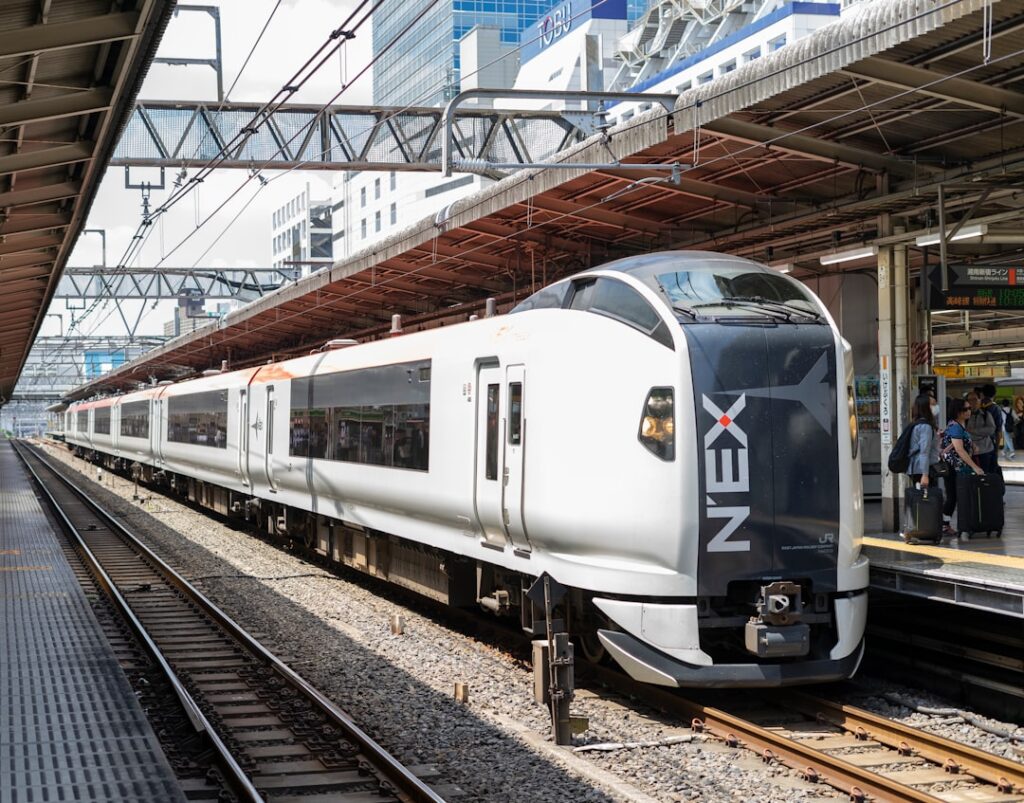
The N’EX is JR East’s limited express train, running direct from Narita Airport to Tokyo Station, Shinagawa, Shibuya, and Shinjuku, with most trains continuing to Yokohama; no transfers needed if your hotel is near one of those stations. A portion of N’EX services (the Omiya-bound through-trains) also continue on to Ikebukuro; if Ikebukuro is your destination, double-check when booking that your specific train continues there, since not every N’EX departure does. In our own experience traveling solo before having kids, this was our default, and we’ve ridden it into Shinjuku, Tokyo, and Shibuya stations on different trips.
Fares (ordinary car, one-way, adult / child is half price):
| Destination | Adult (ordinary car) |
|---|---|
| Tokyo Station | ¥3,140 |
| Shinagawa / Shibuya / Shinjuku | ¥3,330 |
| Yokohama | ¥4,480 |
These reflect JR East’s March 2026 fare revision. Children aged 6–11 pay half the adult fare. Kids under 6 ride free, but only if they sit on a parent’s lap rather than occupying their own reserved seat; if you want a guaranteed seat for a child under 6, you’ll need to buy a ticket for it.
Round-trip discount for visitors: JR East also sells the N’EX Tokyo Round Trip Ticket exclusively to travelers with a foreign passport, currently ¥5,200 for adults and ¥2,600 for children, covering one round trip within 14 days between Narita and the Tokyo metropolitan area. For most families doing one arrival and one departure trip, this round-trip ticket works out cheaper than buying two one-way ordinary car tickets.
How to buy: Reserved-seat ticket machines are in the arrivals area of each terminal, with an English-language menu. You can also reserve online in advance through JR East’s website or the JR East app, worth doing generally, and especially during cherry blossom season (late March–early April), Golden Week (late April–early May), or other national holidays, when reserved seats fill up faster than usual.
Seating and luggage: N’EX is all-reserved seating: every passenger needs both a base fare ticket and a limited express ticket, and you’ll be assigned a specific seat and car. Each car has a dedicated oversized-luggage storage area near the doors (some with dial locks), plus overhead racks for smaller bags. Strollers don’t need to be folded, but if the dedicated storage area is full, check with the conductor or station staff about where to place it rather than leaving it in the doorway or aisle, since blocking doors can be an issue for other passengers and at stops.
Journey time: Around 55–90 minutes depending on destination (Tokyo Station is the fastest; Yokohama takes closest to 90 minutes).
Good to know: N’EX does not accept the contactless credit card tap system used on Tokyo Metro, Toei, and other private railways; it’s a JR line, so you’ll need a paper ticket, an IC card with the appropriate limited-express add-on, or the round-trip ticket described above. See our guide on IC Cards (Suica & Pasmo) with Kids in Japan for how IC cards work alongside reserved-seat trains like the N’EX.
This is checked against JR East’s official N’EX ticket page and the N’EX Tokyo Round Trip Ticket page; confirm current routing and round-trip ticket pricing before booking, as through-service patterns and fares are periodically revised.
Option B: Keisei Skyliner
The Skyliner is the fastest way from the airport into Tokyo. Its fastest departures run non-stop to Nippori (about 41 minutes) and Ueno (about 44 minutes); some trains make one or two additional stops (such as Aoto or Shin-Kamagaya), which adds a few minutes, so check your specific departure if speed is the priority.
Fares (one-way): Adult tickets bought at the station cost around ¥2,580; booking online in advance brings this down to roughly ¥2,310. Children aged 6–11 pay half price (around ¥1,150–¥1,290 depending on where you buy).
Seating: All-reserved seats, similar to the N’EX, with a small dedicated space for oversized luggage in each car.
How to buy: Ticket counters and machines are in the arrivals lobby at Narita, or reserve an e-ticket online before you land.
⚠️ The catch families miss most often: the Skyliner only goes to Ueno and Nippori; it does not serve Shinjuku, Shibuya, Ikebukuro, or Tokyo Station directly. If your hotel is anywhere else, you’ll need to transfer onto the JR Yamanote Line at Nippori, or the Tokyo Metro Ginza/Hibiya Lines at Ueno, meaning another set of stairs, another platform, and another few minutes of managing kids and bags mid-journey. If your hotel is near Ueno or Nippori, the Skyliner is excellent. Otherwise, factor in the transfer before you commit.
Best for: Families whose hotel is in or near Ueno/Asakusa, or anyone prioritizing speed over a direct-to-door connection and comfortable managing one more transfer.
This is checked against Keisei Electric Railway’s official Skyliner fare page.
Option C: Airport Limousine Bus
This is one of the best options for families with young kids, especially useful if avoiding a train transfer with tired children matters to you. The Airport Limousine Bus runs directly from both Narita terminals to dozens of major hotels and stations across Tokyo (Shinjuku, Shibuya, Tokyo Station, Ikebukuro, Ginza, and many hotel doorsteps directly). You board once at the airport curb, sit down with your kids, and don’t stand up again until the bus stops at your hotel: no stairs, no station corridors, no changing trains with a stroller and a toddler in tow. This was our own go-to as a couple before we had kids, and it’s still the option we’d point a bag-heavy family toward first.
Fares (one-way, adult): Typically around ¥2,900–¥3,600 depending on destination, with children aged 6–11 at half price. Children under 6 who don’t need their own seat ride free.
Luggage: This is the bus’s biggest advantage for families: the driver or ground staff loads your suitcases into the under-bus hold for you. You hand your bags over once at the airport and don’t touch them again until you step off at your stop. No stairs, no carrying anything through a station, no transfers. Each passenger can typically check up to two suitcases, each up to around 120cm × 60cm × 50cm and 30kg; check the operator’s current baggage terms before you fly if you’re traveling with an especially large case.
How to buy: Ticket counters and vending machines are in the arrivals lobby of each terminal. Reservations aren’t always required but are recommended for peak travel dates; you can reserve online in advance.
Journey time: This is the one real downside: buses are subject to road traffic. Expect roughly 70–90 minutes in light traffic, but journeys can stretch to nearly two hours during evening rush hour or holiday congestion. Build in buffer time, especially for an evening arrival.
Best for families with a toddler and multiple suitcases: no stairs, no gate transfers, and someone else handles the heavy lifting from curb to hotel lobby. If your hotel is on one of its routes, this is usually the single easiest option in this entire list for traveling with young kids. The only real tradeoff is a less predictable arrival time, so don’t book this if you have a tight same-evening dinner reservation.
This is checked against the Limousine Bus official access-from-Narita page.
Option D: Taxi: Ordinary Metered Taxi vs. Pre-Booked Fixed-Fare Airport Taxi
“Taxi” from Narita splits into two quite different services, and the distinction matters a lot for families with luggage: an ordinary metered taxi (a regular car, priced by the meter as you ride) and a pre-booked, fixed-fare airport taxi/car service (a larger vehicle, price agreed in advance, specifically marketed for airport transfers). Both get you door to door with no transfers, but they differ a lot in vehicle size, price predictability, and how well they suit a family with a full set of luggage. This is what we’ve used ourselves since having young kids: public transit with a tired 3-year-old after a long journey is a different proposition than doing it solo or as a couple, and the door-to-door taxi has been worth the extra cost for us at that stage.
Ordinary metered taxi
A standard taxi hailed from the rank outside arrivals, priced by the meter rather than a pre-agreed fare. Fares to central Tokyo run into the tens of thousands of yen on the meter and can vary with traffic, and most airport-rank taxis are regular sedans, fine for one or two adults with carry-on bags, but tight for a family with a stroller and several large suitcases. This is the least predictable option in both price and vehicle size, and generally the one we’d recommend last for a family arriving with a full set of luggage.
Pre-booked fixed-fare airport taxi / car service (the family-friendly taxi option)
This is the option worth knowing about specifically because it solves the two biggest taxi problems for families: unpredictable pricing and not enough space for luggage and kids. Several established Tokyo taxi and hire-car operators run dedicated, pre-booked airport transfer services from Narita using minivan-class vehicles at a fixed price agreed before you travel; you’re not watching a meter climb in traffic, and you’re not folding a double stroller into a compact sedan’s trunk.
-
Tokyo MK publishes fixed one-way fares from Narita to central Tokyo, e.g. around ¥26,000 to Chiyoda/Tokyo Station and ¥28,000 to Shinjuku/Shibuya/Minato during the day (roughly ¥30,000–33,000 for late-night pickups, 10pm–5am), plus expressway tolls up to about ¥3,700. Two charges are easy to miss when budgeting: an arrivals-lobby pickup requires a mandatory ¥8,000 meet service fee (the driver waits inside the terminal with a name board), and requesting a specific vehicle class such as a minivan (Alphard-type) adds a further ¥2,000 vehicle designation fee. Add both to the base fare and tolls to get the real total before you compare this against the bus or train.
-
Airport Taxi, run by Inbound Platform Co., Ltd. and the service we’ve personally used, prices a flat ¥22,700 one-way between Narita and central Tokyo’s 23 wards, with tolls, parking, fuel, and tax all folded into that one number rather than added on top. Every car is a Toyota Alphard-class minivan by default, so there’s no separate vehicle-designation fee to budget for. Booking is credit-card only, done online or via LINE. One reason we went with this operator over a similarly-named site we weren’t sure about: Inbound Platform is listed on the Tokyo Stock Exchange’s Growth Market (ticker 5587), a subsidiary of the travel company Airtrip, which gave us something concrete to check before handing over a booking and a credit card from abroad. The one thing worth flagging clearly: this operator does not offer a child car seat at all, stated plainly on their own site, so if a car seat matters for your ride, look elsewhere or bring your own.
-
Kokusai Motorcars (km taxi) runs a similar fixed-fare Narita service (roughly ¥26,000–28,000 to central Tokyo wards by daytime zone, more late at night) and specifically offers a minivan taxi option (e.g. Toyota Esquire-class) at the same fare as a standard car, no size upcharge. km’s minivans seat up to 6 passengers and comfortably take several large suitcases, more if the vehicle isn’t full of passengers.
-
Jumbo/wagon taxi specialists (e.g. JumboTaxi.com, using Toyota HiAce or Grand Cabin-class vehicles) go a size class further, advertising fixed-rate Narita transfers for up to 9 passengers and 9 large suitcases in one vehicle, useful for a bigger family group, multiple families traveling together, or anyone with an unusually large amount of luggage or gear (car seats, a full-size stroller, sports equipment).
Why this matters for families specifically: a minivan-class vehicle comfortably takes a folded full-size stroller, several large suitcases, and 4–6 passengers without anyone holding a bag on their lap, something a standard sedan taxi often can’t do once you have two kids’ worth of luggage. And because the fare is fixed and agreed before you ride, a slow crawl through evening traffic on the expressway doesn’t turn into a bigger bill, which matters after a long-haul flight when you’d rather not be doing fare math with tired kids in the back seat. One thing worth planning for either way: it’s still roughly 60–90 minutes on the road. On one of our own Airport Taxi rides, our child fell asleep not long into the ride and then woke up fussy before we’d arrived, simply because the trip still had a while left to run. A snack, a favorite toy, or something to watch on a phone for the last stretch isn’t a bad idea to have ready.
Car seats: Ordinary Japanese taxis (including these fixed-fare and minivan services) are legally exempt from child car seat requirements and do not carry one by default. Japanese law leaves the decision to bring a restraint largely up to the family, but if you want your child seated in an approved car seat, plan to bring your own portable one, or book in advance with one of the small number of operators that explicitly offer child seats on request (availability is limited and not guaranteed even with advance notice, so confirm directly with the operator before you rely on it).
How to book: Pre-booked fixed-fare and minivan/jumbo services need to be reserved in advance, typically online or by phone, with a few hours’ notice recommended and more during holiday periods, rather than picked up on arrival like a standard taxi-stand ride. An ordinary metered taxi needs no reservation; you simply queue at the taxi rank in the arrivals area, or book one on an app like GO or S.RIDE with an estimated fare shown upfront.
Journey time: Similar to the Limousine Bus for either option, roughly 60–90 minutes depending on traffic, though with a fixed fare, traffic affects your travel time but not your final price.
Best for: The pre-booked fixed-fare minivan/airport taxi is best for families with a lot of luggage, more than one child, a very late or very early flight when trains/buses run infrequently, or anyone who wants price predictability plus more space than a bus or sedan taxi offers. An ordinary metered taxi is a reasonable fallback for a small amount of luggage or an unplanned same-day trip, but isn’t the option we’d default to for a family with a full set of suitcases. If a car seat is essential, plan for it separately rather than assuming any taxi option will supply one.
This is checked against the Tokyo Hire-Taxi Association’s fixed fares from Narita, Tokyo MK’s airport fares, Airport Taxi’s fare page and commerce-law disclosure, and Kokusai Motorcars’ Narita fixed fare and minivan taxi pages; confirm current fares, vehicle availability, and reservation lead time directly with the operator before booking, as fixed-fare pricing is periodically revised.
Best Options Compared
| N’EX | Skyliner | Limousine Bus | Ordinary taxi (metered) | Fixed-fare airport taxi (minivan) | |
|---|---|---|---|---|---|
| Adult fare (one-way) | ¥3,140–4,480 | ¥2,310–2,580 | ¥2,900–3,600 | Metered, tens of thousands of yen (varies with traffic) | ~¥26,000–33,000 base fare, flat per car; budget closer to ¥38,000–47,000 all-in once tolls, the mandatory meet fee, and a minivan designation fee are added (Tokyo MK). Airport Taxi’s flat ¥22,700 already includes tolls, parking, and fuel, with no separate vehicle fee, but doesn’t offer a child seat; other operators vary |
| Vehicle / capacity | Train, per-seat | Train, per-seat | Coach, per-seat | Standard sedan, 3–4 passengers | Minivan, 4–6 passengers (jumbo/wagon options up to 9) |
| Journey time | 55–90 min | 41–44 min (to Ueno/Nippori only) | 70–120 min (traffic-dependent) | 60–90 min (traffic-dependent) | 60–90 min (traffic-dependent, price unaffected) |
| Transfers needed | None to Tokyo/Shinjuku/Shibuya/Yokohama; Ikebukuro only on select through-trains | Usually 1 (to reach anywhere but Ueno/Nippori) | None: direct to hotel/station | None | None |
| Luggage handling | You carry it; dedicated storage area on board | You carry it; small storage area | Driver loads/unloads for you | Driver loads it; limited trunk space | Driver loads it; minivan holds several large suitcases |
| Reservation | Required (all seats reserved) | Required (all seats reserved) | Recommended, not always required | Not required | Required, book in advance |
| Best for families | Direct to Shinjuku/Shibuya/Yokohama (and Ikebukuro on some trains) hotels | Speed, if staying near Ueno/Asakusa | Toddlers + heavy luggage, no transfers wanted, best overall for young kids | Light luggage, unplanned same-day trip | Lots of luggage, 2+ kids, fixed price wanted, more space than a sedan or bus seat |
Common Mistakes Families Make
1. Booking the Skyliner without checking where your hotel is
The Skyliner’s speed is tempting, but it only reaches Ueno and Nippori directly. Families who book it assuming it’s “the train to Tokyo” sometimes find themselves navigating an unplanned transfer with a jet-lagged toddler and three suitcases at Nippori Station. Check your hotel’s nearest station before choosing; if it’s not Ueno or Asakusa, you’ll be transferring either way.
2. Underestimating Limousine Bus travel time in traffic
The bus is easy, but “70 minutes” on the website is a best-case, light-traffic number. If you land during evening rush hour, budget closer to two hours. Don’t schedule anything time-sensitive (a restaurant reservation, a late check-in cutoff) right after your bus arrival.
3. Not reserving N’EX seats during peak season
Because N’EX is entirely reserved seating, walk-up tickets aren’t guaranteed; reserved seats fill up faster than usual during cherry blossom season, Golden Week, and other national holidays. Reserve online before you fly if you’re traveling in a busy season, rather than counting on being able to buy a seat on arrival.
4. Forgetting that N’EX and Skyliner fares aren’t covered by credit card tap
Both are limited-express JR/Keisei services requiring a proper ticket or IC card with a reserved-seat surcharge; the contactless credit card tap system that now works on many Tokyo Metro and private railway gates does not apply here. Budget time to buy a proper ticket rather than assuming you can just tap through.
5. Carrying all your luggage through the entire trip instead of sending it ahead
Families sometimes don’t realize that same-day and next-day luggage forwarding is available right at the airport, in both directions: sending bags on ahead when you arrive, or sending them home from the airport on your way out. Hauling multiple suitcases plus a stroller through a train transfer adds friction you don’t need on arrival day, and it’s avoidable.
6. Assuming a walk-up taxi is the same as a fixed-fare “airport taxi”
Queuing at the ordinary taxi rank gets you a standard metered sedan, not the larger, fixed-price minivan service that companies like Tokyo MK, Airport Taxi, or Kokusai Motorcars advertise for airport transfers. Those minivan/jumbo services need to be booked in advance; you can’t simply request one at the curb. If you want the fixed price and the extra luggage space, reserve it online or by phone before you fly rather than expecting to find one on arrival.
Practical Notes: SIM Cards and Luggage Forwarding
Pocket wifi / SIM rental: Counters for major providers (Ninja Wifi, Global Wifi/J Wifi, SoftBank Global Rental, and others) are in the arrivals lobby of every Narita terminal, typically open from around 7:00am to 9:00pm. Reserve online before you land; you’ll usually skip the counter queue and go straight to a pickup desk.
Luggage forwarding (takuhaibin): Yamato Transport (and other carriers) operate baggage counters in the arrivals halls at Narita where you can send your suitcases directly to your hotel, typically for a few thousand yen per bag depending on size and destination. Same-day delivery to Tokyo-area hotels is generally available if you drop bags off earlier in the morning; the exact cutoff varies by counter and destination, so confirm the current cutoff time at the counter itself, since anything dropped off later typically arrives the next day instead. No reservation needed; fill out a form with your hotel’s name and address, hand over your bags, and keep the tracking slip.
These counters work in the departure direction too, which is easy to overlook. We’ve used the departures-side cloakroom to check bulky winter coats before an international flight, and sent luggage home from the airport on the way out rather than carrying it through the terminal. The one thing worth planning around: these counters can get busy, especially around peak flight times, so build in real buffer time before your bus or train departure if you’re using one on your way out, not just on arrival.
Why this matters with kids: if you send your main luggage ahead and keep only a diaper bag, a day bag, and the stroller with you, any of the transport options above becomes dramatically easier, especially the N’EX or Skyliner, where you’re the one carrying bags through the station.
This is checked against Narita Airport’s official baggage delivery page and wifi and SIM rental page.
FAQ
What’s the easiest option with a toddler and 2 suitcases?
The Airport Limousine Bus, in most cases. The driver handles your luggage, there are no stairs or transfers, and you go directly to your hotel or a nearby major station. The only downside is variable travel time in traffic; if you can build in a buffer, it’s the lowest-stress option with a toddler in tow. A pre-booked fixed-fare airport taxi is the other realistic option once public transit with a tired toddler feels like more than it’s worth.
Can we use an IC card or credit card tap for the N’EX?
Not the contactless credit card tap system. N’EX is a JR limited express requiring a reserved-seat ticket, which you buy as a paper ticket, through an IC card with the correct reserved-seat fare applied, or via the N’EX Tokyo Round Trip Ticket for foreign passport holders. Regular IC card taps (the kind you use on ordinary trains) don’t cover the reserved seat charge on N’EX. Budget a few extra minutes at the ticket machine or counter.
Is the Limousine Bus worth it for a family of 4?
Usually yes, if your hotel is on one of its routes. Four half-adult-plus-child fares still tends to come out cheaper than a taxi, while giving you the same no-transfer, no-stairs convenience. The main tradeoff is unpredictable timing in traffic, so it’s less ideal if you have a tight connection right after arrival.
Should we use luggage forwarding?
If you’re arriving with more than one suitcase per adult, it’s worth strongly considering. Sending bags ahead means whichever transport option you choose (train or bus) becomes far less physically demanding, since you’re only managing a stroller and a day bag rather than wrestling suitcases through gates and transfers. The same counters work in reverse on your way home, too.
Does the Skyliner go all the way to Shinjuku or Shibuya?
No. The Skyliner runs non-stop only to Ueno and Nippori. To reach Shinjuku, Shibuya, or Ikebukuro, you’ll transfer onto the JR Yamanote Line at Nippori, or Tokyo Metro at Ueno. If your hotel isn’t near Ueno or Asakusa, factor this extra transfer into your plan.
Is a taxi worth the extra cost with young kids?
It depends which kind of taxi. An ordinary metered taxi in a standard sedan usually isn’t worth it over the bus for a family with real luggage; you’re paying more for a smaller car with no fixed price. A pre-booked fixed-fare airport taxi in a minivan is a different story: it’s worth considering when you have more luggage than a bus or sedan comfortably handles, want a fixed price agreed in advance rather than a running meter, or are traveling at a very early or late hour when trains and buses run infrequently, or when a toddler makes public transit more hassle than it’s worth. Note that ordinary Japanese taxis (including these minivan services) don’t carry a child car seat by default, so this isn’t a reason on its own to choose a taxi over the bus unless you’ve arranged a seat in advance.
What’s the difference between a regular taxi and an “airport taxi” from Narita?
A regular (metered) taxi is priced by the meter as you ride, in a standard sedan, and needs no reservation; you just queue at the taxi rank. An “airport taxi” or fixed-fare car service (offered by companies like Tokyo MK, Airport Taxi, and Kokusai Motorcars/km taxi) is pre-booked in advance, uses a larger minivan-class vehicle, and charges one fixed price agreed before you travel, regardless of traffic. For a family with a stroller and multiple large suitcases, the minivan-class fixed-fare service is usually the more comfortable and predictable of the two; some operators (like dedicated jumbo/wagon taxi services) go even larger, fitting up to 9 passengers and 9 suitcases in one vehicle.
Do kids need their own ticket on these services?
On N’EX and the Skyliner, children aged 6–11 pay a half-price fare and need their own ticket; children under 6 ride free, but only if they sit on a parent’s lap rather than occupying their own reserved seat; if you want your under-6 child in their own seat, you’ll need to buy a ticket for it. On the Limousine Bus, the same under-6-free, 6–11-half-price structure generally applies, with the same caveat about occupying a seat. Always double check this when booking.
What if we land late at night or very early in the morning?
N’EX, Skyliner, and Limousine Bus schedules thin out significantly late at night and don’t run at all in the very early hours; check the specific train/bus timetable for your arrival time before you fly. A fixed-fare taxi is available around the clock (at a higher late-night flat rate from 10pm–5am) and is often the only realistic option for a very late or very early arrival.
Plan the Rest of Your Tokyo Arrival
Once you’ve made it into central Tokyo, here’s what to read next:
→ Navigating Tokyo’s Train System with Kids: A First-Timer’s Guide: how to get around once you’ve arrived, from IC cards to stroller-friendly train cars
Also useful:
Information checked: 2026/09