
TL;DR
-
Haneda is close. Most central Tokyo hotels are 15–45 minutes away, whichever option you choose
-
Tokyo Monorail (~13 minutes to Hamamatsucho, ~¥520/¥260) is the simplest choice if your hotel is near the JR Yamanote Line. Note this requires one easy transfer onto JR at Hamamatsucho
-
Keikyu Line (~11–14 minutes to Shinagawa) offers direct through-service onto the Toei Asakusa Line, genuinely useful if you’re headed to Asakusa, Oshiage, or Nihombashi with no transfer
-
Taxi comes in two forms worth knowing apart: an ordinary metered taxi from the queue (~¥5,000–¥8,300, standard sedan, seats 4), or a pre-booked, fixed-fare airport taxi service (~¥7,600–¥9,000 per vehicle, often in a 9-seat minivan with room for a full family’s luggage). The fixed-fare option is genuinely worth considering for families with lots of bags, since the price is locked in and one fare covers the whole vehicle
-
Airport Limousine Bus (~¥1,300–¥1,400, 45–60 minutes) is an underrated option for families: no stairs, no transfers, and the driver loads and unloads your luggage, sometimes stopping directly at your hotel
-
Adults can tap an IC card straight off the plane. No need to plan ahead, and both trains have step-free routes from arrivals to the platform. Kids needing a discounted child fare still need a proper child IC card or paper ticket (see below)
-
Haneda lends out strollers, and families with young kids get waved through security faster. We’ve used both ourselves, and neither is something most first-time visitors think to ask about
The Situation in Japan
If you’ve read anything about getting into Tokyo from Narita Airport, you’ll know it involves a 60–90 minute train ride, or a taxi fare that runs well into five figures. Haneda is a different story entirely.
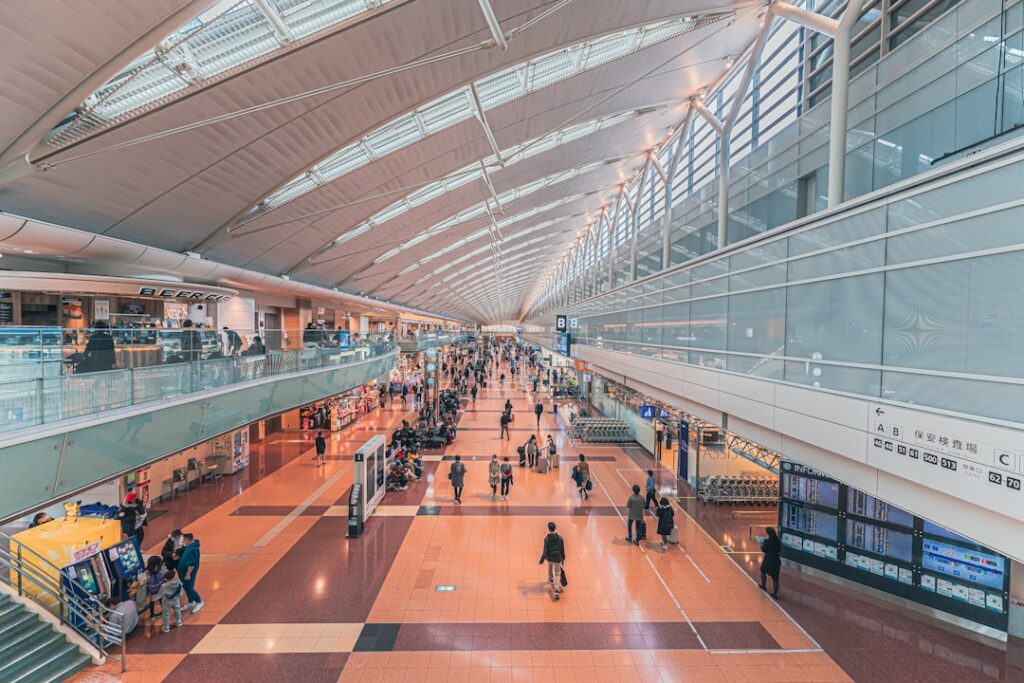
Haneda Airport (HND) sits inside Tokyo’s city limits. Hamamatsucho, on the JR Yamanote Line, is just 7 minutes from Tokyo Station once you’re on the monorail’s connecting train, and Shinagawa (another Yamanote stop, and a Shinkansen hub) is only 11–14 minutes away by Keikyu Line. Where a Narita transfer is a genuine “first big test” of a family trip, Haneda is comparatively low-stakes. You won’t be watching the clock, computing connection windows, or bracing for a long haul with jet-lagged kids and a mountain of luggage.
Why this matters for families specifically:
-
Shorter journey = less meltdown risk. Even the slowest option (taxi in traffic, or a multi-stop local train) rarely exceeds 45–60 minutes. That’s a manageable window even for a toddler who’s had enough of transit for one day.
-
The Keikyu Line runs direct (no-transfer) through-service to several useful areas, and the Monorail’s one easy cross-platform-style transfer at Hamamatsucho is about as simple as transfers get, so either way, you’re unlikely to be wrestling bags and a stroller through a complicated change.
-
Taxi becomes a realistic option, not just an emergency backup. At Narita, a taxi is often financially out of the question. At Haneda, if you land at 10pm with two overtired kids, paying ¥6,000–¥8,000 for a direct, no-transfer ride to your hotel door is a genuinely reasonable call.
-
Haneda has both international and domestic flights, mostly split across terminals. Terminal 3 handles most international arrivals, but Terminal 2 also handles a number of international flights (notably some ANA services), alongside its main role as a domestic terminal with Terminal 1. All terminals are connected to each other by the monorail and Keikyu Line. If your trip includes a domestic flight, say, arriving from Osaka or heading to Okinawa, check your terminal in advance, since it isn’t a simple international-vs-domestic split, and both train lines make moving between terminals simple with clear signage and elevators throughout.
The bottom line: whichever option you pick, you are unlikely to make a “wrong” choice at Haneda in the way you might overthink a Narita transfer. This guide walks through your four practical options so you can pick based on where you’re staying, how much luggage you have, and how your kids are handling the trip so far.
Step-by-Step: Your Options from Haneda
Option A: Tokyo Monorail
The Tokyo Monorail runs from Haneda Airport (all terminals) to Hamamatsucho Station. From there, you’ll need one transfer onto the JR Yamanote Line, the loop line that circles central Tokyo and serves major hubs like Tokyo Station, Shinjuku, Shibuya, and Ueno. It’s not a one-seat ride to any of those; Hamamatsucho is as far as the monorail itself goes. The transfer is straightforward (same station building, well signed), but it is a transfer, worth knowing about in advance if you’re timing a connection with tired kids.
Where to find it: Follow the monorail signage from the arrivals area at whichever terminal your flight uses (Terminal 3 handles most international arrivals, though Terminal 2 also serves some; Terminals 1 and 2 otherwise handle domestic flights). It’s well signed in English throughout, and the walk from arrivals to the platform is short and step-free, with elevators at every level change.
Fare and journey time:
| Adult | Child | |
|---|---|---|
| IC card (Suica/Pasmo) | ¥519 | ¥259 |
| Paper ticket | ¥520 | ¥260 |
Journey time to Hamamatsucho is as little as 13 minutes on the Haneda Express (nonstop), or up to 20 minutes on local trains that stop at intermediate stations, per the Tokyo Monorail’s official schedule.
How to pay: Tap your IC card at the gate, same as any Tokyo train; no separate ticket needed if you already have Suica or Pasmo loaded. If you haven’t set up an IC card yet, you can buy a paper ticket from the machines at the monorail entrance (English-language menus), or set up mobile Suica on your phone before you even land if you’re an adult. A child’s discounted-fare IC card can’t be set up remotely; it has to be purchased in person with ID at a staffed ticket counter, so plan for that step if your kids need one. See our full guide: How to Use IC Cards (Suica & Pasmo) with Kids in Japan.
Luggage and accessibility: Monorail trains have dedicated luggage racks near the doors. Every station on the line has elevators, and the platform-to-train gap is minimal, which matters if you’re pushing a stroller.
Best for: Families staying near the Yamanote Line, Shimbashi, Tokyo Station, Ueno, Shinjuku, or Shibuya, who don’t mind one straightforward transfer at Hamamatsucho onto the JR platform. If your hotel is a short walk or one more train stop from any Yamanote station, the monorail plus that single transfer is still one of the least complicated ways in.
Option B: Keikyu Airport Line
The Keikyu Line runs from Haneda to Shinagawa Station, and, crucially for families, many trains continue straight through onto the Toei Asakusa Line without requiring a transfer. That means a single train can take you directly toward Sengakuji, Nihombashi, Higashi-Ginza (a short walk from Ginza itself), Asakusa, or Oshiage, but not Ueno, which sits on a different line and isn’t reachable via this through-service without changing trains.
Fare and journey time:
| Destination | Adult | Child | Journey time |
|---|---|---|---|
| Shinagawa (from Terminal 3) | ¥330 | ¥160 | As little as 11 min on Airport Limited Express |
| Shinagawa (from Terminals 1/2) | ¥330 | ¥160 | As little as 14 min on Airport Limited Express |
| Asakusa (through-service) | ¥610 | ¥300 | Around 35 minutes |
Fares and times above are from Keikyu’s own airport access guide.
Where to find it: Keikyu’s Haneda Airport stations are signed separately from the monorail; follow “Keikyu Line” signage from arrivals. Like the monorail, the route from arrivals to the platform is step-free with elevators.
Why this matters for families: check the destination display on the front of the train before boarding. If it shows a station past Sengakuji, Asakusa, Oshiage, or similar, that train continues through onto the Toei Asakusa Line with no transfer required. If it shows “Shinagawa” as the final stop, you’ll need to change trains there for anywhere beyond it. This distinction is easy to miss and is one of the most common mix-ups for first-time visitors (see Common Mistakes below).
How to pay: Tap your IC card at the gate exactly as you would on any Tokyo Metro or Toei line. No supplementary fee applies even on Limited Express or Rapid Limited Express services; you pay the standard fare.
Best for: Families heading to Asakusa, Oshiage (Tokyo Skytree), or Nihombashi (and, with a short walk, the Ginza area) without wanting to change trains mid-journey with bags and kids. It’s also the faster option to Shinagawa itself, which is a major Shinkansen hub if your trip continues beyond Tokyo.
Option C: Taxi
“Taxi” from Haneda actually splits into two genuinely different services, and it’s worth knowing the difference before you land, especially if you’re traveling with more luggage than a standard sedan can comfortably hold.
C1: Ordinary metered taxi (from the queue)
This is the walk-up option: follow the taxi signage from arrivals to the staffed rank, and you’re allocated whichever regular sedan is next in line. You pay by meter (or same-day flat zone-rate) plus tolls.
| Destination | Approximate fare |
|---|---|
| Shinagawa / Central Tokyo | ¥5,000–¥6,500 |
| Tokyo Station / Ginza (Chiyoda/Chuo area) | ~¥6,500–¥7,500 |
| Shinjuku | ~¥8,300 |
A 20% surcharge applies late at night (roughly 10pm–5am), and expressway tolls are added on top of the fare where applicable, per Tokyo MK’s published rates.
A standard sedan seats up to four passengers and typically fits two to three large suitcases in the trunk, fine for a couple traveling light, tight for a family of four with a stroller, car seats, and a full set of luggage.
C2: Pre-booked, fixed-fare airport taxi (larger vehicle)
Several established Tokyo taxi companies run a specific “airport fixed-fare” service that’s a different product entirely from the queue: you book in advance (by phone, app, or online form, generally at least an hour ahead), the driver meets you at arrivals, often with a name board, handles the luggage, and the fare is locked in before you get in, regardless of traffic. Many of these operators also offer a jumbo taxi / minivan-class vehicle (typically a Toyota Hi-Ace or similar), which is the detail that makes this genuinely useful for families rather than just a convenience for business travelers.
| Operator | Fixed fare to Chiyoda (Tokyo Station area) | Fixed fare to Shibuya | Fixed fare to Shinjuku | Notes |
|---|---|---|---|---|
| Tokyo MK | ¥7,600 | ¥8,500 | ¥9,000 | Fixed fare is per vehicle, not per person; jumbo/minivan option seats up to 9 with room for luggage; Chuo, Minato, Koto, and Shinagawa wards are meter-only (too close for a fixed rate to apply) |
| Nihon Kotsu | ¥7,600 | ¥8,500 | ¥9,000 | Same ward-based fixed-fare structure as above; reservation required at least 1 hour before pickup; late-night rate (10pm–5am) runs roughly 15–20% higher |
Why this matters for families specifically: the fixed fare is charged per vehicle, not per passenger, so a family of four splits one ¥7,600–¥9,000 fare rather than paying per head, which often works out close to (or cheaper than) four separate train tickets once you account for a stroller and full luggage. A minivan-class (jumbo taxi) vehicle from these operators typically seats up to nine passengers and swallows somewhere around eight to nine large suitcases, enough for two adults, two kids, a stroller, and a couple of car seats in one trip, with no need to split into two cars. Request the larger vehicle when you book if you know you’ll need it; it isn’t always the default car sent.
How to book: Reserve ahead of your flight, by phone, the operator’s English booking form, or (for Tokyo MK) their web reservation system. Have your flight number, terminal, and passenger/luggage count ready so they can send the right size vehicle. Ride-hailing apps (Uber, GO, S.RIDE, and others) also operate from Haneda, including a dedicated pickup zone at Terminal 3, and work more like the walk-up queue in that you book on arrival rather than days in advance, and typically dispatch a standard sedan unless you specifically request a larger vehicle class in the app.
Luggage and comfort: Either taxi option puts you and your bags in one enclosed space with no stairs, gates, or platform transitions, worth the price difference for a family arriving after an overnight flight with an overtired baby. The fixed-fare minivan service goes a step further: the driver loads the luggage, and you know the total cost before you leave arrivals, with no meter anxiety if traffic is bad.
Best for: Late-night arrivals, families with a lot of luggage (more than one large suitcase per person), or anyone traveling with a child who has reached their limit for the day. If you’re a family of four or more with a stroller and multiple suitcases, the pre-booked fixed-fare minivan (C2) is usually the more comfortable and often more cost-effective choice over the standard queue taxi (C1).
Option D: Airport Limousine Bus
Don’t skip past this one because it says “bus”; for families, the Airport Limousine Bus is a genuinely strong option, not just a fallback. It’s a direct coach service from Haneda to a long list of major hotels and hotel districts across Tokyo, including Shinjuku, Shibuya, Ikebukuro, Tokyo Station/Tokyo City Air Terminal, and Ginza, and for many families it’s the single least stressful way into the city.
Why it’s worth serious consideration, not a token mention:
-
No stairs. You board at ground level directly from the arrivals hall and get off at ground level at your hotel. There’s no navigating station stairs, escalators, or platform gaps with a stroller and a sleeping toddler.
-
No transfers. Unlike the Monorail (one transfer at Hamamatsucho) or the Keikyu Line for non-through-service destinations, the bus is a single seat from the airport to your stop; you board once and get off once.
-
The driver handles your luggage. Staff load your suitcases into the under-bus storage compartment at Haneda and unload them at your stop; you’re not lifting, carrying, or wheeling bags at any point in between.
-
It can go directly to your hotel’s door. Many major Tokyo hotels are named stops on specific routes, so “direct to the hotel” isn’t a loose approximation; check the route list and it may genuinely be true for where you’re staying.
Taken together, that means a parent traveling solo with two kids and all the luggage can do this entire journey without wrestling a single bag up a single step, something none of the train options can fully promise.
Fare and journey time: Roughly ¥1,300–¥1,400 one-way for adults (children pay a reduced fare), with journeys typically 45–60 minutes depending on traffic and destination, per the Airport Limousine Bus timetable.
The trade-off: Buses are more exposed to road traffic than trains, so the journey time is less predictable than the monorail or Keikyu Line, especially during rush hour. It’s also slower on paper than either train option. For most families, that’s a reasonable trade for zero luggage-handling and zero transfers, but if your flight lands right into evening rush hour and your hotel is well off the route map, factor in some buffer.
Best for: Families staying at (or near) a hotel directly on a Limousine Bus route who want to avoid handling luggage and navigating stairs or platforms entirely. This is often the most family-friendly option on this list when it lines up with your hotel, not just a last resort.
We’ve taken this bus ourselves from Busta Shinjuku, and it’s genuinely one of the easier ways to move a family with kids across the city: you board once at the terminal, and you’re at the airport with no further steps in between.
Two Things Most Visitors Don’t Know to Ask About
Haneda lends strollers to travelers, and you can pick one up before you even reach security. If you’re arriving without your own stroller, or your own didn’t make the trip, check-in and arrivals areas have a free stroller-loan service; ask at an information counter. We’ve used it ourselves on a day trip with the kids: checked our own stroller in early, borrowed one of the airport’s, and kept using it right up to the departure gate.
Traveling with young children can get you moved through security faster. Staff at Haneda will often direct families with small kids or a stroller to a shorter line or wave them ahead, the same way priority boarding works on a plane. It isn’t guaranteed and isn’t something you can request as a formal fast-track, but don’t hesitate to ask a staff member if you’re traveling with a toddler and the regular line is long.
Best Options Compared
| Tokyo Monorail | Keikyu Line | Taxi (metered, from queue) | Taxi (pre-booked, fixed-fare) | Limousine Bus | |
|---|---|---|---|---|---|
| Cost | ¥519–¥520 adult / ¥259–¥260 child | ¥330–¥610 adult / ¥160–¥300 child | ¥5,000–¥8,300 per vehicle (meter + tolls) | ¥7,600–¥9,000 per vehicle, fixed regardless of traffic (Chiyoda/Shibuya/Shinjuku) | ~¥1,300–¥1,400 adult, reduced child fare |
| Time to central Tokyo | ~13–20 min to Hamamatsucho | ~11–35 min depending on destination | ~20–40 min (traffic-dependent) | ~20–40 min (traffic-dependent, fare unaffected) | ~45–60 min |
| Transfers | One (onto JR at Hamamatsucho) for Yamanote Line stations | None to Asakusa-side through-service stations (Sengakuji, Nihombashi, Asakusa, Oshiage); transfer still needed for Ueno | None | None | None |
| Vehicle size | N/A | N/A | Standard sedan, seats up to 4, ~2–3 large suitcases | Minivan/jumbo option available, seats up to 9, ~8–9 large suitcases | Full coach, no passenger limit per family |
| Luggage ease | Racks near doors | Standard train; can feel crowded around weekday evening rush hour | No handling, but tight if you have more than 1 suitcase per person | Driver loads and unloads everything; sized for a full family’s luggage in one trip | Easiest, stowed separately, handled once |
| Booking | None needed | None needed | None needed, join the queue at arrivals | Reserve ahead (phone/app/web), ideally 1+ hour before landing | None needed for walk-up tickets; some routes allow reservation |
| Best for families when… | Staying near the Yamanote Line | Heading to Asakusa, Oshiage, or Nihombashi directly | Light luggage, no advance planning, short notice | Family of 4+, lots of luggage, want price certainty and no traffic-meter anxiety | Hotel is directly on a bus route, no stairs, no transfers, luggage handled for you |
Common Mistakes Families Make
1. Not realizing Keikyu offers direct service toward Asakusa while the Monorail only reaches the Yamanote side
These two train lines serve different halves of the city, and only the Keikyu Line offers a genuine no-transfer through-service, to Sengakuji, Nihombashi, the Higashi-Ginza/Ginza area, Asakusa, or Oshiage. The Monorail always requires one transfer onto JR at Hamamatsucho, even for Yamanote Line stations. Ueno is a common mix-up: it’s often assumed to be reachable no-transfer via Keikyu’s through-service like Asakusa is, but it isn’t; Ueno sits on a different line and needs a change of trains either way. Many visitors default to the monorail simply because it’s more famous, without realizing a transfer is coming regardless of which line they pick.
2. Boarding a Keikyu train without checking the destination display
Not every Keikyu train continues through to the Asakusa Line; some terminate at Shinagawa. Check the sign on the front of the train (or ask station staff) before boarding if your destination is past Sengakuji.
3. Assuming a taxi will be prohibitively expensive, like at Narita
Taxi fares from Haneda are meaningfully lower than the equivalent trip from Narita, simply because Haneda is so much closer to the city. That said, do the math honestly: a ¥5,000–¥9,000 taxi is still more expensive in total than four train fares at ¥330–¥610 each (roughly ¥1,320–¥2,440 for a family of four); the taxi is not the cheaper option. What it buys you is convenience: no transfers, no stairs, no managing bags and kids through gates. Remember, though, that both the metered taxi and the fixed-fare service charge per vehicle, not per passenger, so the gap narrows considerably for a family of four splitting one fare, compared to what it looks like per-person on paper. For a family that values the convenience, it’s a reasonable trade, but go in knowing it’s a premium, not a bargain.
4. Not knowing the pre-booked, fixed-fare airport taxi option exists
Many first-time visitors only know about the taxi queue at arrivals and assume that’s the only taxi option. Several established companies, Tokyo MK and Nihon Kotsu among them, run a separate pre-booked, fixed-fare airport taxi service with larger minivan-class vehicles available on request. For a family with a stroller, car seats, and a full set of luggage, this is worth booking in advance rather than defaulting to the queue and hoping a large enough car shows up.
5. Underestimating how quickly a train can feel crowded
Neither the monorail nor the Keikyu Line is typically as packed as a Yamanote Line rush-hour train, but both can fill up around evening rush hour on weekdays. If you land in the early evening on a weekday, a taxi or a slightly later train can be more comfortable with a stroller and bags.
6. Assuming Terminal 3 is the only international terminal
Most international arrivals use Terminal 3, but Terminal 2 also handles a number of international flights (including some ANA services), alongside its main role as a domestic terminal. Don’t assume your international flight lands at Terminal 3; check your specific flight’s terminal in advance. All terminals are connected by the monorail and Keikyu Line, so moving between them if needed is straightforward, but build in a few extra minutes if you’re doing so with a stroller and bags.
FAQ
Which is faster, the Monorail or the Keikyu Line?
It depends on your destination. To Hamamatsucho (where you’d transfer onto the Yamanote Line), the Monorail’s Haneda Express takes about 13 minutes, very hard to beat. To Shinagawa, the Keikyu Line’s Airport Limited Express takes as little as 11 minutes from Terminal 3, or about 14 minutes from Terminals 1/2. If you’re headed toward Asakusa, Oshiage, or Nihombashi, the Keikyu Line’s through-service (about 35 minutes to Asakusa with no transfer) beats taking the Monorail, transferring at Hamamatsucho, and then changing trains again to reach those areas.
Is a taxi affordable from Haneda?
More affordable than you’d expect, and considerably cheaper than the equivalent trip from Narita Airport. An ordinary metered taxi from the queue runs roughly ¥5,000–¥8,300 to central Tokyo, plus tolls and a late-night surcharge; a pre-booked fixed-fare airport taxi runs ¥7,600–¥9,000 per vehicle to destinations like Chiyoda (Tokyo Station area), Shibuya, or Shinjuku, with the price locked in regardless of traffic. Both are charged per vehicle, not per passenger, so a family of four splits one fare rather than paying four times over, which narrows the gap with the ¥1,320–¥2,440 you’d pay for four separate train fares more than it first appears. The taxi still isn’t the cheaper option on paper, but it removes all the luggage-handling and transfer steps entirely, which is worth the difference for some families.
What’s the difference between a regular taxi and an “airport taxi” service at Haneda?
A regular taxi is what you get by joining the queue at arrivals: a standard sedan, seats up to four, charged by meter (or a same-day flat zone-rate) plus tolls. An “airport taxi,” offered by companies like Tokyo MK and Nihon Kotsu, is a different, pre-booked product: you reserve in advance (at least an hour before landing), the driver meets you at arrivals and handles your bags, and the fare to your ward is fixed before you set off, whatever the traffic does. Both companies also offer a jumbo taxi / minivan option (typically a Toyota Hi-Ace–class vehicle) that seats up to nine and has room for around eight to nine large suitcases, genuinely useful if you’re traveling as a family with a stroller, car seats, and full luggage, since it means everyone and everything travels in one vehicle instead of splitting across two standard taxis.
Can we use our IC card straight off the plane?
If you’re an adult with a mobile Suica or Pasmo already set up, yes; both the Tokyo Monorail and Keikyu Line accept it at the gate, and you can set this up on your phone before you even land, no in-person step required. Kids are a different story: a discounted child-fare IC card can’t be set up remotely; it has to be purchased in person with ID at a staffed ticket counter (not from the touch-screen machines), so build that into your arrival plan if your kids need one. See our full guide: How to Use IC Cards (Suica & Pasmo) with Kids in Japan.
How do we get between Haneda’s terminals with a stroller?
Both the Tokyo Monorail and Keikyu Line connect Terminal 3 with Terminals 1 and 2 (note that Terminal 2 also handles some international flights, so terminal assignment isn’t a clean international/domestic split), and the route from arrivals to the platforms is step-free with elevators throughout. If you’re only passing through the terminal (not boarding a train), moving between terminal buildings is also possible via a free shuttle bus; ask at the information desk if you need this. For more general tips on stroller logistics across Japan, see Getting Around Japan with a Stroller: What Nobody Tells You.
Do kids under 6 ride free on both the Monorail and Keikyu Line?
Yes. As with the rest of the Tokyo rail network, children who haven’t yet started elementary school (roughly under 6) ride free with a paying adult, up to two children per adult. Children aged 6–11 pay the child fare listed above, and need their own child IC card or paper ticket; the child IC card must be purchased in person with ID at a staffed counter, so it’s not something you can set up remotely like an adult’s mobile Suica. Note that Terminals 1 and 2 share a single Keikyu/monorail station complex even though they’re separate buildings, so if you’re moving between them with a child in tow, follow the in-terminal signage rather than assuming you need to leave and re-enter through the trains.
Which option should we pick if we’re jet-lagged and just want to get to the hotel?
If your hotel is near the Yamanote Line, the Monorail plus one straightforward transfer at Hamamatsucho is the simplest low-effort choice: short, frequent, and step-free. If your hotel sits directly on a Limousine Bus route, that’s arguably the least effort of all: no stairs, no transfers, and the driver loads and unloads your bags for you. If you’re arriving very late at night, have more luggage than you can comfortably carry, or have a child who has completely run out of patience, a taxi is a perfectly reasonable choice at Haneda’s prices; this is one of the few Japanese airports where that’s true, even though it costs more than the train. For a bigger family with a full set of luggage, the pre-booked fixed-fare airport taxi in a minivan-class vehicle is often the most comfortable version of that choice, since everyone and everything fits in one car with the price already settled.
Is Haneda or Narita easier for families?
Haneda, by a clear margin, mainly because of the shorter distance to central Tokyo. Every option, train, taxi, or bus, is faster and (for taxi) considerably cheaper from Haneda than the equivalent from Narita. If your flights give you a choice of airport, Haneda is the easier arrival for families with young children. For the Narita side of this comparison, see Tokyo from Narita Airport with Kids: The Easiest Way.
Can we borrow a stroller at Haneda?
Yes. Haneda runs a free stroller-loan service you can pick up from an information counter in the check-in or arrivals area, useful if your own stroller is checked, damaged in transit, or you didn’t bring one at all. We’ve used it ourselves on a day trip: checked our stroller at bag drop, borrowed one of the airport’s for the rest of the terminal, and kept using it right up to the gate.
Does the Limousine Bus take reservations?
Some routes allow or require advance booking, particularly around peak travel seasons; others operate on a walk-up basis with tickets purchased at the counter in the arrivals area. If your hotel is on a specific route, it’s worth checking the current timetable before you fly, especially if you’re arriving late in the evening when services run less frequently.
Once we’re on the train, how do we know when to get off?
Both the Monorail and Keikyu Line have automated announcements and displays in English, and Google Maps will track your position and prompt you before your stop, the same approach covered in our main guide to Navigating Tokyo’s Train System with Kids.
Plan the Rest of Your Tokyo Arrival
Now that you’re on your way from Haneda, here’s what to line up next:
→ Navigating Tokyo’s Train System with Kids: the full first-timer’s guide to Tokyo’s trains once you’ve reached the city
→ How to Use IC Cards (Suica & Pasmo) with Kids in Japan: set up payment before or right after you land
→ Getting Around Japan with a Stroller: What Nobody Tells You: practical stroller logistics beyond the airport
→ Tokyo from Narita Airport with Kids: The Easiest Way: if part of your trip involves flying into Narita instead
→ Getting Around Japan with Kids: The Complete Transport Guide: every transport option for families, in one overview
Information checked: 2026/09