
TL;DR
-
Tokyo Racecourse, in Fuchu, is a working JRA horse-racing venue that local families also use as a cheap, huge, well-equipped playground. The leisure side of it barely appears in English-language travel guides
-
On a standard race day, adult admission is ¥200, free for anyone under 15; major G1 race days can carry higher special pricing (sometimes ¥500–¥1,000). On quiet non-race weekdays and “Park Wins” days, entry is free for everyone
-
The big catch: the free infield Kids Garden playground (slides, an inflatable dome, a mini train) is only open on race days and Park Wins days, not on ordinary non-race weekdays. Check the JRA calendar before you plan a visit around it
-
There’s no age restriction on entering the racecourse: the legal restriction (age 20+) applies only to buying a betting ticket. The betting counters sit inside the grandstand buildings, a different part of the grounds from the infield playground and the Hiyoshigaoka Park kids’ area near the East Gate
-
The free, air-conditioned JRA Racing Museum near the East Gate stays open even on non-race days and gives kids a jockey-costume photo op and hands-on, starting-gate-themed exhibits
-
Best family day type: a “Park Wins” day: Kids Garden is open, entry is free, and it’s noticeably calmer than a full race day
-
2026 heat-season note: JRA closed the infield (including the Kids Garden) from late June through August 30, 2026, and paused horse-interaction events through mid-September, as a heat-safety measure. This is a seasonal, 2026-specific restriction, so confirm current status before a summer visit
At a Glance
| Entry (standard race days) | Adults ¥200 · Under 15: free · major G1 race days can be higher (¥500–¥1,000) |
| Entry (non-race weekdays / Park Wins days) | Free for everyone |
| Hours | Gates typically open around 9:00–9:30 on race days; closing follows the last race, usually mid-to-late afternoon |
| Nearest station | Fuchu-Keiba-Seimon-mae (Keio Line), 2 min walk via a covered footbridge to the main gate (open on race/Park Wins days) |
| English support | Limited: signage and announcements are mostly Japanese; this is a genuinely local spot, not a tourist-oriented one |
| Strollers | Fine on the infield lawn and Kids Garden (flat, paved paths); the multi-storey Fuji View Stand food court is less stroller-friendly |
| Baby facilities | Several nursing rooms and diaper-changing stations around the grounds |
| Kids Garden (playground) | Free, but only open on race days and Park Wins days |
| Typical visit | 3–5 hours |
Details above reflect JRA’s (Japan Racing Association) own official site, Fuchu City local guides, and Japanese parent blogs describing actual family visits, checked 2026/08.
Is It Worth It?
Short answer: yes, but only if the day type lines up with what you want to do there.
Tokyo Racecourse isn’t a theme park pretending to be a racecourse; it’s a working JRA racing venue with a large, free infield playground attached. Family accounts of visiting describe treating it much like a trip to a big municipal park: bring a picnic sheet, let toddlers crawl around on the infield lawn, let older kids loop through the Kids Garden’s slides and mini train, and treat the actual racing (visible on the giant Turf Vision screen) as background entertainment rather than the point of the visit. A dedicated children’s restroom building near the Kids Garden, with separate facilities and multiple stalls on each side, is the kind of detail that shows up specifically in accounts from parents who’ve actually taken young kids there, rather than in general venue descriptions.
That framing (a big, cheap park with a bonus spectacle attached, not a novelty) is the actual local use case, and it’s an inexpensive, low-effort outing that families in western Tokyo choose the same way they’d choose a municipal park.
The honest caveats: this only works if you time it right. The playground closes on ordinary non-race weekdays, English support is minimal, and if you drive, parking near the venue can fill up before 10am on a popular Saturday. It’s also not central: Fuchu is a 30–45 minute train ride from most central Tokyo bases, so this is a deliberate half-day trip, not a stop you stumble into.
By age:
-
0–1 (baby): The infield lawn is ideal for blanket time, tummy time, and early crawling: flat, grassy, and genuinely spacious. Multiple nursing rooms and diaper-changing stations are spread around the grounds. Strollers move easily on the outdoor paths.
-
2–4 (toddler): The Kids Garden has a separate, smaller inflatable dome and a fenced toddler zone specifically for this age. The mini train is free to ride; how long the queue is depends heavily on how busy the day is.
-
5–8 (young kids): The sweet spot. Big enough to handle the full Kids Garden circuit (climbing structures, the larger inflatable dome, the mini train) and old enough to enjoy watching a real race go past on the giant screen, even without understanding the rules.
-
9+ (older kids): The JRA Racing Museum’s hands-on jockey and starting-gate-themed exhibits tend to land well with this age group, as does the scale of the paddock and the giant Turf Vision screen up close.
What to Expect
Kids Garden: the reason to come, but only on the right days
The Kids Garden sits inside the racecourse’s infield and is the main draw for families: large climbing structures with slides and tunnels, two separate inflatable “fluffy” domes (a smaller one for preschoolers, a bigger one for elementary-age kids), and a free mini Shinkansen ride that runs roughly 10:00–15:00. Wait times for the mini train reportedly vary a lot by crowd level: some visits describe almost no queue, others describe a real wait on a busy Saturday, so treat it as a bonus rather than something to plan a schedule around. It’s reachable from both the Fuji View Stand side and the west gate near Fuchu-Honmachi Station.
The important limitation: the Kids Garden is only open on days the infield itself is accessible: race days and “Park Wins” days (see below). On an ordinary non-race weekday, the infield is closed and there’s no playground to visit, even though the racecourse itself may technically be open and free to enter. Check the current month’s JRA race schedule before building a trip around this.
Race day vs. non-race day vs. “Park Wins” day
This is the single biggest thing to plan around, and English-language sources rarely spell it out:
| Day type | Admission | Infield / Kids Garden | Gates open | What’s realistically worth visiting for |
|---|---|---|---|---|
| Race day (usually weekends/holidays during meets) | ¥200 standard, more on major G1 days; free under 15 | Open | Main + West + East | Full atmosphere: live racing, food stalls, horse events, and the Kids Garden, but the busiest and most “adult” feeling |
| “Park Wins” day (Tokyo takes bets on races held elsewhere) | Free | Open | Main + West + East | The infield playground open with meaningfully lighter crowds than a live race day |
| Ordinary non-race weekday | Free | Closed | East Gate only | JRA Racing Museum (every open day), plus Hiyoshigaoka Park if it’s a Wednesday–Friday; the Kids Garden itself is not accessible |
Note that “ordinary non-race weekday” doesn’t mean the whole racecourse is shut: it means the infield and the main/west gate footbridges aren’t in use, and the only realistic entry point is the East Gate. Confirm the current day type on the JRA official schedule before planning a visit around a specific facility.
If a stress-free, uncrowded visit with a working playground is the goal, a Park Wins day is the target to aim for. The JRA publishes each racecourse’s schedule (including which days are race days vs. Park Wins days) on its official site. It’s worth checking the week before you go, since the pattern changes month to month.
Hiyoshigaoka Park and the water-play area
Near the East Gate, Hiyoshigaoka Park is a separate green space with a pirate-ship-themed climbing structure, stone Anpanman statues that toddlers gravitate toward, benches, and (roughly from late spring into early autumn) a seasonal water-play feature called Basha Basha Park, with fountains and hand pumps. Its opening pattern is actually broader than the Kids Garden’s: it’s generally open Wednesday through Friday and on holidays, in addition to race days, so unlike the infield playground, it can be worth a visit even on a quiet weekday, as long as you pick a Wednesday–Friday rather than a Monday or Tuesday. Confirm the current month’s calendar on the JRA site, since the exact pattern is published and updated there.
Watching an actual race, even without betting
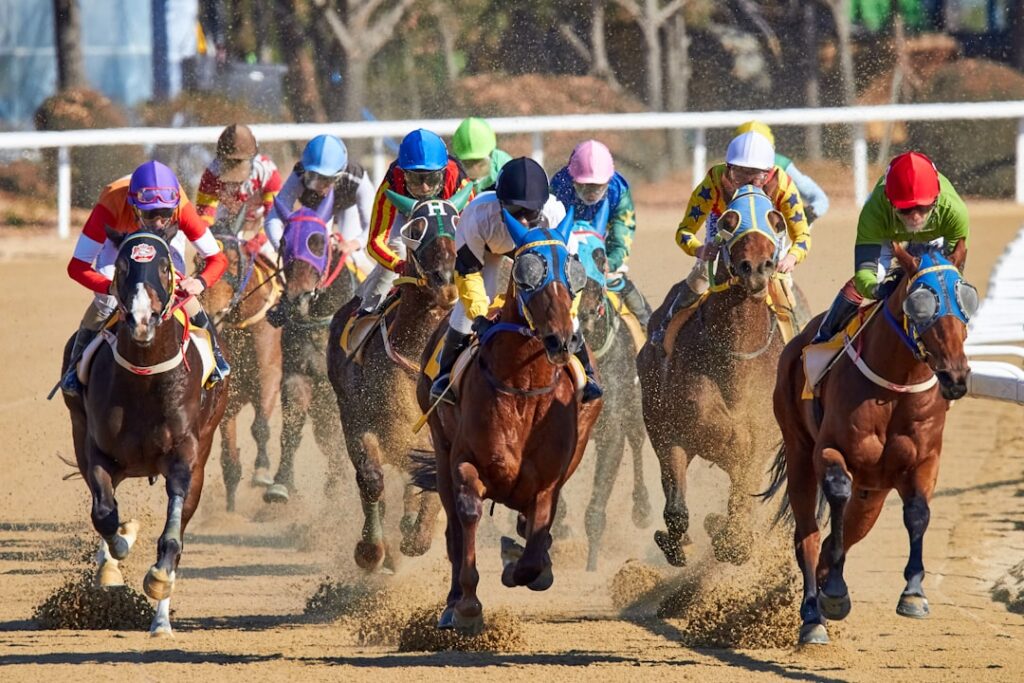
You don’t need to place a bet to get something out of a live race. The paddock lets you watch horses and jockeys up close before a race, and the Turf Vision screen (at 11.2m by 66.4m, Guinness-certified as the world’s largest when installed) gives even non-fans a clear, close-up view of the finish. More than one family account of visiting with young kids mentions watching the horses round the final turn, live and on the giant screen at the same time, as a genuine highlight of the day, separate from the playground.
Horse and pony experiences: book through the app
Beyond the Kids Garden, the racecourse runs hands-on horse events on race days: short pony rides, horse-drawn carriage rides, and at times donkey or alpaca petting, generally through a “Horse Center” or “Bashaba Park” area. Many of these are coordinated through the JRA racecourse event app: turn on location services once you’re on the grounds and it shows that day’s events, with sign-up by lottery or first-come basis depending on the event. Not every hands-on event runs through the app, and the exact roster changes, so check the day’s posted schedule on arrival rather than assuming a specific experience will be available.
2026 note: as a heat-safety measure, JRA closed the infield area at Tokyo Racecourse from June 27 through August 30, 2026, and separately paused horse-interaction events through September 13, 2026 during that summer’s Park Wins period. Both restrictions were specific to the 2026 heat season. Confirm current status on the JRA site if you’re planning a summer visit around the infield or a specific horse experience.
JRA Racing Museum: the free, indoor backup plan
Just inside the East Gate, the JRA Racing Museum is free to enter (you only need the racecourse admission fee if it’s a race day) and is built with kids in mind: a “become a jockey” dress-up corner and hands-on, starting-gate-themed exhibits alongside the racing history displays; the specific attractions are refreshed periodically, so treat the exact lineup as a pleasant surprise rather than a guarantee. It typically runs 10:00–17:00 on race days and Park Wins days, and 10:00–16:00 on other open days (East Gate access only), closed Mondays and Tuesdays. Because it’s indoor and air-conditioned, and open on days the outdoor Kids Garden isn’t, it’s the most reliable single reason to make the trip on a quiet non-race day.
Food: where it’s family-friendly and where it isn’t
Tokyo Racecourse has a genuinely large food scene for a sports venue: dozens of food stalls and restaurants are scattered across the grounds on race days, from fast-food-style udon and rice bowl counters to a formal restaurant on the upper floor of the Memorial Stand. Be aware of the split:
-
Family-friendly: the fast-food courts on the lower floors of Fuji View Stand and Memorial 60 Stand (ramen, rice bowls, katsu, takoyaki), a convenience store on Stand 3, and food stalls near the Kids Garden itself. Bringing your own picnic sheet for the infield lawn is a normal, common move; seating fills up fast on busy days.
-
More adult-oriented: in good weather, the open-air seating around the upper stands takes on a lively, beer-garden-like atmosphere, and it tends to skew toward an adult crowd rather than families. Nothing is off-limits to children, but it’s a section worth being aware of rather than one to head for with a toddler.
-
The catch on quiet days: on ordinary non-race weekdays, most restaurants and stalls close along with the rest of the infield. If you’re visiting outside a race day or Park Wins day, bring your own food: the on-site options largely aren’t operating, and the Museum area near the East Gate is your main indoor option.
Family Tips
-
Aim for a “Park Wins” day if you can. It gets you the open Kids Garden and free entry with lighter crowds than a live race day. Check the current month’s schedule on the JRA site before you go.
-
Bring a picnic sheet. Between the infield lawn and limited race-day seating, this is a practical, low-effort thing to pack that several family accounts of the racecourse mention.
-
If you’re driving, build in a buffer for parking. Family accounts describe the closest lots filling up by mid-morning on popular Saturdays; the train is the more predictable option, and parking is capped at ¥2,000 on race days / ¥1,000 on Park Wins days regardless.
-
The outdoor infield and Kids Garden are flat and stroller-friendly; the multi-storey Fuji View Stand food court is more work with wheels. A carrier as backup for that one building is a reasonable call if you’re relying heavily on a stroller elsewhere.
-
Register for horse events through the app once you’re on-site, not before: the JRA racecourse event app needs location services turned on at the venue to show that day’s slots, and not every event runs through it.
-
Check the day type before you go, not just the date. Whether it’s a race day, a Park Wins day, or a plain non-race weekday changes which gates, which playgrounds, and which food options are actually open.
Common Mistakes Families Make
-
Assuming the whole racecourse works like a normal park every day. The infield Kids Garden closes on ordinary non-race weekdays: it only opens on race days and Park Wins days. Hiyoshigaoka Park has a wider schedule (generally Wednesday–Friday, holidays, and race days) but is also not a plain every-day facility. Check the JRA calendar before you go.
-
Driving without a backup parking plan on a popular race day. Family accounts describe the closest lots filling by mid-morning.
-
Visiting on a quiet non-race weekday expecting food options. Most restaurants and stalls close along with the infield on those days: bring your own food, or plan around the Museum area near the East Gate.
-
Overlooking the JRA Racing Museum. It’s free, indoor, air-conditioned, and open even on days the outdoor playground isn’t: a solid fallback on a quiet day, hot day, or rainy day.
-
Assuming a horse racing venue is an odd place to bring kids. There’s no age restriction on entering the racecourse itself: the legal restriction (age 20+) applies only to purchasing or handling a betting ticket, which is not something a family visit centered on the playground and the animals needs to go near. The betting counters themselves are inside the grandstand buildings, a different part of the grounds from the infield playground and the East Gate kids’ area.
Getting There with Kids
Recommended on race days and Park Wins days: Keio Line → Fuchu-Keiba-Seimon-mae Station
This station exists specifically to serve the racecourse and connects directly to the main gate via a covered footbridge (dry access even in rain). It runs every day, not only on race days, though service is minimal on quiet weekdays (short, infrequent trains) and ramps up considerably with longer trains and added express services on race days.
Tokyo Racecourse has three gates in regular use (the south gate was closed in 2023). Which one is relevant depends on the day type:
| Station | Line | Walk | Gate | When it’s useful |
|---|---|---|---|---|
| Fuchu-Keiba-Seimon-mae | Keio Line (Keibajo branch) | ~2 min | Main Gate | Race days and Park Wins days |
| Fuchu-Honmachi | JR Musashino Line / Nanbu Line | ~5 min (via a dedicated footbridge) | West Gate | Race days and Park Wins days |
| Higashi-Fuchu | Keio Line (main line) | ~10 min from the south exit | East Gate | Every open day, including quiet non-race weekdays; this is the gate for the JRA Racing Museum and Hiyoshigaoka Park |
If your visit is built around the JRA Racing Museum or Hiyoshigaoka Park on a plain non-race weekday, plan around Higashi-Fuchu Station and the East Gate rather than the main-gate route: the main/west gate footbridges are tied to race and Park Wins day operation.
IC card: Use Suica or Pasmo at any of these stations: no special tickets needed for the trains. If this is your family’s first time navigating Tokyo’s rail network, see our guide: Navigating Tokyo’s Train System with Kids.
By stroller: The main-gate and west-gate routes use step-free covered footbridges, so getting to those gates with a stroller is straightforward on race and Park Wins days. For general strategy on bringing a stroller around Tokyo, see Navigating Japan with a Stroller.
By car: On-site parking is capped at ¥2,000 on race days and ¥1,000 on Park Wins days. Family accounts describe the closest lots filling by mid-morning on popular Saturdays, so the train is the more predictable option if you’re aiming for an early start.
Nearby and How to Combine
Tokyo Racecourse sits far enough west that it works best as a deliberate half-day-to-full-day outing on its own, rather than a stop you tack onto a central Tokyo itinerary. Budget 30–45 minutes each way from most central bases.
Okunitama Shrine: A well-known, historic shrine just a 3-minute walk from Fuchu-Honmachi Station (the same station used to reach the racecourse’s west gate). If you’re already making the trip out to Fuchu, it’s an easy, low-effort add-on before or after the racecourse, particularly around New Year or shrine festival dates.
If you’re based centrally and building a full day around western Tokyo, pairing the racecourse with a relaxed lunch and a walk around the Fuchu-Honmachi/Okunitama Shrine area on the same trip makes the most of the journey out.
FAQ
Is Tokyo Racecourse free for kids?
Yes. Anyone under 15 enters free on race days, and general admission is free for everyone on non-race weekdays and “Park Wins” days. On a standard race day, adult (and 15+) admission is ¥200; major G1 race days can carry higher special pricing, so it’s worth checking the schedule for your specific date.
Do we need to know anything about horse racing to enjoy it?
No. Most of what draws local families (the Kids Garden playground, the infield lawn, Hiyoshigaoka Park, the free Racing Museum) has nothing to do with understanding the sport. Watching a race on the giant Turf Vision screen is a bonus spectacle, not a requirement.
Is the Kids Garden open every day?
No, and this is the detail to plan around. The infield playground only opens on race days and “Park Wins” days. On an ordinary non-race weekday, the playground is closed even though the racecourse grounds may technically be accessible.
Can children go near the betting areas?
There’s no age restriction on entering the racecourse itself. The legal restriction is narrower and specific: nobody under 20 can purchase or receive a betting ticket, under Japan’s Horse Racing Law. The betting counters and machines are inside the grandstand buildings, a different part of the grounds from the infield playground and the East Gate kids’ area. That’s a matter of layout, not a formal barrier keeping children away.
Is Tokyo Racecourse stroller-friendly?
On race days and Park Wins days, yes: the main-gate and west-gate approach routes use step-free covered footbridges, and the outdoor infield and Kids Garden are flat and paved. The multi-storey Fuji View Stand food court building is more awkward to navigate with a stroller. On a quiet non-race weekday, access is via the East Gate near Higashi-Fuchu Station instead, which is a longer walk (~10 minutes) without the dedicated footbridge.
What is “Park Wins” and why does it matter for families?
“Park Wins” refers to days when Tokyo Racecourse doesn’t host its own live race but takes bets on races happening at other JRA tracks. On these days, admission is free and the infield (including the Kids Garden) is typically open, but crowds are noticeably lighter than on a full live race day. For families, it’s often the best of both worlds: an open playground without the biggest crowds.
Is English spoken or signed at Tokyo Racecourse?
Not really, and that’s part of what makes it feel different from typical tourist attractions: signage, announcements, and staff communication are almost entirely in Japanese. It’s a genuinely local family spot rather than one built for international visitors, so go in expecting to navigate mostly by observation and the JRA app’s visuals.
What’s the best time of year to visit with kids?
Spring and autumn racing meets bring comfortable weather and full programming. Late spring through early autumn also brings the seasonal water-play area at Hiyoshigaoka Park online, which is a strong draw for younger kids on a hot day. Whatever the season, check the current month’s JRA schedule first to confirm whether your planned date is a race day, a Park Wins day, or a quiet non-race day.
Information checked: 2026/08