
TL;DR
-
Vacation rentals (Airbnb etc.) often beat hotels for families, since they add more space, a kitchen, and laundry; stick to residential neighborhoods 2–4 stops from the tourist center
-
For hotels, Ueno has the best mix of transport links and family-friendly attractions within walking distance
-
Japanese hotel rooms are significantly smaller than Western equivalents; always search for family rooms or interconnecting rooms, not just “double” or “twin”
-
Most city hotels provide free cots on request; confirm at booking, not on arrival
-
If Disney is your focus, stay in Maihama (Chiba) rather than central Tokyo, since it changes the whole park experience
-
Book 3–6 months ahead during cherry blossom season, Golden Week, and August; family rooms sell out long before standard rooms
What Makes Tokyo Hotels Different for Families
Western families often book the first hotel they find in Shinjuku or near Shibuya, then spend the whole trip hauling strollers through crowds. Choosing the right neighborhood makes an enormous difference with kids. Here’s what actually matters.
Room size and occupancy
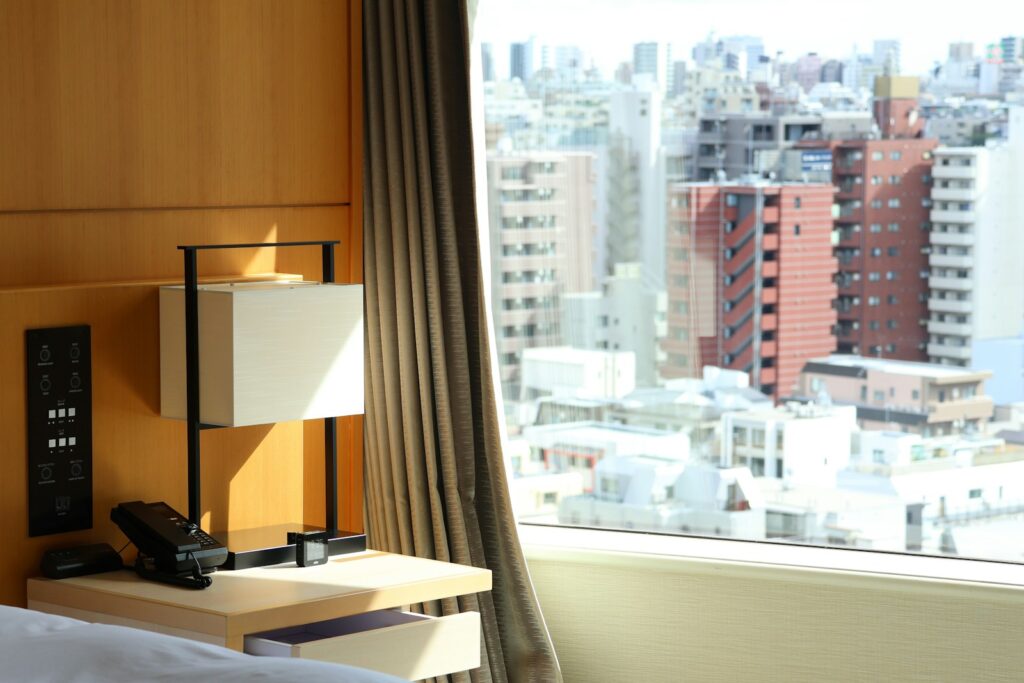
Japanese hotel rooms are compact by North American and European standards. A “standard double” in Tokyo is often 18–22 sqm, workable for two adults but tight for a family of four. Japanese hotels also enforce occupancy rules strictly. A room listed for two adults may not legally accommodate children. Filter for family rooms from the start.
Interconnecting rooms (adjacent rooms with a connecting door) are the most comfortable option for families with older children. Availability is limited, so book early and confirm the connection at check-in.
Japanese hotel bathrooms
Most Japanese hotel bathrooms have a separate toilet and a combined bath and shower unit. The deep soaking tub is ideal for small children, much easier to bathe toddlers in than a walk-in shower. The shower head is handheld, which helps with rinsing. If your kids are at the “splash everything” age, you’ll appreciate the fully waterproof wet-room style of Japanese bathrooms.
Sleeping arrangements
City hotels use Western-style beds with optional roll-away cots (free at most properties). Some hotels, particularly those with Japanese-style rooms, set up additional futon mattresses on the tatami floor at turndown. For families with young children who might roll out of bed, a floor futon is actually a practical solution. Ask when booking if you prefer one option over the other.
Breakfast
Hotel breakfast in Japan is often a buffet with a wide range of options: rice, miso soup, tamagoyaki, fruit, yogurt, eggs, and bread. For families with picky eaters, this format reduces the morning stress of finding somewhere everyone can eat. Factor it into the price comparison: standalone buffet breakfast costs ¥1,500–3,000 per adult if purchased separately.
The Best Neighborhoods for Families in Tokyo
Ueno: Most Convenient for First-Time Families
Ueno offers the best combination of transport access and walkable family attractions of any central Tokyo neighborhood. Within walking distance: Ueno Zoo (Japan’s oldest and largest, excellent for children under 10), the National Science Museum, the Tokyo National Museum, and Ueno Park, a large green space that turns into one of the city’s best cherry blossom spots in spring.
Ueno sits on both the JR Yamanote loop line and the Ginza subway line, and Asakusa is one stop away. Hotel prices here are more reasonable than Shinjuku, and the streets around the park are notably less chaotic than Shibuya or Akihabara.
Best for: First-time families booking a hotel, kids aged 3–12, itineraries that include museums and Asakusa
Asakusa: Best for a Traditional Experience
Asakusa is the most atmospheric neighborhood in Tokyo, the kind of place that looks like Japan is supposed to look. The shopping arcade (Nakamise) running up to Senso-ji Temple is car-free, lined with snacks, toys, and traditional crafts, and manageable with a stroller. Street food is everywhere: ningyoyaki (fish-shaped cakes filled with red bean paste), freshly fried senbei, and matcha soft serve.
Hotels in Asakusa offer good value for the quality, and the neighborhood pairs naturally with Ueno (10 minutes by subway) and Akihabara (15 minutes).
Best for: Families wanting traditional Tokyo atmosphere, families on a second visit who have already covered the main sights
Shinjuku: Best for Transport Convenience
Shinjuku is Tokyo’s busiest transport hub and the most central base for families making day trips. Long-distance buses to Hakone, Kawaguchiko (Mt. Fuji), and Nikko depart from Shinjuku Expressway Bus Terminal. The JR, Keio, Odakyu, and multiple subway lines converge here, making the city-wide connections as fast as anywhere.
The trade-off: Shinjuku is loud and crowded, and the Kabukicho entertainment district sits close to some budget hotel clusters. Stay in west Shinjuku (near the metropolitan government building) or south Shinjuku for a quieter experience. Large city hotels here, including Keio Plaza Hotel, Hyatt Regency Tokyo, and Park Hyatt Tokyo, have excellent family room configurations.
Best for: Families taking multiple day trips, families with older children who want central city access
Shinagawa: Best When Airport Access Matters Most
Shinagawa doesn’t come up as often in Tokyo guides, but it’s where we book a room whenever my own parents visit with us. It sits directly on the Keikyu Line from Haneda Airport (11–14 minutes, no transfer) and is also a Shinkansen stop, so it works well if the trip includes a side trip beyond Tokyo. For grandparents traveling with us, minimizing the number of transfers and walking distance from the airport matters more than being in the middle of the sightseeing action, and Shinagawa’s large hotels (with easy step-free access) make that trade-off an easy one.
It’s a business district first, so it’s quieter in the evenings than Shinjuku or Ueno, and you’re a short ride from most central sightseeing rather than in the middle of it.
Best for: Families prioritizing easy airport transfers, especially with less mobile travelers in the group, or anyone connecting onward by Shinkansen
Odaiba: Best for Young Children
Odaiba is a man-made island in Tokyo Bay, and it punches above its weight for families with young children. The main attractions: Legoland Discovery Center Tokyo, the National Museum of Emerging Science and Innovation (Miraikan), and Toyota Mega Web. Shopping malls here (DiverCity, Aqua City) have extensive play areas and relaxed food courts. teamLab’s two immersive digital art venues are close by rather than on Odaiba itself: teamLab Planets is a short hop away in Toyosu, and teamLab Borderless relocated to Azabudai Hills in February 2024 after its original Odaiba location closed in 2022, and both pair easily with a day based here.
Hotels on Odaiba are modern, spacious, and relatively affordable. The downside is connectivity: Odaiba is accessible only by the Yurikamome monorail or the Rinkai Line, which adds a step when traveling to central Tokyo.
Best for: Families with toddlers and children under 8, itineraries built around Miraikan and Legoland, with an easy add-on trip to teamLab in Toyosu
Maihama: Best for Disney Families
Maihama is technically in Chiba Prefecture, not Tokyo, but it’s a 15-minute direct train ride from Tokyo Station on the JR Keiyō Line. If Tokyo Disneyland or Tokyo DisneySea is a primary goal of the trip, staying in Maihama removes the daily commute entirely: you arrive at park opening without rushing, and if a child hits the wall at 3 pm, the hotel is 10 minutes away rather than an hour.
Disney’s official hotels (the Grand, the Ambassador, Tokyo DisneySea Hotel MiraCosta) are premium-priced but include early park entry, which at peak times is a meaningful advantage, per Tokyo Disney Resort’s own hotel guide. Third-party hotels nearby, including Hilton Tokyo Bay and Sheraton Grande Tokyo Bay, offer shuttle buses and cost 30–50% less.
Best for: Disney-focused families, families with children under 8 who need mid-day breaks from the parks
A Local’s Note on Residential Neighborhoods
We live in Yotsuya, on the Chiyoda/Shinjuku border, and it’s worth mentioning as a quieter alternative to the neighborhoods above if a central, walkable, mostly residential base appeals to you: it’s a short ride from Shinjuku and central Tokyo, without the crowds or neon. It’s not set up for tourists the way Ueno or Asakusa are, with fewer English menus and fewer obvious attractions on the doorstep, so it suits a family that wants a genuinely local base and doesn’t mind a slightly longer trip to the main sights over one that wants everything within walking distance from day one.
Best Options: Hotel Types Compared
| Type | Typical size | Price range (per night) | Best for |
|---|---|---|---|
| City hotel, family room | 30–45 sqm | ¥25,000–55,000 | Families of 3–4 who want comfort |
| Apartment hotel | 35–60 sqm | ¥22,000–48,000 | Longer stays, families with babies needing a kitchen |
| Business hotel + roll-away cot | 18–25 sqm | ¥12,000–22,000 | Budget stays, very young children who share a bed |
| Ryokan (Japanese inn) | Medium–large | ¥30,000–90,000+ | Families wanting authentic Japanese sleep experience |
| Disney official hotel | 30–40 sqm | ¥55,000–130,000+ | Disney-first families; early park entry included |
Price ranges above reflect typical listings on Booking.com and Jalan as of 2026/05.
Choosing between price and extra comfort? Our budget-friendly hotels guide focuses on practical family rooms at lower price points, while our luxury family hotels guide covers properties where larger rooms, easier logistics, and family-focused service justify the splurge.
Want the full ryokan (Japanese inn) experience with kids? Our Best Ryokan Near Tokyo for Families guide covers onsen stays in destinations such as Hakone, Atami, and Nikko, all reachable as a day trip or overnight from central Tokyo.
Apartment hotels worth knowing:
-
MIMARU Tokyo (multiple locations including Ueno, Akihabara, Shinjuku): large-format rooms explicitly designed for groups and families, tatami areas, kitchens, popular with international visitors
-
Sequence Miyashita Park (Shibuya): stylish, family-friendly, kitchenette, good for older children
-
Flexstay Inn (multiple locations): budget-conscious, larger rooms than business hotels, reliable cleanliness
For a stay of a week or longer, this whole category is worth a closer look: our Serviced Apartments in Tokyo for Families guide covers MIMARU, Tokyu Stay, and true monthly-lease residences in more depth, including which rooms actually have a kitchen or washer-dryer and how housekeeping differs from a hotel.
Vacation Rentals: A Space-First Option for Families
For families of four or more, or anyone staying longer than a few nights, a vacation rental often makes more practical sense than a hotel. The space-per-yen calculation changes completely: you get a living room, a kitchen, and real bedroom separation, all things that matter when you’re traveling with small children.
The tradeoff is less predictable service, stricter house rules, and more responsibility at check-in. Before deciding, compare the practical differences in our Airbnb vs Hotel in Tokyo with Kids guide.
Why it works well with kids:
-
Multiple rooms mean parents can decompress after the children are in bed
-
A kitchen lets you heat milk, store snacks, or make a quick meal without navigating a restaurant at 7 pm with tired children
-
In-unit laundry is common, and it’s a genuine relief on trips longer than 5 nights
-
The atmosphere is simply more relaxed than a hotel room, and children behave accordingly
Where to look:
Airbnb is the most accessible platform for international visitors, though Japan’s regulations cap short-term rentals at 180 days per year per property, so supply is genuinely tighter than in other major cities. Search early, and read reviews carefully for any mention of noise or management responsiveness. VRBO lists some properties as well.
Best neighborhoods for vacation rentals, inside the Yamanote Loop:
| Neighborhood | Nearest station | Character | Why it works for families |
|---|---|---|---|
| Kagurazaka | Kagurazaka (Tōzai Line) / Iidabashi | Old Tokyo meets French café culture; cobblestone alleys | Charming, walkable, no nightlife; strong Airbnb stock including large maisonette-type apartments |
| Yotsuya / Yotsuya-Sanchome | Yotsuya (JR Chuo, Marunouchi, Namboku) | Quiet residential pocket; near Shinjuku Gyoen | 9-min walk to Shinjuku Gyoen (great for kids); very calm streets; Tokyu Stay Yotsuya offers hotel rooms with in-room washer, kitchen |
| Jimbocho | Jimbocho (Hanzōmon, Mita, Shinjuku Lines) | Booktown; near Kitanomaru Park | Quiet on weekends; large apartments available; 10-min to the Imperial Palace East Gardens |
| Shinjuku Gyoen area | Shinjuku-Sanchome / Yotsuya-Sanchome | Green oasis edge; one block from Shinjuku without the chaos | Shinjuku Gyoen directly accessible; family-sized Airbnb units available; easy metro connections |
All four sit inside the Yamanote Loop, central enough to reach any major attraction in 20–30 minutes, but quiet enough that kids can walk to a konbini at 8 pm without navigating a crowd of izakayas.
Areas to avoid when booking vacation rentals:
Some areas have cheap or abundant listings that are not appropriate for families:
-
Shin-Okubo: popular for Korean food and street snacks, but the main street is extremely crowded and lined with entertainment venues; noisy well into the night and not a comfortable base for families with young children
-
Kabukicho / East Shinjuku: Tokyo’s largest entertainment district; avoid entirely for family stays
-
Roppongi: nightlife-heavy; listings exist but the neighborhood environment is not family-oriented
-
Ikebukuro east exit area: adult entertainment cluster; avoid
A general rule: if the listing’s neighborhood has a visible cluster of hostess bars, gaming arcades, or late-night clubs, look elsewhere. Residential streets one or two blocks behind the main drag are a different world.
Common Mistakes When Booking Family Hotels in Tokyo
Not checking occupancy limits before booking. Japanese hotels are legally strict about maximum occupancy. Booking a twin room as two adults and then arriving with two children can create a check-in problem. List all family members including children in the booking, and verify the hotel’s child policy in advance.
Forgetting to request a cot. Cots are free at most city hotels but limited, typically 1–2 per floor. Request one at booking time. Arriving without a reservation and asking at check-in usually works, but not always.
Booking on the wrong side of the city for your itinerary. If your first days are in Maihama and your last days are in Harajuku, a single hotel at one end creates daily commute friction. Either split the stay or choose a central neighborhood like Ueno.
Choosing a non-refundable rate too early. Tokyo hotel prices are relatively stable, so the discount for booking non-refundable months in advance is often small. Book a free-cancellation rate until your plans are confirmed.
Overlooking bath setup. Families with young children underestimate how useful a soaking tub is for bathing small kids. If your hotel only has a shower stall, that’s manageable, but worth knowing before check-in rather than after.
FAQ
What’s the minimum age for children to stay free?
Most Japanese city hotels allow children under 6 to stay free when sharing a parent’s bed and using no additional bedding. Children aged 6–12 often incur a small charge (¥1,000–3,000). Always verify the specific policy at booking; it varies by property.
Do Tokyo hotels have baby equipment to borrow?
Many mid-range and above hotels offer cots, baby baths, bottle warmers, and strollers for loan at no charge. Request these when booking, as supply is limited. Budget hotels and business hotels typically do not offer this service.
Is breakfast worth paying for with kids?
Generally yes. Japanese hotel buffets cover a wide enough range that even picky eaters find something: rice, scrambled eggs, fruit, yogurt, bread. For families with an early start (a common pattern with young children), having breakfast in the hotel removes a stressful morning decision.
Is a vacation rental a good choice for families in Tokyo?
Yes, often the best choice for families of four or more. You get real bedrooms, a kitchen, and laundry, all things that matter with children. Airbnb is the easiest platform for international visitors, though Japanese regulations limit supply compared to other cities. Book early and focus on residential neighborhoods (Nakano, Sangenjaya, Jiyugaoka) rather than entertainment or nightlife areas. See the vacation rental section above for a full neighborhood guide.
Is Shinjuku safe for families?
Yes. The majority of Shinjuku is a busy but safe business and shopping district. The Kabukicho entertainment district (northeast of the station) is best avoided late at night with young children, but it’s a small area easily sidestepped. Hotels in west or south Shinjuku have no issues.
How early should we book family rooms?
-
Peak periods (cherry blossom March–April, Golden Week late April–early May, August school holidays, New Year): 3–6 months ahead
-
Standard periods: 4–8 weeks is usually sufficient, though family rooms sell out faster than standard inventory at any time of year
Planning your Tokyo itinerary? Our guide to Navigating Tokyo’s Train System with Kids covers transport logistics, and Asakusa with Kids has a full neighborhood guide for one of the best family areas in the city.
Information checked: 2026/09