
TL;DR
-
Shrine festivals (matsuri) are free, happen in ordinary residential neighborhoods, and need no tickets, which makes them easy to fit around a small child’s day. For our kids, the portable shrines (mikoshi) and the game stalls are the main draw
-
We live in central Tokyo and have taken our twins to Suga Shrine in Yotsuya and Hanazono Shrine in Shinjuku four times each, Akasaka Hikawa Shrine twice, plus the Sanno Matsuri and Tomioka Hachimangu’s water-throwing festival once each. Until about age 3, we went with a stroller every time
-
We plan around the day the mikoshi goes out, usually arriving in the afternoon. The miyairi, when the mikoshi returns to the shrine in the evening (sometimes close to 7 p.m., after dark), is spectacular but the most crowded part of the day, so we usually skip it; it’s still worth seeing once
-
Festival stall food is fun, but as parents we’re more careful with it than with restaurant food in Japan, and we stick to things cooked hot in front of us. We still always end up with shaved ice (kakigori) and ramune, the soda sealed with a glass marble
-
The games are the other main event for kids: yo-yo balloon fishing, bouncy-ball scooping, goldfish scooping, lotteries, and the cork-gun shooting gallery (shateki). Lottery stalls rarely give out the big prizes, so treat them as a game and nothing more
-
The surprise hit with our kids is the character masks (omen), around ¥1,000 each. We buy one a year and reuse them at every festival
Why Shrine Festivals Work So Well with Kids
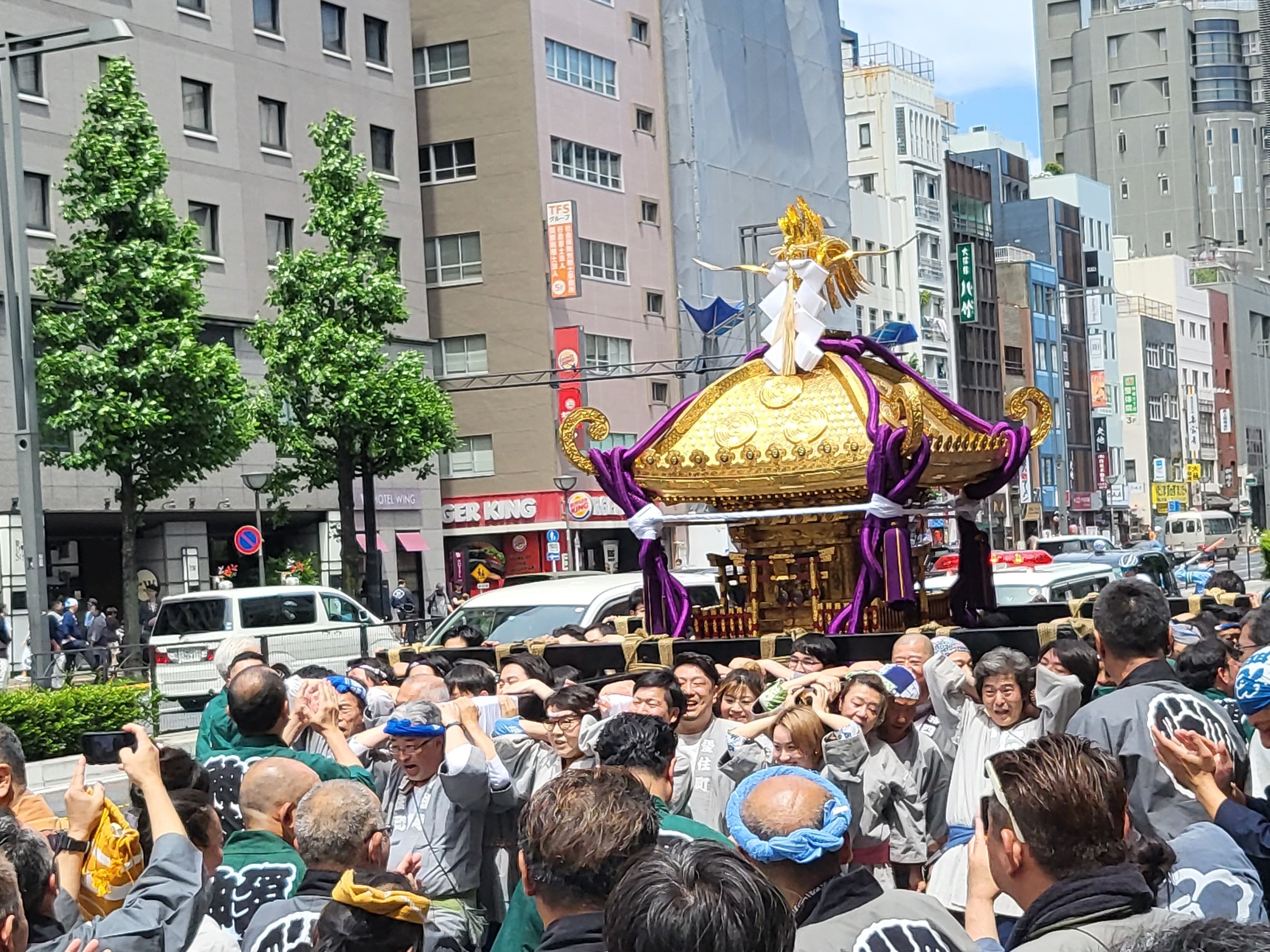
Most Tokyo neighborhoods belong to a local shrine, and once a year that shrine holds its main festival. For a few days, the streets around it fill with lanterns, food stalls, and people in matching happi coats carrying mikoshi, the portable shrines that take the shrine’s deity on a tour of the neighborhood.
For us as parents, the appeal is how little planning it takes. There are no tickets or reservations, so we arrive when it suits nap time and leave as soon as someone gets tired. Our twins are into mikoshi more than anything else at a festival. A big one carried down the street by dozens of bearers chanting in rhythm is a lot to take in, and they still stop and stare every time.
Many of the main festivals in central Tokyo fall in May and June, with another cluster in September. The big shrines post their festival dates and the mikoshi schedule on their official websites ahead of time, and a search for the shrine’s name plus “reitaisai” (annual grand festival) usually brings up the current year’s dates. Smaller neighborhood festivals are mostly announced on posters around the area, so if you see lanterns going up along the streets near your hotel, a festival is probably a few days away. For a month-by-month view of the year, see our guide to the best time to visit Tokyo with kids.
Best Options: The Festivals We Keep Going Back To
Dates shift a little every year, so check each shrine’s official announcements before you go. Several of these festivals also alternate between a larger “main” year and a smaller year.
Hanazono Shrine (Shinjuku), late May. We’ve been four times. It’s right next to Shinjuku’s shopping and nightlife district, so it’s easy to combine with the rest of a day in the area. In 2026, stalls were open from the evening of Friday, May 22 through Sunday the 24th, the neighborhood mikoshi went out on Saturday the 23rd, and the shrine’s own mikoshi was carried on Sunday the 24th, returning to the shrine around 7:30 p.m. For more on what else is nearby, see our Shinjuku with kids guide.
Suga Shrine (Yotsuya), early June. Another four-time favorite of ours. It’s a neighborhood festival in a quieter residential area, which makes it a little more relaxed with small children than the festivals right next to big stations.
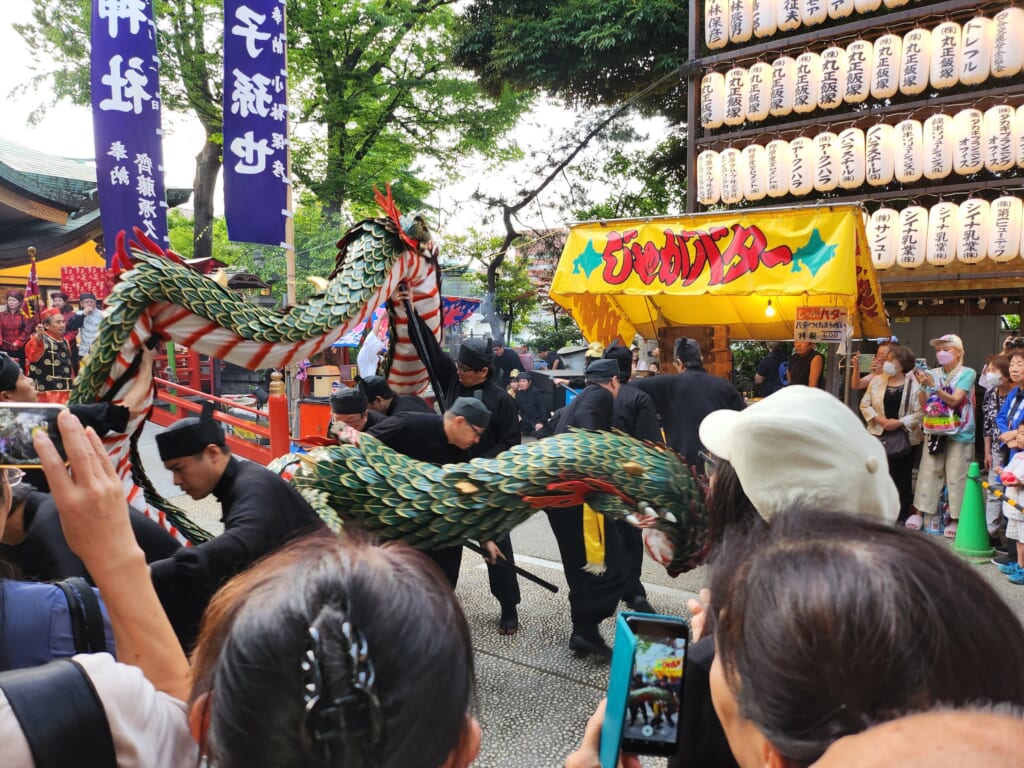
Sanno Matsuri at Hie Shrine (Akasaka), June. One of the three great festivals of old Edo. Its large procession, where a long line of participants in court costume walks through central Tokyo, takes place in even-numbered years; 2026 was one of them. We’ve been once.
Akasaka Hikawa Shrine (Akasaka), mid-September. We’ve been twice. The shrine rotates the focus of its festival over a three-year cycle, with some years centered on the shrine’s own mikoshi and others on the neighborhood mikoshi or its Edo-style floats, so what you see depends on the year.
Tomioka Hachimangu (Monzen-Nakacho), around mid-August. Better known as the water-throwing festival: spectators throw purifying water over the mikoshi and its bearers as they pass, which also gives the bearers some relief from the August heat. The biggest version, with dozens of neighborhood mikoshi, happens once every three years (2026 was one). We’ve been once. If you go with small children, expect to get splashed if you stand near the front.
Kumano Shrine (Nishi-Shinjuku), around the third weekend of September. Our favorite thing about this one isn’t at the shrine itself. During the festival, stalls appear around Shinjuku-sanchome, a fair distance from the shrine, and many are run by local restaurants. We’ve had quick tempura from Tsunahachi there. Because the food comes from restaurants that are open year-round, we’re more comfortable feeding it to our kids than typical stall food, and there was enough space to park our stroller and eat outside in the festival atmosphere.
Our general rule: festivals close to a major shopping area or station are the easiest to work into a trip, since you can leave the moment the kids are done and still have food, toilets, and a train nearby.
The Kids’ Mikoshi
At most of the festivals we go to, the day before the main adult mikoshi there’s a children’s procession: a smaller kids’ mikoshi, and often a small float (dashi) that children pull along with a rope. Kids who take part get sweets at the end, which is a big part of the appeal for ours. The catch is that the sweets go to children who walk with the procession from start to finish, so turning up at the end to collect a bag doesn’t work.
There’s a set meeting place and time, so it’s best to ask the neighborhood association or at the shrine office in advance. At the festivals we know, taking part is generally enough to get the sweets, but some places require registration ahead of time, which makes it harder to arrange as a visitor passing through for a few days. If you ever live in Japan, though, we’d really encourage signing your kids up. As a traveler, it’s still worth catching the children’s day if you can. Watching a line of small kids in happi coats pulling a float down the street, with parents walking alongside, is a side of the festival most visitors never see.
Festival Food: Our Honest Take
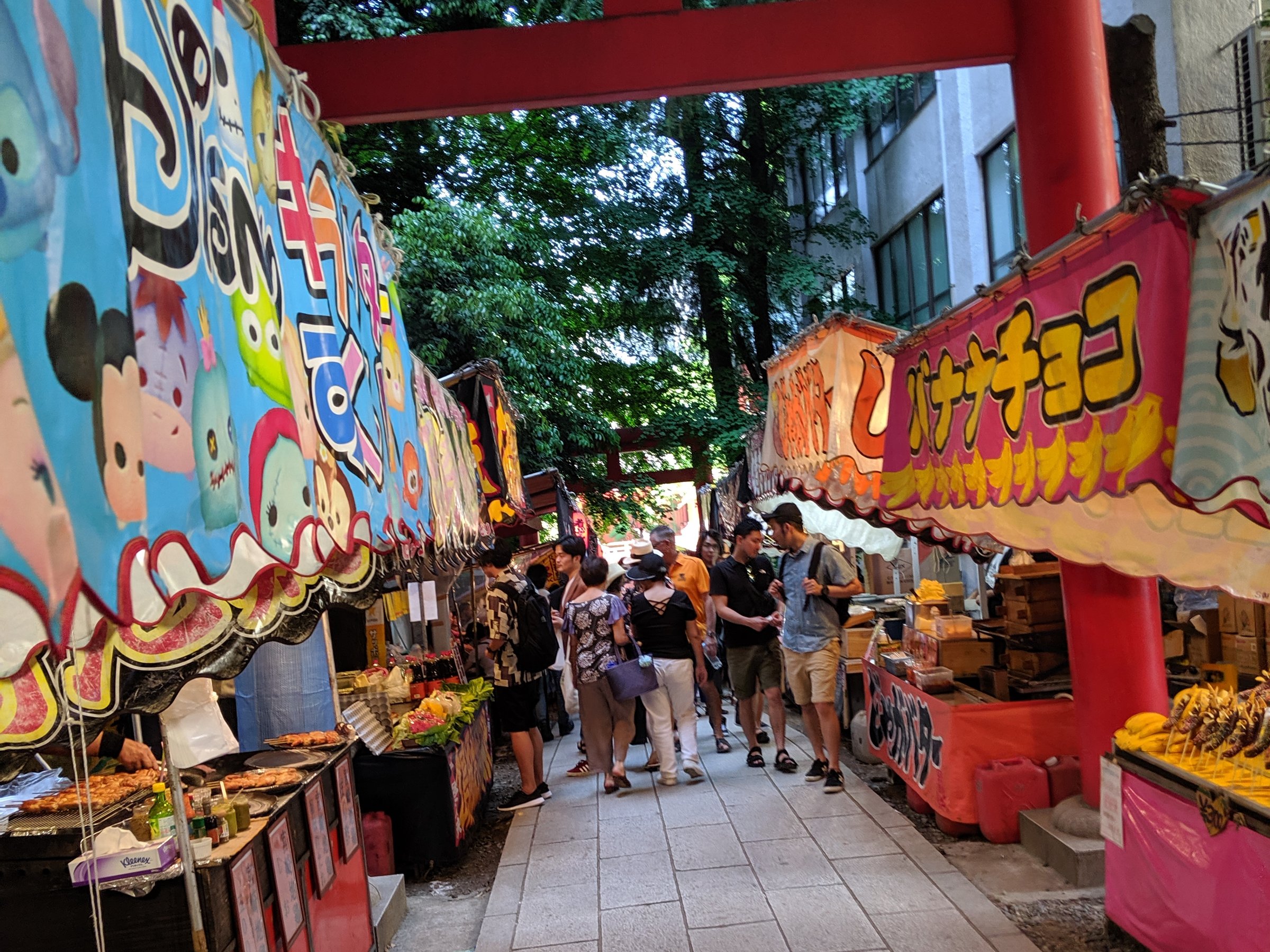
Festival stalls (yatai) sell the classics: yakisoba, takoyaki, chocolate-dipped bananas, grilled corn, shaved ice, and more. It’s part of the fun, but honestly, of everything we eat in Japan, stall food is what we’re most cautious about with our kids. We skip things that look like they’ve been sitting out for a while and choose food that’s cooked hot in front of us.
That said, we still always end up buying kakigori, the shaved ice drenched in brightly colored syrup. The other drink our kids love is ramune, a soda sold in a glass bottle sealed with a marble that you push down into the bottle to open it. It’s not something you’ll find in most other countries, and opening it is half the entertainment.
Festival Games: What Our Kids Actually Play
The game stalls are the other main event, and probably the part your kids will remember most:
-
Yo-yo fishing (yo-yo tsuri): hooking a water-filled balloon on a rubber band out of a tub with a paper hook. Easy enough for preschoolers
-
Bouncy-ball scooping (super ball sukui): scooping rubber balls out of a water tank with a fragile paper scoop
-
Goldfish scooping (kingyo sukui): the same idea with real goldfish. Think about whether you can take a live fish back to your hotel before your child wins one
-
Lottery (kuji): you pay, draw a ticket, and get the matching prize. The big, expensive toys hanging at the front are rarely what comes out, so it’s best enjoyed as a game of chance with a small prize at the end
-
Shooting gallery (shateki): knocking prizes off a shelf with a cork gun. Our twins started doing this at 4, and it’s still hard for them. They keep aiming for the biggest prize and going home with nothing, which hasn’t stopped them from wanting to try again every time
Masks. Nearly every festival we go to has a stall selling plastic character masks (omen), usually around ¥1,000 each, which feels expensive for a plastic mask. Our kids love them anyway. We buy one each year and bring them along to every festival after that.
Step-by-Step: How We Plan a Festival Afternoon
- Check the shrine’s festival dates and the mikoshi schedule. Kids generally find the mikoshi the most exciting part, so we plan around the day it goes out
- Arrive in the afternoon. That’s when we usually go. The stalls are open, the mikoshi is moving through the streets, and it’s before the evening crowds peak
- Decide whether to see the miyairi. This is when the mikoshi returns to the shrine, usually in the evening, and at some festivals it’s close to 7 p.m. and already dark. It’s very crowded, so we usually avoid it with the kids, but it’s spectacular and worth seeing once if your children can handle a crowd
- Bring the stroller if your child still uses one. We used ours at every festival until about 3. Mikoshi are carried along roads wide enough for cars, so with a stroller we either wait on a side street as the mikoshi passes or fall in behind it and follow along
- Use the toilets in the shrine grounds. Shrines have toilets, and in our experience most also have somewhere to change a diaper, so the shrine is the place to head back to
- Carry small change. Stalls generally take cash, and games and snacks add up quickly
- Leave when the kids are done. There’s no ticket to get your money’s worth from, so cutting the visit short costs nothing
Yukata and Jinbei
A summer kimono (yukata), or for boys the shorts-and-top set called jinbei, suits a festival perfectly, and plenty of local families dress their kids up. We buy new ones for ours about once every two years as they grow. We’ve never rented one, so we can’t speak to rental shops, but a yukata or jinbei is something your child can keep wearing at home after the trip, so buying one is worth considering if you have room in your luggage. A yukata also gets plenty of use at summer’s neighborhood dances, covered in our guide to bon odori in Tokyo with kids.
FAQ
Can tourists join a Japanese shrine festival?
Watching is open to everyone and free, and you can buy from the stalls and play the games like anyone else. Carrying a mikoshi or entering children in the kids’ procession usually goes through the local neighborhood association, so that part is much harder to arrange as a short-term visitor.
When are Tokyo’s shrine festivals?
Many of the main ones fall in May and June (Hanazono Shrine, Suga Shrine, the Sanno Matsuri) and September (Akasaka Hikawa Shrine, Kumano Shrine), with Tomioka Hachimangu around mid-August. Dates change slightly every year, so check the shrine’s official announcements before you go.
Is festival food safe for kids?
We let our kids eat it, but we’re more careful with it than with restaurant or convenience store food. Our rule is to skip anything that looks like it’s been sitting out and choose food cooked hot in front of us. At some festivals, such as Kumano Shrine’s, local restaurants set up stalls too, and we’re more relaxed about those.
Can I bring a stroller to a Japanese festival?
Yes. We took ours to every festival until our kids were around 3. When the mikoshi comes through, we either step into a side street or follow behind it. Avoid the miyairi at the end of the day if you don’t want to push a stroller through a dense crowd. Toilets in the shrine grounds usually have a place to change diapers too.
What age is best for a Japanese festival?
We’ve gone every year since our twins were 1, but what works changes with age. Under 3, we kept visits short and watched the mikoshi from the stroller, away from the densest crowds. By around 4, the games became the main attraction, and our twins started on the shooting gallery that year.
How much money should we bring?
Most stalls take cash. Games and snacks are typically a few hundred yen each, and character masks run around ¥1,000, so a few thousand yen per child covers a good afternoon.
Information checked: 2026/10