

TL;DR
-
This is a niche, adults-paced experience worth doing deliberately if it interests you, rather than because a list somewhere says every visitor should. Our own family has never taken our kids to a genuine old-school kissaten; the chain alternatives covered below are what we’ve actually used instead
-
Morning sets are strongly associated with Nagoya and Aichi Prefecture, not Tokyo. Tokyo’s version is a smaller, scattered echo of a habit that’s closer to a daily ritual back in the Nagoya area
-
Some old-school kissaten are legally smoking-only, which bars anyone under 20 from entering. Not just a bad idea with kids, an actual keep-out. This is a real, checkable detail, not a maybe
-
Most old, independent kissaten weren’t designed with strollers or young kids in mind. Narrow entrances, stairs to a basement or mezzanine, and counter-only seating are common
-
Check the entrance signage before you go in. The difference between a shop with a separated smoking room and one that’s smoking throughout the whole space changes whether your kids can enter at all
-
Komeda Coffee, the direct Nagoya-rooted chain version of the morning-set ritual, is the more reliably family-workable version of the tradition, with booth seating and a kids’ plate. Beyond that specific tradition, our own family also regularly uses two other chains for a relaxed family morning: Good Morning Cafe, a modern brunch-style chain with two Shinjuku-ward branches (Waseda and Daikyo-cho), where we took our own kids at around age 2 and they loved it, and Café Veloce, a nationwide budget coffee chain that, in our experience, is often quieter at the branches away from stations
What a Kissaten Morning Set Actually Is
A kissaten is an old-style Japanese coffee shop, usually small, usually independently owned, often decades old, and distinct from a modern café chain in both menu and atmosphere: thick-cut toast, siphon or drip coffee, cream soda, and a pace that assumes you’re staying a while.
The “morning set” (often just called “morning” in Japanese) is the custom that makes these shops worth a special trip: order your regular drink before roughly 10:30–11am, and the shop adds on toast, a boiled or fried egg, sometimes a small salad, for free or for a token amount on top of the drink price. It’s not a separate breakfast menu you order from; it’s a bundle that comes with the drink automatically during those hours, at some shops without even asking.
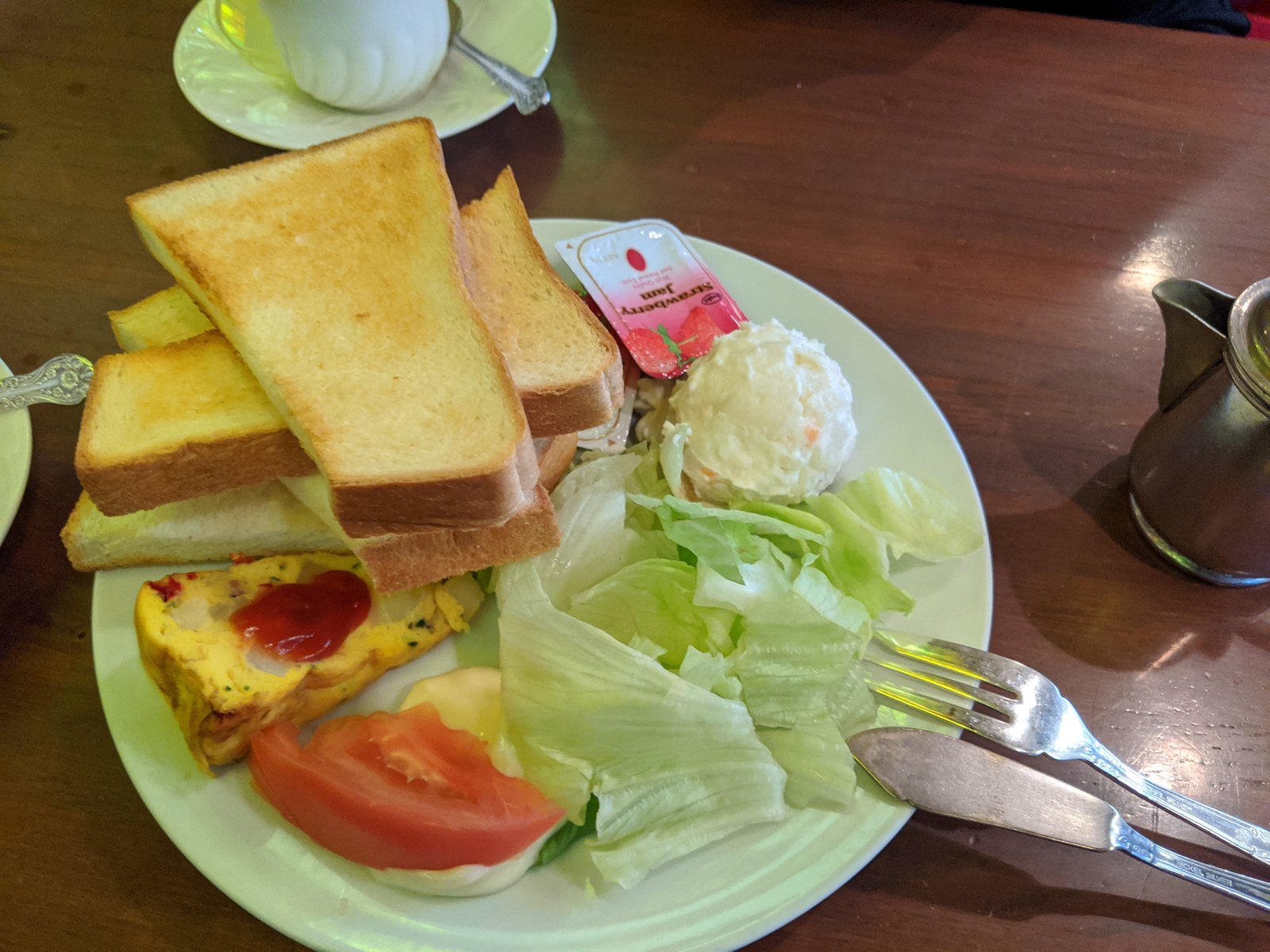
The exact origin is disputed, with competing mid-20th-century claims from Aichi and Hiroshima. What matters for a visitor is the regional pattern: the custom became especially established around Nagoya, where shops competed on how generous a drink-plus-breakfast set could be. Tokyo has versions of the same idea, but not the same citywide morning culture.
Tokyo has its own version of this, but it’s a different scale. It’s not a citywide daily habit the way it is around Nagoya; it’s a scattered custom kept alive by specific old shops, found in pockets of Tokyo’s older neighborhoods (Shitamachi areas like Yanaka and Asakusa, plus parts of Nihonbashi, Kanda/Jimbocho, and Ginza) where a decades-old kissaten culture survived the city’s redevelopment. Finding one is closer to a deliberate outing than something you’ll stumble into at random the way you might in the Nagoya area.
Is This Actually Good for Families?
A genuine old-school kissaten, a single owner, a handful of regulars who’ve been coming for years, a hushed and unhurried room, isn’t really built around young children, and it’s fair to say a fair number of Japanese parents with a toddler in tow would rather try a family restaurant or a modern cafe chain that particular morning than gamble on an old-guard kissaten’s mood. Our own family falls into exactly that category: we’ve never actually taken our kids to a genuine old-school kissaten, for that reason.
The realistic read is that family fit depends heavily on the specific shop and whether your kids can sit reasonably still for 20–30 minutes that morning. A quiet, unfamiliar room is not the place to test a rough morning or a toddler having an off day; that is a better fit for a family restaurant or one of the chain alternatives covered further down. A calmer visit at a shop with table seating and a mixed crowd can go fine.
The Smoking-Section Warning
This is the detail that catches visiting families off guard, and it’s a legal issue, not just an atmosphere one.
Japan’s revised Health Promotion Act, which took full effect in April 2020, generally requires restaurants to be non-smoking or to isolate smoking in a sealed room. There’s a nationwide exception for small, pre-existing businesses, an “existing specified food-service facility” that was already operating as of April 1, 2020, run by an individual or a small company (capital ¥50 million or less), with a customer seating area of 100㎡ or less, which can continue to allow smoking inside without building a separate certified room.
Tokyo’s own local ordinance is stricter than the national law on this specific point: to make the entire interior smoking-allowed rather than partitioning off a certified room, a small pre-existing Tokyo shop must also have no paid employees, a condition on top of the national size and capital limits. In effect, that’s a solo- or family-run operation, which describes a real number of Tokyo’s oldest kissaten, but not every one of them.
Here’s the part that matters most for a family: under the law, anyone under 20 is barred from entering any designated smoking space, full stop; being accompanied by a parent doesn’t create an exception. Two different situations can apply, and they’re not the same for your family:
-
A shop with a separate smoking room (the entrance sign will say a smoking room is available): your kids just can’t go into that specific room; the rest of the shop is fine.
-
A shop that has made its whole interior smoking-allowed (no partition, sometimes posted simply as a “smoking allowed” sign): the entire shop is off-limits to anyone under 20, not just uncomfortable to be in.
In practice: look for the posted signage at the entrance, and don’t assume; a sign reading “non-smoking” means the shop is fully smoke-free and safe to enter with kids, while any sign mentioning a smoking room or smoking allowed means you need to check which of the two situations above applies before bringing your children in. Confirm current hours and smoking policy directly, since older write-ups can lag behind what is posted at the door.
How to Tell If a Specific Kissaten Is Family-Workable
Beyond the smoking question, a few quick things to check, from the sidewalk if you can, or by a quick search before you go, tell you whether a given kissaten is realistically workable with kids:
-
Layout. Many old kissaten occupy narrow, decades-old buildings, with a step at the entrance, tight aisles, or basement seating. Check the room before bringing in a full-size stroller.
-
Seating type. Booth or table seating works far better than counter-only seating, which is common in the smallest single-owner shops.
-
Crowd, on the day you’re going. A shop full of solo regulars reading newspapers is a different room from one with a mixed daytime crowd, and it’s hard to predict from the outside which you’ll get. Weekday mornings generally mean a shorter wait since fewer people are out, but the people who are there on a weekday are more likely to be quiet regulars rather than a looser weekend mix; going early mostly buys you a shorter line, not necessarily a more forgiving room.
-
Kids’ amenities. Don’t assume a kids’ chair, a kids’ menu, or a changing table; plenty of genuine old-school kissaten simply don’t have them. If any of that matters for your visit, it’s worth asking ahead, or defaulting to one of the chain alternatives below.
-
Owner and staff. A small, one- or two-person operation moves slower and has less slack for a chaotic table than a bigger staff. This isn’t a knock on the owners; it’s just a different kind of business than a family restaurant.
None of this is a strict rulebook; it varies shop to shop, and the only way to really know is to look when you arrive. But a shop that’s non-smoking, has workable seating, and isn’t packed with quiet regulars that morning is a realistic option; a shop that fails more than one of those is better saved for a morning without your kids along.
Best Options: Where Family-Workable Kissaten Actually Exist in Tokyo
A few real examples, useful less as a “must-visit list” and more as a sense of what’s out there and where to start looking:
Yanaka / Nezu / Sendagi (Yanesen). This older Shitamachi area still has a cluster of retro kissaten and cafés. Kayaba Coffee is a well-known starting point, but confirm current opening hours, reservations, and stroller access directly before making it the anchor of a family morning.
Asakusa. One of Tokyo’s older, more tourist-accustomed districts, which in our reading makes its kissaten scene generally more used to a mixed, casual crowd than a more formal shopping district, though that’s a broad tendency, not a guarantee for any specific shop. If your family is already spending a morning in Asakusa, working a kissaten stop into the day is a natural add rather than a special trip; the well-regarded Pelican bakery, whose bread supplies several kissaten toast menus around the city, is based here.
Nihonbashi / Kanda / Jimbocho. These areas have a genuine concentration of old kissaten tied to the neighborhood’s office-worker and university-student history. Check the smoking signage and seating layout carefully here before committing, using the checklist above; several shops in this cluster lean toward a quieter, more regulars-driven room than Yanesen or Asakusa. Kissako Kaiseiken, in Nihonbashi Ningyocho near Ningyocho Station’s Exit A2, is a longtime example (founded 1919) that uses bread from Asakusa’s Pelican bakery for its toast (corrected 2026/09: earlier listed under Asakusa, confirmed via multiple independent sources to actually be in Nihonbashi Ningyocho).
Ginza. Generally regarded as a more formal, dressed-up part of the city’s café scene than the other areas on this list. Not somewhere to treat as a default family stop, though; as with everywhere on this list, it comes down to the specific shop.
The Practical Alternative: Chains That Actually Work With Kids
If the actual goal is “let the kids try a Japanese morning” rather than “sit in an authentic single-owner 1955 kissaten,” our own family’s experience points to a few nationwide and regional chains that solve the family-fit problem directly, in different ways.
Komeda Coffee, which also traces its roots to Nagoya, is the chain we’ve actually taken our kids to for a morning set. It runs its own version of the ritual inside a shop designed for families: booth and table seating, kids’ chairs, a dedicated kids’ plate and kids’ drink menu, and diaper-changing facilities at some stores (searchable on the chain’s own store-locator page). It won’t give you the same sense of stepping into old Tokyo that a genuine retro kissaten does, but it’s a predictable choice if you want the ritual without leaving whether a specific small shop works with your kids that morning up to chance.
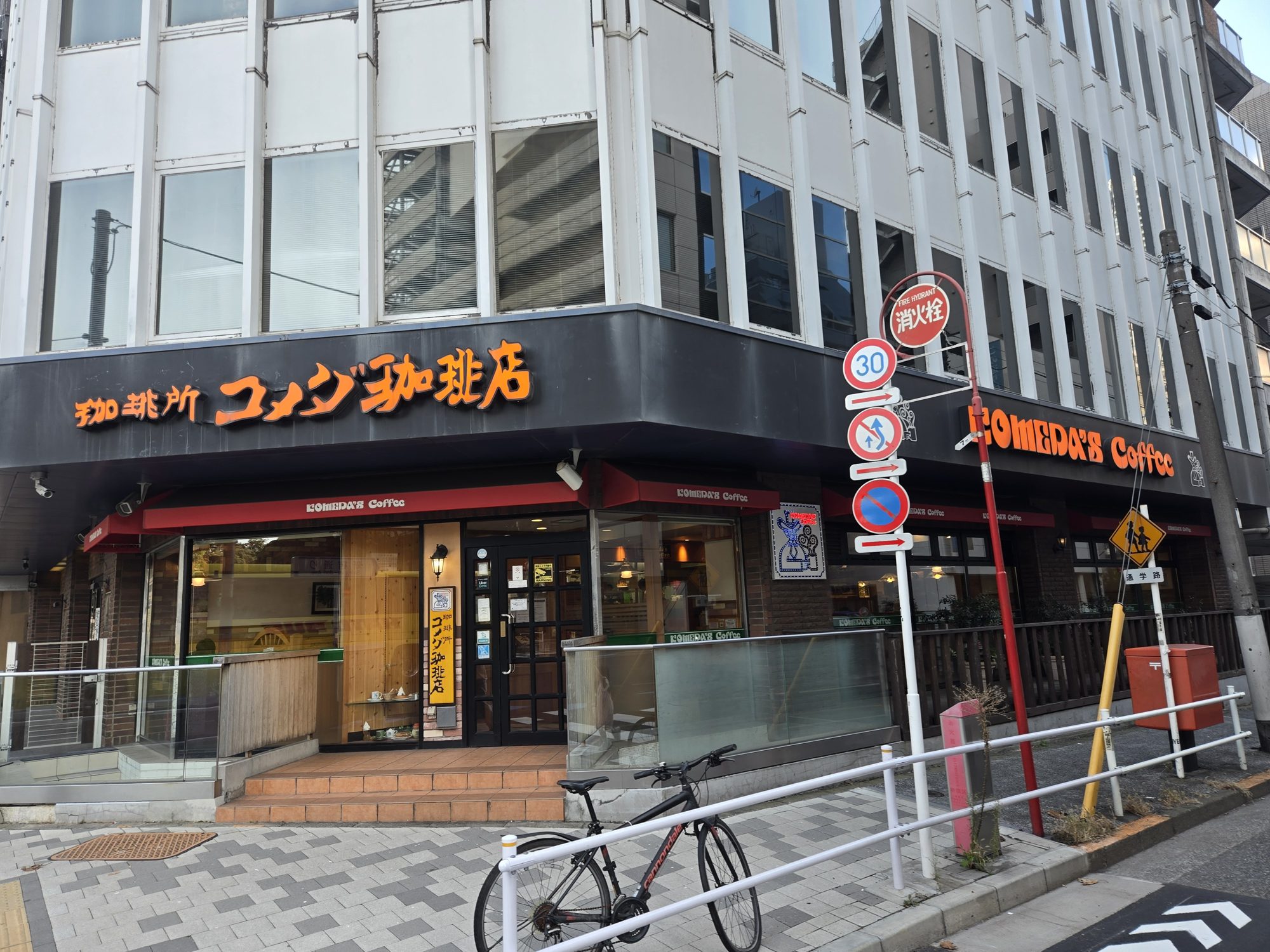
How Komeda’s morning set works. Until 11am, ordering a drink gets you bread for free. You pick thick-sliced toast or a round loaf roll, spread with butter or strawberry jam, plus one topping: a boiled egg, a homemade egg spread, or Komeda’s own sweetened red bean paste (ogura-an). There’s no salad in the set, but the regular menu is available during morning hours too, so you can add a small salad on the side. One thing to know: the menu at the branch we visited said kids’ drinks don’t count toward the morning set, so a child who wants their own morning set has to order from the regular drinks menu.
What our visit was like. One of us took our 4-year-old twins to the Shinjuku-gyoemmae branch a little after 8am on a Saturday in October 2026. The room was about 80% full. Staff told us to sit anywhere, but no four-person tables were free, so the three of us took a two-person table. Waiting a little for a bigger table would have been an option too, and the shop has kids’ chairs that can be pulled up alongside a small table. Water came in cups with lids, and they brought kids’ plates and cutlery, both of which make a breakfast with preschoolers noticeably less stressful. Afterward we walked off breakfast in Shinjuku Gyoen, which opens at 9:00 and is a few minutes away (see our Shinjuku guide). We finished that morning with lunch at Kaiten Sushi Ginza Onodera in Omotesando.
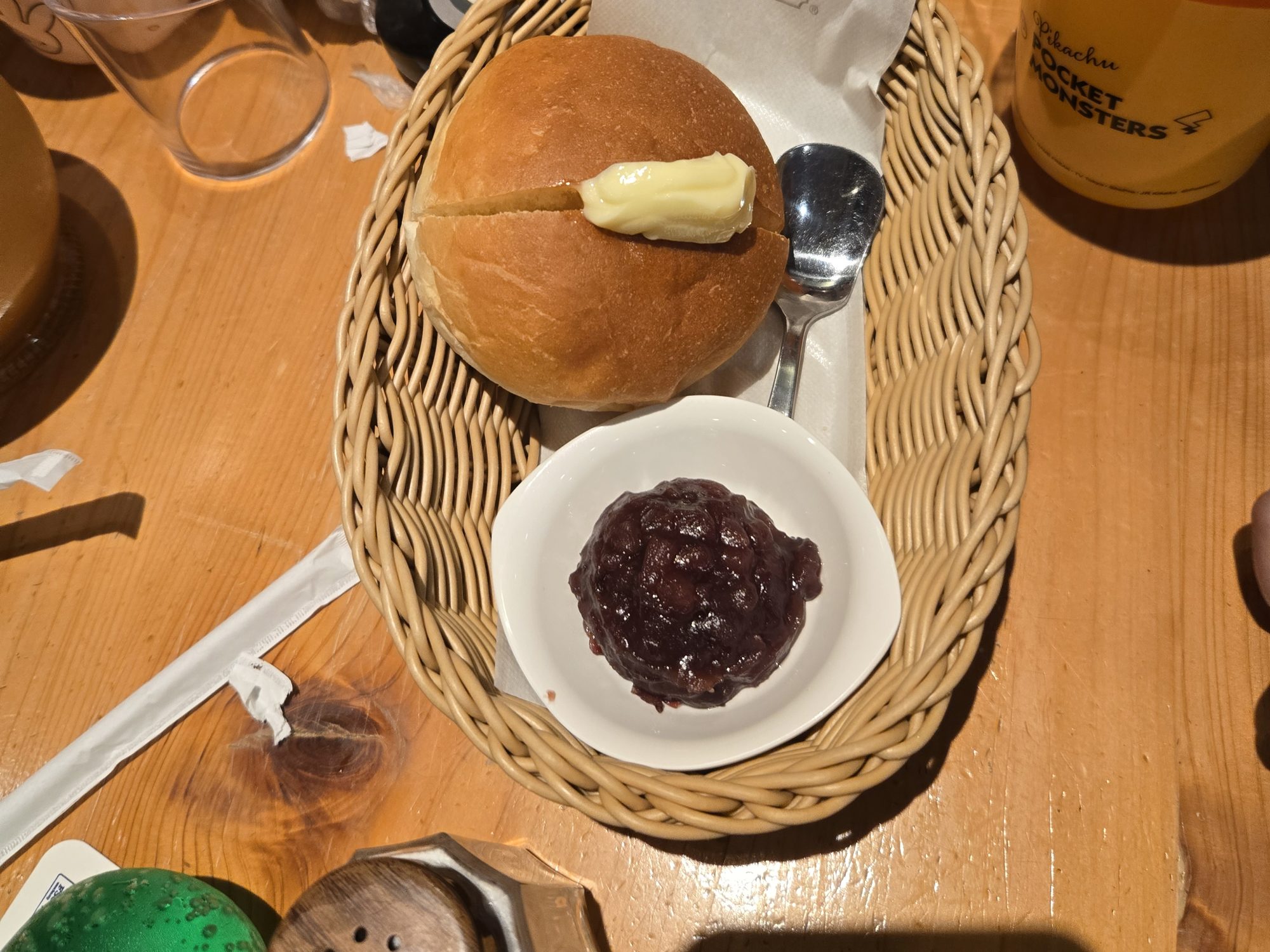
Two things we’d tell another family. First, Komeda’s portions run large, including the items labeled “mini,” so order less than you think you need for a small child. Second, the soft drinks are big too. If you’d rather your kids didn’t have a large juice first thing in the morning, skip a morning set for them and order an extra slice of toast or an extra portion of red bean paste from the add-on menu instead. Our son’s favorite was the ogura-an: a gently sweet bean paste that’s worth trying while you’re in Japan.
Good Morning Cafe is a modern brunch-style chain with two branches in Shinjuku ward, at Waseda and Daikyo-cho (the Daikyo-cho branch operates as “Good Morning Cafe Nowadays”). It’s a different kind of morning experience entirely, closer to a Western brunch cafe than a classic kissaten; the Daikyo-cho branch’s morning menu includes fresh-baked brioche and acai bowls, while the Waseda branch runs morning service on weekends and holidays. Our own family took our kids there at around age 2, and they loved it. It’s a good option if the goal is simply a relaxed, kid-workable breakfast out rather than the specific toast-and-egg kissaten ritual.
Café Veloce, a nationwide budget coffee chain with roughly 170 branches, is one our own family also uses regularly. In our experience, the branches away from station crowds tend to be quieter, which makes them an easy, low-pressure option on an ordinary morning rather than something you need to plan around.
None of these three will replicate the specific atmosphere of a decades-old single-owner kissaten, but between them they cover a range of what a family might actually want from a Tokyo morning out: the classic Nagoya-style ritual (Komeda), a more modern brunch experience (Good Morning Cafe), or just a quiet, no-fuss coffee stop (Veloce).
Common Mistakes Families Make
1. Assuming the morning set runs all day.
It typically cuts off around 10:30–11am. Arrive later and you’re just ordering a regular drink at regular price, with no toast or egg included. At Komeda, the cutoff is 11am.
2. Walking in with a stroller without checking the smoking signage first.
Look for a “non-smoking” sign at the entrance for a fully non-smoking shop. Anything mentioning a smoking room or smoking allowed needs a second look; if the whole shop is designated smoking rather than a separate room, your children legally cannot enter, not just uncomfortably so.
3. Expecting a kids’ menu or a kids’ chair.
Most old-school kissaten simply don’t have one. If a kids’ chair or kids’ plate specifically matters for your visit, Komeda is the confirmed option; if the goal is just a relaxed, kid-workable morning out more generally, Good Morning Cafe or Veloce, which our own family also uses, are worth considering too.
4. Treating it as a fast breakfast stop before sightseeing.
A kissaten morning is built for lingering, not speed; if your family is racing to an opening time somewhere, this isn’t the option that fits that morning. A konbini or bakery run is faster.
5. Assuming Tokyo works like Nagoya.
Nagoya-area morning sets can be famously generous: small side dishes, larger portions, sometimes a genuine competition between shops over what comes free with a coffee. Tokyo’s version is more modest: toast and an egg is a typical, not a minimum, expectation.
FAQ
What is a kissaten?
An old-style Japanese coffee shop, usually small, independently owned, and often decades old, distinct from a modern café chain in both menu (siphon coffee, thick toast, cream soda) and pace (built for lingering, not speed).
What is a “morning” or morning set in Japan?
A custom where ordering a regular drink before roughly 10:30–11am comes bundled with toast and a boiled or fried egg, for free or a small add-on price. It’s specific to kissaten and kissaten-style chains, not a standard feature at every café.
Did morning sets really start in Nagoya?
The exact first shop is disputed; even Ichinomiya’s own local business association, widely credited as a birthplace of the custom, says on its history page that there are competing theories and no conclusive answer. What’s not disputed is the region: the custom is strongly tied to Nagoya and Aichi Prefecture, where it became a near-daily habit for a lot of locals, before spreading in a smaller form to other cities including Tokyo.
Are Tokyo kissaten smoking or non-smoking?
It varies by shop. Small, pre-2020 businesses can legally keep smoking allowed under exceptions in Japan’s Health Promotion Act and Tokyo’s own (stricter) local ordinance. Anyone under 20 is legally barred from any designated smoking area; the question is whether that’s a separate smoking room (only that room is off-limits) or the entire shop (posted simply as smoking allowed, with no partition, so the whole shop is off-limits). Check the door signage rather than assume.
Is it actually worth doing with young kids?
It depends on the shop and on your kids that particular morning. A genuine old-school kissaten is built around a quiet, adult-paced atmosphere, and our own family has never actually taken our kids to one for that reason; we’ve used Komeda, Good Morning Cafe, and Veloce instead. It tends to go better with school-age kids who can sit calmly for 20–30 minutes, a toddler on a good day, or as a solo outing for one parent. A chain descended from the same culture is the more reliably family-workable version of the ritual.
What should we order?
Ask if a morning set is available, whether in English (“Is there a morning set?”) or simply by pointing at another table’s plate, rather than assuming; at some shops any regular drink automatically triggers it, at others you choose a specific set or pay a small add-on. If a kids’ drink isn’t on the menu, which is common at genuine old-school kissaten, a juice or milk is usually available as a simple alternative. At Komeda, kids’ drinks didn’t qualify for the morning set at the branch we visited; a child who wants their own set orders a regular soft drink, or you can simply add an extra slice of toast for them.
Do we need to book ahead?
Most small kissaten don’t take reservations for a casual morning visit, but it varies; some popular retro spots (Kayaba Coffee in Yanaka, for one) do, and it’s worth using if you want to guarantee a table. Where reservations aren’t an option, going earlier in the service window on a weekday generally means a shorter wait, though not necessarily a quieter room.
Is Komeda Coffee a real kissaten?
It’s a kissaten-style chain rather than a single independent shop, but it shares the same Nagoya-rooted morning-set tradition and offers the same free toast-and-egg-with-a-drink format. It’s the practical, family-designed version of the custom rather than the retro, single-owner experience. Good Morning Cafe and Veloce, which our own family also uses, are a further step away from the classic kissaten format but solve the same basic need for a relaxed, workable morning out with kids.
Plan Your Japan Trip
Also useful:
Information checked: 2026/10