
At a Glance
| Entry | Free (Yoyogi Park, Meiji Shrine, both districts themselves) · Cosmo Planetarium Shibuya ¥800 adults / ¥400 elementary–middle school / preschoolers free · Shibuya Sky ¥2,700–¥3,400 for adults depending on time slot (web ticket), free for preschoolers up to age 6 |
| Nearest stations | Shibuya Station (JR Yamanote/Saikyo/Shonan-Shinjuku, Tokyo Metro Ginza/Hanzomon/Fukutoshin, Tokyu, Keio Inokashira) · Harajuku Station (JR Yamanote) · Meiji-jingumae ⟨Harajuku⟩ Station (Tokyo Metro Chiyoda/Fukutoshin) |
| Getting there | Shibuya and Harajuku are one JR Yamanote Line stop apart (about 2 minutes), or a 20–25 minute walk via Cat Street and Meiji-dori |
| English support | Good at major commercial buildings (Shibuya Sky, Hikarie, Scramble Square, Shibuya PARCO); mixed to minimal on Takeshita Street and small backstreet shops |
| Strollers | Fine in Yoyogi Park and on Cat Street; genuinely difficult on Takeshita Street, especially weekends; Shibuya Station itself is one of the more complex transfers in Tokyo |
| Baby facilities | Good: Shibuya Hikarie (ShinQs), Shibuya Scramble Square, and the ward-run “co Shibuya” family support facility near the station all have nursing and changing rooms |
| Typical visit | Half a day for Harajuku and Yoyogi Park alone; a full day if you add Shibuya Sky, the planetarium, or a Yoyogi Park festival |
As of 2026/08 · Source: official venue sites and researched Japanese-language sources (linked throughout)
Is It Worth It?
Short answer: yes, and it’s more manageable with kids than its reputation suggests, once you know which parts of the chaos to walk into and which to route around.
A quick note on where this guide comes from: this isn’t years of weekly residence the way our Shinjuku guide is. Our family’s experience here is a handful of specific outings, not a running log of the neighborhood. What we can offer firsthand is real, though: a family trip to Shibuya’s planetarium, and repeated visits to Yoyogi Park for its festival calendar. Everything else in this guide is built from research in Japanese-language sources (official venue pages, ward information, and Japanese parenting blogs) rather than English-language travel sites.
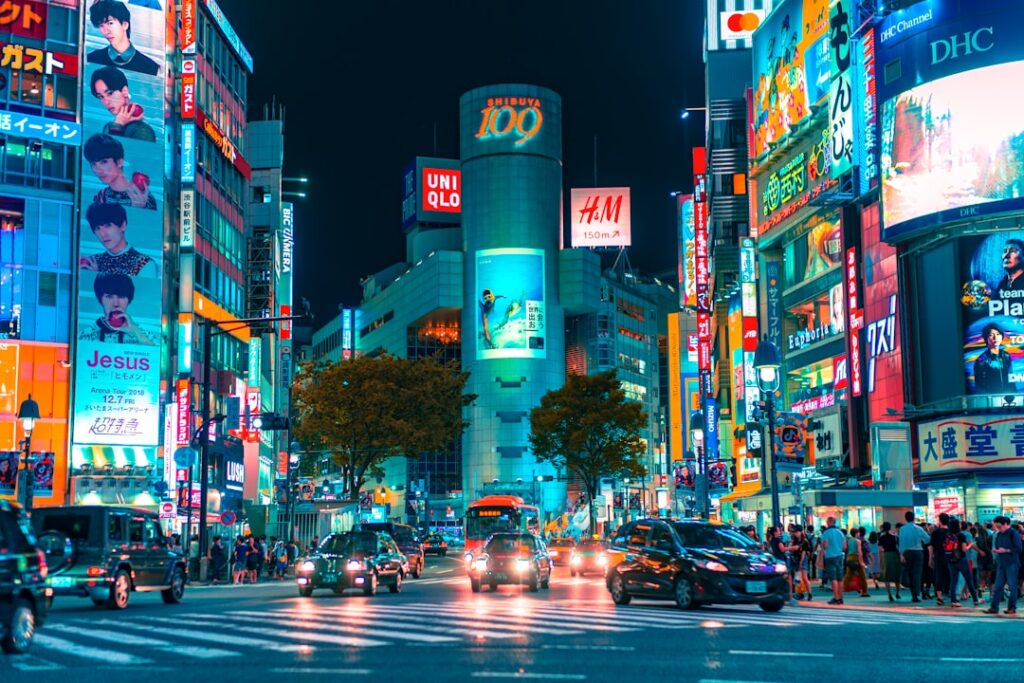
Shibuya and Harajuku get lumped together because they’re one train stop apart, but they’re a study in contrasts: Shibuya is a dense commercial and transit hub built around the world-famous scramble crossing, while Harajuku is smaller-scale and split between the teenage fashion energy of Takeshita Street and the quiet forest of Meiji Shrine. Between the two sits Yoyogi Park, one of Tokyo’s largest green spaces and, as it turns out, a genuinely good place to bring kids.
By age:
-
0–2 (baby/infant): Yoyogi Park’s lawns are the best stop for letting a baby or toddler crawl and stumble around outdoors. Department store baby rooms at Hikarie and Scramble Square cover feeding and changing. Skip Takeshita Street on weekends entirely at this age; there’s little upside to fighting that crowd with a stroller.
-
3–6 (preschooler): Cosmo Planetarium Shibuya’s kids-oriented sessions, the character floors at Kiddy Land, and Yoyogi Park’s open space for running around all land well at this age. A festival at Yoyogi Park, if the timing works out, can be a memorable stop for a preschooler.
-
7–10 (primary school): Old enough to enjoy the spectacle of the scramble crossing itself, handle Shibuya Sky’s height and the wait involved, and get a kick out of Pokémon Center Shibuya or the toy floors at Kiddy Land.
What to Expect
Shibuya Station: Complex, But You Don’t Need All of It
Shibuya Station is consistently named among Tokyo’s most confusing stations to transfer through: it’s a three-dimensional maze where JR, Tokyu, Keio, and three Tokyo Metro lines all converge at different levels, and the walk between some lines (JR to the Hanzomon/Ginza/Fukutoshin platforms in particular) is long enough that it catches even Tokyo residents off guard.
The practical fix is the same one that works in Shinjuku: don’t try to understand the whole station, anchor on a landmark. “Meet at the Hachiko exit” or “come out toward Shibuya Scramble Square” is a far more useful instruction with kids in tow than a gate or exit number. If you’re transferring between very different lines (say, JR to the Ginza Line), budget extra time rather than assuming a quick change: the distances involved are genuinely longer than they look on a map.
The Scramble Crossing: A Free Spectacle Worth Pausing For
Shibuya’s scramble crossing is one of the busiest pedestrian crossings in the world, and it’s genuinely fun to watch with kids rather than just cross once and move on. The free way to do it: the second floor of the Starbucks inside the Tsutaya building on the northwest corner has floor-to-ceiling windows looking straight down onto the crossing. No ticket needed, just the price of a drink if you want a seat by the window (and no guarantee of one, since everyone has the same idea).
For a wider, higher view, Shibuya Sky (see below) looks down over the crossing from above. The rooftop deck atop the Magnet by Shibuya109 building (now rebranded Crossing View & Rooftop Lounge MAG8) also overlooks the crossing, but it’s a paid lounge (around ¥1,800, including one drink), not a free viewpoint.
As of 2026/08 · Source: MAG8 official site
Cosmo Planetarium Shibuya: A Kid-Tolerant Atmosphere We Experienced Firsthand
Shibuya’s planetarium has changed hands and locations more than once over the years, so it’s worth being specific: the one currently operating is Cosmo Planetarium Shibuya, on the 12th floor of the Shibuya Cultural Center Owada, about a 5–8 minute walk from Shibuya Station’s south/west side. It’s open Tuesday–Friday 12:00–20:00 and weekends/holidays 10:00–20:00, closed Mondays. Entry is ¥800 for adults and ¥400 for elementary and middle schoolers; preschoolers get in free as general admission (riding on a parent’s lap is always free; a seated preschooler ticket may still apply for some special ticketed events).
As of 2026/08 · Source: Shibuya Cultural Center Owada: Cosmo Planetarium Shibuya
This is one of the few attractions in this guide we’ve actually taken our kids to, and it’s the reason a Shibuya planetarium made it into this guide at all: the atmosphere is what stood out on our visit, more than the show itself. A bit of noise and fidgeting from kids in the room was clearly tolerated rather than shushed, which made for a more relaxed outing than we’d expected from a planetarium. We can’t say with certainty which type of session we were in, and that distinction turns out to matter, so here’s what we found researching it afterward: the planetarium runs a regular Kids Time screening slot aimed at preschool and early-elementary children, a shorter thirty-minute show (currently one themed around Shibuya’s own Hachiko exploring space), and it also periodically runs a separate, explicitly relaxed-rules session called the Nigiyaka Planetarium, literally a “lively planetarium”: it does away with the usual “stay quiet, no devices, no leaving mid-show” rules of a normal screening specifically so people who’d otherwise hesitate to come (including a family with a fussy toddler) can attend without worry.
As of 2026/08 · Source: Shibuya Cultural Center Owada: Nigiyaka Planetarium event page
Our take: whether what we experienced was a standard Kids Time session with a naturally relaxed vibe, or we happened onto a Nigiyaka Planetarium-style session, the practical takeaway is the same either way: this venue clearly builds kid-tolerant options into its schedule. If a fussy toddler makes you hesitate about a planetarium, it’s worth checking the current schedule for a Kids Time or Nigiyaka Planetarium session before ruling one out.
Yoyogi Park: Layout and the Festival Calendar
Yoyogi Park is one of Tokyo’s largest central parks, with broad lawns, wooded paths, and an event plaza near the Harajuku side. The event calendar changes frequently and temporary closures affect parts of the grounds, so check the park operator’s current notices rather than planning around a recurring festival from an older article.
This is where our own family habit comes in, and it’s simple: if something on the calendar interests you, it’s worth going, but the well-known events (the big food festivals especially) draw genuinely large crowds, big enough that getting near a food stall can mean a long wait. Our approach is to go with a low-commitment mindset: if it’s too crowded when we get there, we just leave, or wander the rest of the park instead. We don’t build the whole day around getting into a packed event, because that’s the setup for a miserable afternoon with kids. Check what’s on before you go (the event organizers post schedules a few weeks ahead), but treat the plan as “let’s see what’s happening” rather than “we’re getting into that festival no matter what.”
Meiji Shrine: The Forest Approach, Honestly Assessed for Strollers
Meiji Shrine sits inside a dense forest right next to Yoyogi Park and Harajuku Station, and the walk in from the main entrance is part of the experience: tall trees, quiet, a real change of pace from Harajuku’s crowds just outside. The practical detail worth knowing: the main approach path is covered in loose gravel (tamajari) for most of its roughly 900-meter length from the south entrance to the shrine buildings, which is hard going for stroller wheels. There is a paved strip running along the edge of the gravel path in sections, built for wheelchair and stroller access, but it doesn’t run the entire distance.
The practical read: a stroller is workable if you’re patient and stick to the paved edge where it exists, but if you’re visiting with a baby who’s easily rattled or you’re short on patience that day, a baby carrier is the more relaxed choice for this particular walk. Either way, it’s free to enter and one of the better contrasts to the rest of this guide: a calm, green space five minutes from Harajuku’s busiest street.
Takeshita Street: The Honest Crowd Warning, and a Better Alternative
Takeshita Street is only about 350 meters long, which is part of the problem: it’s narrow, lined with shops selling crepes, cheap fashion, and character goods. The street is pedestrian-only every day from 11:00 to 18:00, and on weekends and school holidays especially, it fills with enough people (a large share of them school trip groups and tourists) that forward motion slows to a shuffle. A stroller in that crowd isn’t a minor inconvenience; it’s genuinely difficult to move, and you’ll spend more energy protecting the stroller from the crowd than enjoying the street.
The practical fix: if you’re set on walking Takeshita Street with a stroller, a weekday morning is the easiest window. Early evening also thins the crowd, though a few shops start winding down by then. Weekends, especially the 11:00–18:00 pedestrian hours, are genuinely difficult with a stroller. If a carrier is an option, that removes most of the difficulty.
The calmer alternative for many families is Cat Street. It runs broadly parallel to the busiest Harajuku route toward Shibuya and is easier to browse with a stroller than Takeshita Street at peak times. It has a more grown-up mix of shops and cafés, so choose it for walking comfort rather than for concentrated character goods and crepes.
Character and Kids Shops
-
Kiddy Land Harajuku: a genuine toy store, not just a merchandise stop for adult collectors. Five floors: B1 is entirely Snoopy Town; 3F is toys aimed at both boys and girls; 2F covers Disney, Ghibli, Miffy, and Doraemon; 4F has Rilakkuma and Hello Kitty shops. Easy to spend half an hour here even without buying anything.
As of 2026/08 · Source: Kiddy Land Harajuku official site -
Pokémon Center Shibuya: located on the 6th floor of Shibuya PARCO, a short walk from Shibuya Station. Smaller than some of Tokyo’s other Pokémon Center locations but a reliable stop if your kids are Pokémon fans.
As of 2026/08 · Source: Pokémon Center Shibuya official page
Shibuya Sky: Worth It, With Conditions
Shibuya Sky, the outdoor rooftop observation deck atop Shibuya Scramble Square (229 meters up), earns a place in this guide with a couple of specific caveats. The glass safety fencing is set at eye level rather than blocking the view, so it doesn’t feel caged in, but it’s an open-air rooftop, which means it’s genuinely windy, and strollers are not allowed on the rooftop deck itself for safety reasons. If you’ve brought your own stroller, you’ll need to leave it below; the venue offers loaner strollers at the 46th-floor information counter if you need one indoors.
As of 2026/08 · Source: Shibuya Scramble Square official FAQ
Pricing is time-slot based (web tickets currently run about ¥2,700 for adults before 15:00 and ¥3,400 from 15:00, with same-day window tickets priced higher), and tickets frequently sell out, so book online in advance rather than counting on walk-up availability. Preschoolers (up to age 6) are free. Given the price and the fact that the entire value of the visit depends on clear weather, we’d call this one for families with kids old enough to actually appreciate a view (roughly 7 and up) rather than a must-do with a baby or toddler, and worth skipping outright if the forecast is cloudy.
As of 2026/08 · Source: SHIBUYA SKY official ticket page
Navigating with a Stroller
The honest summary across this guide: Yoyogi Park and Cat Street are genuinely easy with a stroller; Shibuya Station’s transfers and Takeshita Street on a weekend are the two places that will wear you out. Meiji Shrine’s gravel approach sits in between: doable with patience, easier with a carrier.
-
At Shibuya Station, don’t assume a quick transfer between different train operators: the walk between JR and some Metro lines is one of the longer ones in Tokyo. Budget extra time rather than cutting it close.
-
On Takeshita Street, treat weekends as a stroller no-go and either go on a weekday morning, go after 18:00, or route through Cat Street instead.
-
At Meiji Shrine, stick to the paved edge strip where it exists on the gravel approach, and consider a carrier as backup for a fussy day.
-
In Yoyogi Park and on Cat Street, no special planning needed: both are flat, wide, and stroller-friendly by Tokyo standards. For general Japan-wide stroller strategy, see our stroller guide.
Family Tips
Go to a Yoyogi Park Festival with No Commitment
Our rule, described above: check what’s on, go if it interests you, and be ready to leave or wander elsewhere if it’s too crowded when you arrive. Don’t build the whole day around getting into one specific event.
Check the Planetarium’s Relaxed-Session Calendar
Cosmo Planetarium Shibuya’s Kids Time program is a solid regular option for preschool and early-elementary kids, but if the timing lines up with one of the periodic “Nigiyaka Planetarium” relaxed-rules sessions, that’s the better fit for a toddler who might make noise or need to step out mid-show.
Take Cat Street Instead of Fighting Takeshita Street
Unless your kids are specifically set on the crepes and character shops of Takeshita Street, Cat Street covers similar ground at noticeably lower crowd density: an easier walk with a stroller or a tired kid.
Anchor on a Landmark at Shibuya Station
Pick a specific exit or building (Hachiko, Shibuya Scramble Square, Shibuya Hikarie) as your meeting point rather than a gate number, and if you’re transferring from JR to a Tokyo Metro line, budget extra time for the walk between them.
Common Mistakes Families Make
1. Walking into Takeshita Street on a weekend afternoon with a stroller
The 11:00–18:00 pedestrian-only hours (every day, but worst on weekends) make this one of Tokyo’s most crowded shopping streets. If a stroller is non-negotiable, go on a weekday morning or use Cat Street instead.
2. Building a whole day around one specific Yoyogi Park festival
Popular events get genuinely packed. Go with a “we’ll see” attitude rather than a fixed plan, and be ready to walk away if the crowd isn’t worth it.
3. Assuming a quick transfer at Shibuya Station
The walk between some lines (JR to certain Metro platforms in particular) is longer than it looks. Budget extra time, especially with a stroller.
4. Bringing a stroller up to the Shibuya Sky rooftop deck
It’s not allowed, for wind-safety reasons. Plan to leave it below, or use the loaner strollers available at the 46th-floor counter.
5. Skipping Meiji Shrine because “it’s just a shrine”
The forest approach is a genuine, free change of pace after Harajuku’s crowds, even a short walk in is worth it, gravel path and all.
FAQ
Is Shibuya too overwhelming for young kids?
The station and the scramble crossing area are genuinely intense, but the fix is the same one that works elsewhere in Tokyo: pick a landmark to anchor around rather than trying to take in the whole area at once. Yoyogi Park and Meiji Shrine, both a short walk away, offer an easy decompression point.
What’s the current planetarium in Shibuya?
Cosmo Planetarium Shibuya, on the 12th floor of the Shibuya Cultural Center Owada, a short walk from Shibuya Station. It runs a regular Kids Time screening slot for preschool and early-elementary children and periodically runs relaxed-rules “Nigiyaka Planetarium” sessions.
Is Takeshita Street worth it with a stroller?
On weekends, honestly, no: it’s one of Tokyo’s most crowded streets during the 11:00–18:00 pedestrian window. Go on a weekday morning or evening if you’re set on it, or take Cat Street instead for a calmer, wider alternative nearby.
Does Yoyogi Park have a playground?
Not really: the park itself is mostly open lawn and forest rather than built-out play equipment. A small neighborhood park just outside, Yoyogi Fukamachi Children’s Park, has some play equipment if that’s specifically what you need.
Is Meiji Shrine stroller-friendly?
Workable but not effortless: the main approach is loose gravel for most of its length, with a paved strip along the edge in sections rather than the whole way. A carrier is the easier option if your child or your patience is running thin that day.
Is Shibuya Sky worth it with kids?
For kids around 7 and up on a clear day, yes: it’s a genuinely impressive view. For a baby or toddler, the cost, the weather dependency, and the no-stroller-on-the-rooftop rule make it a lower priority than the free options in this guide.
How much time should we plan for Shibuya and Harajuku together?
Half a day covers Harajuku, Yoyogi Park, and Meiji Shrine at an easy pace. Add a few more hours if you’re also doing the planetarium, Shibuya Sky, or a Yoyogi Park festival.
Getting There
Shibuya and Harajuku sit on the JR Yamanote Line, one stop apart, with Shibuya additionally served by the Saikyo Line, Shonan-Shinjuku Line, Tokyo Metro Ginza/Hanzomon/Fukutoshin Lines, Tokyu Toyoko/Den-en-toshi Lines, and the Keio Inokashira Line. Harajuku is a short walk from Meiji-jingumae ⟨Harajuku⟩ Station on the Tokyo Metro Chiyoda and Fukutoshin Lines. For IC card basics and general Tokyo train navigation, see our Tokyo trains guide.
| From | Line | Journey time (approx.) |
|---|---|---|
| Shinjuku | JR Yamanote Line | ~7 min |
| Tokyo Station | JR Yamanote Line (direct, no transfer) | ~25 min |
| Ikebukuro | JR Yamanote Line | ~16 min |
| Ginza | Tokyo Metro Ginza Line | ~15 min |
Nearby and How to Combine
Shibuya and Shinjuku are a quick, direct ~7-minute ride apart on the JR Yamanote Line, making it realistic to combine the two into a longer day if your family has the energy: Shibuya/Harajuku in the morning (Yoyogi Park, Meiji Shrine), then Shinjuku Gyoen and a department store baby room stop in the afternoon. See our full Shinjuku with kids guide for that side of the pairing. For most families with young kids, though, Shibuya/Harajuku on its own (anchored around Yoyogi Park) is a comfortable half-to-full day without needing to add anything else.
Information checked: 2026/08