

TL;DR
-
Conveyor-belt sushi (kaiten-zushi) chains, Sushiro, Kura Sushi, and Hama-zushi, are the default fast dinner for tired families. Ordering is entirely photo-based on a touch panel. Basic plates start around ¥110–150 depending on the chain and store type (Sushiro alone splits stores into suburban, semi-urban, and urban tiers, with a central Tokyo branch’s cheapest plate starting nearer ¥150 than ¥110), with premium plates running well above that (some over ¥400), so a filling meal isn’t a fixed price, but it’s genuinely possible to eat well for a family of four without spending much
-
Book the queue app before you leave the house, not when you arrive. Our own family switched from a Kura Sushi branch near Ochiai-Minami-Nagasaki to a newer one that opened closer to home in Shinjuku, and the habit that carried over between stores was the same: reserve through the app for both Sushiro and Kura Sushi, because a walk-in at lunchtime can mean a genuinely long wait
-
The “grab anything off the passing belt” experience isn’t universal anymore, and it varies by chain and even by branch. After 2023 incidents of customers filming themselves tampering with lane food, Sushiro moved to belts that carry only ordered items at most locations. Hama-zushi runs a mix; newer “straight lane” stores are order-only with no rotating belt at all, while some older branches still rotate. Kura Sushi is the one major chain still running a genuinely free-flowing rotating belt at most of its stores, with each plate sealed under a patented antibacterial cover
-
The two chains’ kid-facing gimmicks work differently, and it’s worth knowing which one your kids will respond to. At Kura Sushi, dropping a finished plate into the tableside slot is the appeal on its own: every five plates triggers “Bikkura Pon,” and a capsule toy visibly drops down from above into a small hatch, which is what actually excites a young kid, more than the prize inside. At Sushiro’s newer full-touch-panel stores, the format is different: tap in and try a short minigame built around a licensed character (branded “Digiro”), and how much the table has ordered affects when the game becomes available, though Sushiro doesn’t publish how winning itself is decided
-
All three major chains offer a free digital queue, the Sushiro app, Kura Sushi’s app or EPARK, and Hama-zushi’s own app, and joining one before you arrive is the single most useful thing you can do to avoid standing around with tired kids. Weekday dinners tend to peak in the early evening and weekends get busy across both lunch and dinner hours, but exact wait times vary a lot by branch and neighborhood, so a queue reservation doesn’t always mean instant seating, just a shorter wait than walking in cold
-
Every seat at a kaiten-zushi counter has a self-serve hot water tap for tea, and the water is kept scalding, well above 90°C, worth knowing before a curious toddler starts pressing buttons at the table
-
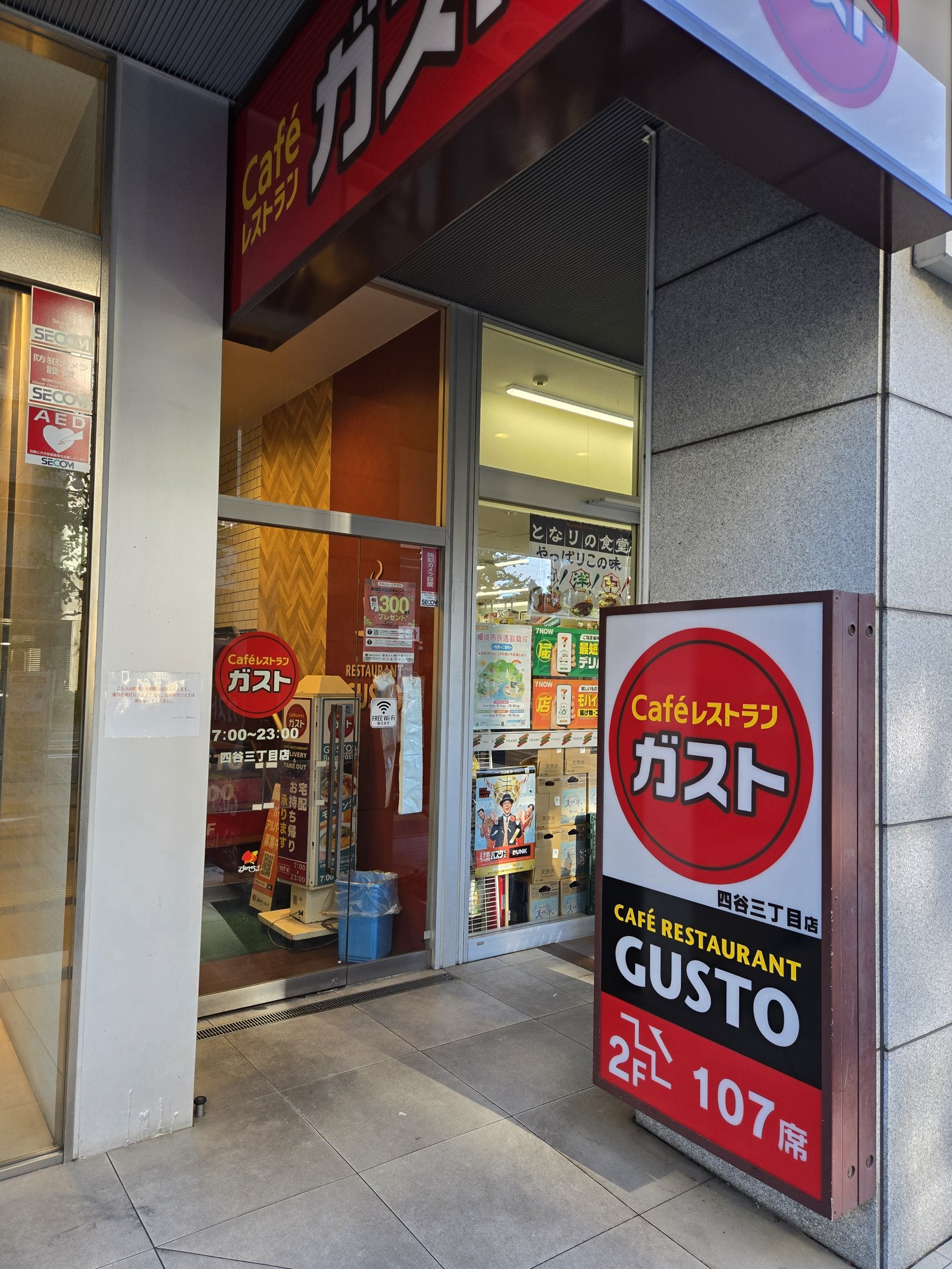
Family restaurants, Saizeriya, Gusto, Jonathan’s, Bamiyan, are built around a self-serve drink bar, and pricing varies more by store location and time of day than by chain alone. On the ground, Saizeriya’s drink bar runs ¥300 tax included ordered on its own, or ¥200 as part of a food set, with kids’ pricing at ¥100 (free age 3 and under); Gusto runs ¥329 tax included bundled with a food set, or ¥549 ordered standalone, with kids free at age 3 and under and ¥130 up to elementary-school age. Some branches also price it lower at lunch, so treat any single figure as a starting point for your specific store, not a fixed nationwide price
-
Saizeriya’s small portions turn out to be a feature for a family, not a gap. It has no dedicated kids’ menu, but our own approach works well precisely because portions are small: order a handful of regular dishes and let the table share, rather than one main each, since most mains, including the ¥300 Milano-style doria, sit in the ¥300–500 range. In our case the doria, fries, and pizza are consistently what the kids reach for first
-
The once-standard 24-hour family restaurant is mostly gone. Skylark Group, which owns Gusto, Jonathan’s, and Bamiyan, eliminated round-the-clock operation chain-wide in 2020 over staffing costs, then began reintroducing some late-night hours at select branches from 2023 onward. Current hours are branch-specific, so don’t assume any location is open past 23:00 without checking
-
Ramen at dinner is a slightly different proposition than ramen at lunch, but only slightly. A handful of small, independent ramen shops, usually ones leaning into a late-night, drinking-focused atmosphere, post no-young-children policies in the evening, but this is genuinely rare, not a real risk for most families. A quick look at a shop’s Google Maps photos and reviews before you go is an easy way to get a read on the room. For a dinner that sidesteps the question entirely, a budget chain like Kourakuen, which runs a dedicated kids’ set (roughly ¥290–490) and stocks high chairs at most branches, is the lower-friction choice
-
High chairs exist at all of these categories but aren’t a guarantee at any single branch. Numbers vary store to store, and central Tokyo locations, basement floors, small footprints, are more likely to be tight on stroller space than suburban locations
Best Options: Which Fits Your Family Tonight
| Your situation | Lean toward | Why |
|---|---|---|
| Toddler or baby who can’t wait long for food | Kaiten-zushi, reserved via app | Once seated, ordered plates tend to arrive quickly since most items are made to order in small batches, so there’s less of a wait than a from-scratch kitchen dish, though hot sides like udon or fries still take a few minutes |
| Picky eater who won’t touch fish | Family restaurant (Gusto, Bamiyan, or Jonathan’s) | A drink bar plus a hamburg steak, curry, or fries plate is a safer bet on a night you can’t gamble on dinner |
| Group of 5 or more, or multiple generations | Family restaurant | Kaiten-zushi box seating commonly tops out around 4–6; family restaurants have larger tables and don’t split groups across counters |
| Want ramen but need it to feel welcoming with kids | A ramen chain (Kourakuen) over a specific famous shop | Budget chains are built around families; some standalone ramen shops lean into a late-evening, adults-only atmosphere and a few explicitly turn away young children |
| Tight budget, need to fill everyone up fast | Kaiten-zushi, or Saizeriya shared plates | The lowest plate tier at every major kaiten-zushi chain starts around ¥110–150 depending on the branch, and Saizeriya’s small, cheap portions make ordering several dishes to share an easy way to fill a table without a big bill |
| Need somewhere open past 23:00 | Check the specific branch first | Most locations across all these categories now close by 23:00–24:00; late-night hours exist only at specific branches, not chain-wide |
If your evening doesn’t cleanly fit one row, kaiten-zushi is worth trying first for speed, with a family restaurant as the fallback when someone in the group won’t eat sushi at all. If you’d rather trade the prize games for better fish at a higher price, our review of Kaiten Sushi Ginza Onodera in Omotesando covers a premium kaiten shop we took our twins to for lunch.
Why This Is a Different Question From Lunch
Our Quick Lunches guide covers gyudon and udon counters, built for a five-minute stop between sightseeing stops. Our Sitting Down for Lunch guide covers ramen and teishoku, where you wait a bit longer for food cooked to order. This guide is about a different moment: it’s 6pm, everyone’s tired from a full day of walking, and you need a place that can absorb a cranky kid, has a high chair, doesn’t require Japanese, and won’t take an hour. Kaiten-zushi, family restaurants, and budget ramen chains are what ordinary Japanese families with young kids reach for on a weeknight, not a special dinner out.
It’s also worth saying plainly: some nights, Japanese families with young kids skip eating out entirely and pick up bento or prepared side dishes from a supermarket or department-store basement food floor to eat back at home. It’s a normal, unglamorous option, not a failure to find somewhere “authentic.” If everyone’s truly done for the day, that’s a legitimate fourth option alongside the three covered here.
Kaiten-Zushi: How the Touch Panel and Belt Actually Work
Ordering is done by tapping photos
At Sushiro, Kura Sushi, and Hama-zushi, you’re seated, either as a walk-in or via an app reservation, at a table or counter with a built-in touch panel. Every item, nigiri, rolls, udon, fries, dessert, is shown as a photo with a price, so pointing and tapping gets you through an order without needing to read Japanese. Kids’ items (egg sushi, corn mayo, chicken nuggets, soft-serve) sit in their own category on the same panel. Hama-zushi additionally runs a named kids’ set, the “Hamakko Set,” a potato plate, a three-item combo, or a shoyu ramen set, each with a small toy-gacha coin, so it’s worth checking that category specifically rather than assembling a kids’ meal item by item, as Hama-zushi’s own menu shows.
The belt itself changed after 2023, and it’s not the same at every chain
The delivery system now varies by chain and branch. Some stores send only ordered items directly to the table, while others still use a rotating belt alongside an express lane. The family rule is the same in either format: keep small hands away from the lane and use the touch panel rather than taking or touching anything you did not order.
The gacha games that actually keep kids at the table
The two biggest chains solve this with different mechanics, and it’s worth knowing which one will land with your kids. Kura Sushi’s well-known feature is Bikkura Pon: every five finished plates dropped into the tableside collection slot triggers a mini-game on the touch panel, and a win sends a small toy dropping down from above into a capsule hatch built into the table. In our own experience, the capsule physically dropping down is the part that gets our kids excited, more than whatever the actual toy turns out to be. The five-plate trigger also feeds plates into an automated under-table system that counts and returns them to the kitchen, so it does double duty as both entertainment and a genuinely efficient plate-tracking system.
Sushiro’s newer full-touch-panel stores run a different format: instead of a plate-counting slot, the panel occasionally offers a short minigame built around a licensed character, and succeeding at it wins a small prize. From what we’ve seen, the odds of winning seem to track with how much the table has ordered rather than being pure chance, though Sushiro doesn’t publish the exact mechanics.
Reservations and realistic wait times
All three major chains offer a free digital queue: the Sushiro app, Kura Sushi through its own app or EPARK, and Hama-zushi through its own app supporting both queue and time-slot booking. These are priority-queue tools rather than a guaranteed table at a guaranteed minute. Even so, joining the line remotely before you leave your hotel is still the single most useful thing you can do, since it starts your wait time running before you’ve even arrived. This isn’t a theoretical tip: our own family reserves through the app for both Sushiro and Kura Sushi as a matter of habit now, because a walk-in at lunchtime can mean standing around for a genuinely long while with two tired kids. Weekday dinner crowds tend to build in the early evening; weekends get busy across both lunchtime and dinner hours, with walk-in waits that can run long on a Saturday evening without a reservation. Exact numbers vary by branch, neighborhood, and day, so treat any specific minute count you read as a rough tendency rather than a promise.
A few things specific to visiting with young kids
-
The hot water tap is scalding, and it’s right at every seat. Kaiten-zushi counters commonly give each seat a tap dispensing water kept above 90°C, meant for mixing powdered green tea in a small cup, worth keeping a curious toddler’s hands away from, and worth knowing exists before your child presses an unfamiliar button expecting something else.
-
High chairs and booster seats are common but not unlimited. Hama-zushi’s official FAQ states booster seats are available at every location; Sushiro’s official site states it provides children’s chairs and diaper-changing tables at most locations. None of that guarantees one is free the moment you arrive on a busy evening, so ask staff for one when you’re seated rather than assuming it’s held for you through the app reservation.
-
Central Tokyo branches can be tight on space. Some city-center locations are smaller, on a basement or upper floor, or otherwise cramped compared to a roomier suburban store, so confirming stroller space, or being ready to fold it at the entrance, saves an awkward moment.
-
Touch panels are Japanese-first, but photos carry the order, and a number of branches in tourist-heavy areas offer a language toggle for the panel itself.
Ramen at Dinner: Chain vs. a Specific Shop
Ramen behaves slightly differently at dinner than it does at lunch, and it’s worth knowing about before you commit to a specific, well-reviewed shop with kids in tow, though it’s a minor consideration, not a real risk for most families. At lunchtime, most ramen counters are simply feeding office workers on a break. In the evening, a small number of independent shops, usually ones leaning into a late-night, drinking-focused atmosphere, post explicit policies turning away young children, even though the same shop is fine at lunch. This is genuinely rare, not something to plan a trip around, but it’s easy to check ahead of time: a shop’s Google Maps listing (interior photos, recent reviews, posted hours) usually gives you a good sense of the room before you show up with kids.
For a dinner that sidesteps the question entirely, a budget ramen chain built around families is the more reliable pick. Kourakuen offers children’s choices, but items, prices, and promotions change, so check the current official menu rather than planning around an expired free-meal campaign.
If you do want to try a specific, well-reviewed ramen shop rather than a chain, a quick check on Google Maps, interior photos, recent reviews mentioning families or kids, before you queue up is a simple way to get a read on whether it’s the kind of quiet, adults-paced room where a young child might feel like an awkward fit at that hour, even when the exact same shop is completely normal at lunch.
Family Restaurants: The Drink Bar Is the Whole Point
What a drink bar actually gets you
A drink bar is a self-serve station with soft drinks, tea, and coffee. Pay once, refill as many times as you like for the length of your meal. Pricing varies by chain, by whether you order it standalone or as part of a meal set, and, more than either of those, by the specific store and time of day; several chains price a lunchtime drink bar lower than the same drink bar at dinner. Treat the figures below as a starting point for your specific branch, not a fixed nationwide price:
-
Saizeriya: ¥300 tax included standalone, ¥200 as part of a food set; ¥100 for kids up to elementary-school age, free age 3 and under
-
Gusto: ¥329 tax included when ordered as part of a food set, ¥549 tax included standalone; free for kids age 3 and under, ¥130 up to elementary-school age
-
Jonathan’s: priced differently standalone versus bundled with a meal; check the current menu for the branch and time of day
-
Bamiyan: pricing can vary by time and whether food is ordered; check the current menu before promising a particular kids’ rate
Saizeriya and Gusto pricing checked in 2026/09; pricing varies by store and meal timing, so confirm at the specific branch.
Saizeriya: no listed kids’ menu, but that’s the point, not a gap
Saizeriya’s current menu doesn’t display a dedicated children’s meal section, and once you’ve eaten there with young kids a few times, the reason stops feeling like a gap: the regular menu is already small-portioned and cheap enough that ordering a spread and sharing it works better than a single kids’ plate would. Our own approach is exactly this: order several dishes and let the kids pick from whatever’s on the table, and the doria, fries, and pizza are reliably what disappear first. Many mains, including the Milano-style doria at ¥300, sit in the ¥300–500 range, according to Saizeriya’s official menu, which is what makes ordering a child a regular dish, or splitting one between a parent and a child, a genuinely easy call rather than a compromise. Saizeriya doesn’t clearly state a bring-your-own-baby-food policy on its official site, but in practice most branches are accommodating if you ask staff directly.
Gusto, Jonathan’s, Bamiyan: dedicated kids’ menus, sometimes with a bundled drink bar
Unlike Saizeriya, the Skylark Group’s other three chains keep a proper kids’ menu, according to Gusto’s official family-dining page, and often bundle in a small toy or sticker sheet: a capsule-toy coin with certain items at Gusto, an Anpanman tableware point-collection program at Bamiyan, a coloring sheet at Jonathan’s. Whether the drink bar is included depends on the specific item; some of Gusto’s family-oriented kids’ plates explicitly bundle a kids’ drink bar, while others price it separately, so it’s worth checking the individual menu item rather than assuming either way.
Kourakuen and Ohsho: cheap, but not built around a kids’ menu the same way
Kourakuen’s ramen-focused kids’ set is covered above. Ohsho (Gyoza no Ohsho), the Chinese-food chain best known for gyoza, doesn’t run a dedicated kids’ menu at most branches. What families use instead is the “Just Size” line, smaller, cheaper portions of fried rice, gyoza, and tianjin rice, handy for splitting with a child even though Ohsho markets it as a smaller-appetite option generally, not specifically as a kids’ item, per its official Just Size menu page.
High chairs and crowd timing
High chairs are stocked at all of these chains, but the number per store varies and isn’t unlimited, worth a glance through the window before committing on a busy evening if a high chair matters. Family restaurants tend to get busiest on Friday evenings, Saturday lunch and evening, and weekday lunch hours; a weekday dinner outside the early-evening rush, or an early weekend dinner, is generally the easier time to walk in without a wait, though this varies by location and isn’t a guarantee.
Hours: 24-hour service is mostly a thing of the past
Family restaurants used to be a genuine round-the-clock option in Tokyo. Skylark Group, which owns Gusto, Jonathan’s, and Bamiyan, eliminated 24-hour operation chain-wide by early 2020, citing staffing costs and thin overnight sales, and most branches now close somewhere between 23:00 and 24:00. Starting in 2023, the company began extending roughly 2,000 stores to midnight closing and pushing around 250 stores further, to 2am, 5am, or back to full 24-hour service, but this remains branch-specific, not something to assume of any given location, according to Skylark’s own corporate history page.
Common Mistakes
-
Walking into kaiten-zushi on a Saturday evening with no reservation. Weekend evening waits without an app booking can run long; all three major chains offer a free queue reservation that takes under a minute to set up before you leave your hotel.
-
Assuming every kaiten-zushi belt still works the “grab anything passing by” way it used to. At most Sushiro and newer Hama-zushi stores, the belt now carries only your own table’s order; expecting to grab a random plate will just leave you confused about why nothing’s circulating. Kura Sushi and some older Hama-zushi branches still run a classic rotating belt.
-
Letting a curious toddler play with the tableside hot water tap. It’s kept scalding for tea and sits within easy reach at every seat, worth a heads-up before your child starts pressing unfamiliar buttons.
-
Worrying that Saizeriya has no kids’ menu. It doesn’t, but its regular menu is already small-portioned and cheap enough, many mains ¥300–500, that ordering a spread of dishes to share, rather than one kids’ plate, is usually the better move anyway.
-
Not doing a quick Google Maps check before queueing at a well-known ramen shop’s evening service. It’s rare, but a handful of shops, usually ones leaning into a late-night, drinking-focused atmosphere, turn away young children in the evening even though they’re fine at lunch. A look at recent photos and reviews takes a minute and avoids an awkward moment; a budget chain like Kourakuen sidesteps the question entirely.
-
Counting on a 24-hour family restaurant for a late finish. Round-the-clock operation is the exception now, limited to specific branches; most locations close by 23:00–24:00, so check the specific branch before planning a late dinner around one.
-
Not confirming high-chair or stroller space in advance at a central Tokyo branch. Both are limited in number and space, and city-center locations tend to be smaller than suburban ones; a quick look through the window, or a request through the reservation app, avoids an awkward moment on arrival.
FAQ
Is kaiten-zushi actually safe to eat for kids, given the belt’s had food-tampering issues?
The 2023 incidents were about customers tampering with food, not the chains’ own hygiene practices, and the industry response addressed exactly that: Sushiro and many Hama-zushi stores now put only ordered plates on the belt, and Kura Sushi seals its rotating plates under a plastic cover. All three remain everyday dining for Japanese families, including with young kids.
Do I need to read Japanese to order at a kaiten-zushi restaurant?
No. Ordering is done through a touch panel showing photos of every dish, including kids’ items, so you can order by pointing and tapping. Some branches in tourist-heavy areas also offer a language toggle on the panel itself.
Which kaiten-zushi chain is most set up for young kids?
All three run official kids’ facilities, Hama-zushi’s FAQ states booster seats at every location, and Sushiro’s site states it provides children’s chairs and diaper-changing tables at most locations. Exact facilities vary branch to branch, so it’s worth requesting a booster seat or box seating when you reserve through the app rather than assuming. If it helps to know how the games differ: Kura Sushi’s plate-drop mechanic tends to excite younger kids on its own, while Sushiro’s character minigames suit a slightly older kid who can follow a short game on the panel.
What does a drink bar cost, and is it worth it with kids?
It varies by chain, by store location, and by whether it’s ordered standalone or bundled with a meal, roughly ¥200–300 (Saizeriya) up to ¥549 (Gusto standalone) for an adult, and free to a low fixed rate for kids depending on age. Some branches also price it lower at lunch than dinner. For a family staying more than a few minutes, it’s usually worth it both for refills and as something to occupy a restless kid for a few minutes.
Does Saizeriya still have a kids’ menu?
No, and once you’ve eaten there with kids a few times, that stops feeling like a gap. The regular menu is already small-portioned and cheap, many mains, including the ¥300 Milano-style doria, run ¥300–500, so ordering several dishes to share works better than a single kids’ plate. Doria, fries, and pizza are the three that tend to go first.
Will a ramen shop turn us away for having young kids?
Almost never, and it’s rarer than it might sound. Only a small number of independent shops, usually ones with a late-night, drinking-focused atmosphere, post policies against young children in the evening, even though the same shop is fine at lunch. A quick check of a shop’s Google Maps photos and reviews before you go is an easy way to get a read on it. A budget chain like Kourakuen, built around a kids’ set and high chairs, sidesteps the question entirely.
Can we count on a family restaurant being open late at night?
Not by default. Skylark Group ended chain-wide 24-hour operation in 2020, and most branches now close by 23:00–24:00. Since 2023 the company has extended roughly 2,000 stores to midnight and pushed around 250 further to 2am, 5am, or full 24-hour service again, but that’s branch-specific, so check the individual location rather than assuming.
Plan Your Japan Trip
Also useful:
-
Quick Lunches in Tokyo with Kids: Gyudon, Udon & Food Courts
-
Sitting Down for Lunch in Tokyo with Kids: Ramen, Teishoku & More
-
Japan’s Convenience Store Food with Kids: 7-Eleven vs FamilyMart vs Lawson
Information checked: 2026/09