

TL;DR
-
Yakiniku (Korean-Japanese grilled beef) is a popular, mainstream dinner-out choice for families in Tokyo, and the tabletop grill is what makes it work with kids. Family-oriented chains build real kids’ menus and equipment around exactly that appeal. Our own kids started going at age 3, and the live cooking in front of them is still what makes it an easy sell on a tired evening
-
The real safety habit at a yakiniku table is keeping raw-meat tongs separate from the chopsticks you eat with, and keeping a young child’s hands away from the hot grill itself. Both are standard yakiniku etiquette for any diner, not a family-specific accommodation. In practice it’s usually an adult in your group who does the grilling and serves food onto a child’s plate, rather than the child (or restaurant staff) grilling directly, which is exactly how our own family does it
-
Chain kids’ items are cheap and specific: Gyu-Kaku’s à la carte kids’ dishes run ¥198–528 tax included (kalbi, chicken, curry/kids’ plate), Anrakutei’s dedicated kids’ yakiniku set is ¥506 tax included for elementary age and under, and Jyujyu Karubi’s all-you-can-eat course is free for preschoolers and a flat ¥1,099 tax included for elementary schoolers, not half-price, despite what some of the chain’s older promotional pages still say
-
Independent Japanese restaurants are far more often counter- or close-table-only than sit-down restaurants back home. A private room (koshitsu) or a semi-private booth (han-koshitsu) is a specific, filterable feature on booking sites, not something you can assume a restaurant has just because it takes reservations. Rashomon in Yotsuya, one of the yakiniku restaurants our own family uses, has proper zashiki (tatami floor) seating with real distance between tables, which is what actually matters with kids: a bit of noise from our table has never felt like a problem there
-
A restaurant that feels genuinely easy to walk into with kids makes a real difference to how the evening goes. Toraji’s branch under the Godzilla head in Kabukicho has a casual atmosphere and clientele that our own family finds easy to walk into with young kids, in a way that isn’t true of every yakiniku restaurant in the same neighborhood
-
Tempura restaurants span very different price tiers: a casual tempura-rice-bowl chain is priced closer to a quick meal than an evening out, a family-friendly sit-down restaurant’s standard set course runs roughly ¥2,600–4,000 per adult, and a fuller kaiseki-style course at the same restaurant can run ¥6,500–12,000. Know which tier you’re booking rather than assuming “tempura restaurant” means one price point
-
A sit-down tempura restaurant can work even with a baby who isn’t eating solid food yet. Our own family took our twins to Tsunahachi at Takashimaya when they were under a year old, had the restaurant make room beside the table for the double stroller, and ate a full course while both of them slept through it
-
Private rooms and tatami-floor family rooms at popular yakiniku and tempura restaurants are a limited, bookable resource, especially on weekends. Booking ahead is the safer default for this tier of dinner, even though a standard table at a chain yakiniku restaurant is usually fine to walk into
-
This is a step up from a quick dinner (family restaurants, kaiten-zushi, ramen). Yakiniku and tempura, the two formats covered here, aren’t the only mid-range sit-down dinners in Tokyo, but they’re a genuinely popular, approachable pair for a family evening without the cost or formality of a celebration dinner
Best Options: Which Dinner Fits Your Family Tonight
| Your situation | Lean toward | Why |
|---|---|---|
| Toddler (1–3), first sit-down dinner as a family | Yakiniku chain with table seating, an adult in your group does the grilling | Chain restaurants like Gyu-Kaku and Anrakutei are built around families, with cheap kids’ items and basic gear (high chairs, kid-sized utensils); keeping the child’s hands away from the grill and letting an adult cook and plate their food removes the real risk without giving up the format |
| Kids old enough and careful enough to grill their own food, at a parent’s judgment | Yakiniku, standard seating is fine | Grilling their own meat under supervision is the actual appeal once a child can handle it responsibly; no need to pay extra for a private room unless you also want to avoid a busy dining room |
| Want a calmer, quieter evening than a busy grill restaurant | Tempura set course | Table service, a fixed course instead of an interactive grill, and a more traditional dining pace, better suited to a tired toddler who’s done being “hands-on” for the day, or even a baby who’ll sleep through the meal in a stroller |
| Family of 5+, or traveling with grandparents | Private room (koshitsu) or zashiki seating at either format | Group size alone makes a private room worth booking; it’s the difference between a relaxed table and everyone squeezed along a shared counter |
| Budget-conscious, want to avoid a room charge | Yakiniku chain, standard table | Chain yakiniku kids’ items run from around ¥198–528 tax included per dish and most standard tables carry no extra charge; private rooms at both formats can add a per-person or flat room fee |
| Baby who’s crawling or just starting to walk | Skip the grill table for now, or ask for a table seat away from the grill | An infant or new walker reaching for the hot grill surface is the real risk at a yakiniku table; a tempura set restaurant, or a yakiniku table where an adult keeps the child seated away from the grill and does all the cooking, is the safer choice at this age |
Why This Is a Step Up From a Quick Dinner
Our Quick Lunches guide and our Sitting Down for Lunch guide cover the fast, low-commitment tier: food in minutes, out the door, minimal planning required. A quick dinner in Tokyo works the same way: a kaiten-zushi counter, a family restaurant chain, a bowl of ramen. Fast, cheap, reliable, and genuinely fine most nights of a trip.
This guide covers the tier just above that: an evening where you want to actually sit down, order a few rounds of food, and let dinner take an hour instead of twenty minutes, without going all the way to a formal, expensive occasion meal. Yakiniku and tempura are two of the more approachable formats at this tier, not the only sit-down dinner options in Tokyo (shabu-shabu, izakaya-style dining, and yakitori are other common choices for the same kind of evening), but a genuinely popular pair that suit families for different, specific reasons worth understanding before you book.
Yakiniku: A Genuinely Popular Family Dinner Out
Yakiniku (literally “grilled meat,” Japan’s Korean-influenced tabletop barbecue) is a popular, mainstream family dinner-out choice in Tokyo, not a novelty aimed at visitors. The grill embedded in the table turns the meal into something interactive rather than a plate that just arrives, which is a genuine part of the appeal for a family with kids. Our own kids first went to a yakiniku restaurant at age 3, and years later the appeal hasn’t changed: watching the food actually finish cooking in front of them still holds their attention better than most restaurant formats do.
How the grill actually works with kids at the table
Most family-oriented chains build the grill into the table itself, though whether it’s gas, electric, or charcoal varies by chain and even by branch, and the surface stays hot for a while after you finish cooking, which is the main thing to manage with a young child nearby regardless of heat source.
A few habits handle most of it, and they’re standard yakiniku practice for any diner, not something specific to families:
-
Keep raw-meat tongs separate from the chopsticks you eat with. Meat touches the tongs while raw (placing it on the grill, flipping it) and shouldn’t touch the utensil you or your child eat with afterward. This cross-contamination risk is a food-safety issue most sources on yakiniku etiquette emphasize alongside the grill’s heat, not instead of it, so both deserve the same level of attention with a young child at the table.
-
An adult in your group does the grilling and serves the child’s plate, rather than handing tongs to a young child. This is simply the common-sense way most families manage the format regardless of the child’s age, and it keeps small hands away from the hot surface without needing to rely on restaurant staff. It’s also how our own family has always done it. At some restaurants, particularly smaller family-run ones, staff may be willing to help if you ask, but don’t expect it as standard service.
-
Seat a young child on the side of the table furthest from the grill, and don’t leave them unsupervised near it even briefly.
-
Let cooked meat cool for a moment before serving it to a young child. Straight off the grill it’s hotter than it looks, and make sure it’s cooked through, not just browned on the outside.
Kid-friendly cuts
There’s no single official standard here, but one detailed cut-by-cut guide published by a yakiniku restaurant offers a useful, specific starting point rather than a rule: thin-sliced kalbi is described as moderately fatty but tender and easy to cut small, making it a common first cut for young kids, alongside chicken breast or thigh. Thin-sliced tongue is described as easier to bite through than a thicker cut, and loin is leaner, with heartier cuts like harami (skirt) needing more cutting before they’re manageable, according to Yakiniku Kouchan’s own published guidance. Treat this as one restaurant’s guidance, not a safety standard: thin slicing makes a cut easier to bite through, but it doesn’t remove choking risk on its own, so judge by your own child’s chewing ability and cut everything small regardless of which cut you order, and check that it’s cooked through rather than just browned.
What kids’ menus and pricing actually look like
Family-oriented yakiniku chains build real kids’ offerings, not an afterthought:
-
Gyu-Kaku, a well-known nationwide chain, sells individual kids’ dishes rather than one fixed set: kids’ kalbi (¥275), kids’ chicken or sausage (¥198 each), a kids’ curry or general “kids’ plate” (¥528), plus small fruit sides (¥165), all tax included, so you build a plate to your child’s actual appetite instead of committing to one bundle, per Gyu-Kaku’s official kids’ menu. Exact items and prices vary by branch.
-
Anrakutei offers a dedicated kids’ yakiniku set, rice, mild grilled cuts, a couple of sides, and dessert, for ¥506 tax included, limited to elementary-school age and under, plus a separate kids’ drink-and-toy set.
-
Jyujyu Karubi, an all-you-can-eat chain (drinks are priced separately), prices its all-you-can-eat course by age bracket: preschool-age children eat free, and elementary-school-age children pay a flat ¥1,099 tax included. The chain’s site isn’t fully consistent on this: some pages still mention an outdated half-price structure, so the current campaign page is the one to check when booking.
-
Yakiniku King doesn’t run one dedicated kids’ menu, but its family page lists concrete accommodations: small plates and child-sized utensils, spill-proof cups, and children’s chairs. Not every branch carries every item, so it’s worth confirming with the specific location if any one of them matters for your visit.
Asking for a kids’ set or a kids’ chair (kodomo isu) at the door is a completely ordinary request at any of these chains; no need to over-explain what you need.
Two restaurants our own family actually uses
Beyond the chains, two specific places have become regular choices for our own family, for two different reasons. Rashomon in Yotsuya has proper zashiki (tatami floor) seating with real distance between tables, and in our experience that spacing is what actually matters: our kids being a little loud has never felt like an issue there, in a way it might at a restaurant with tables packed close together. Toraji, at the branch in the Shinjuku Toho Building in Kabukicho (the one under the Godzilla head), has a casual atmosphere and a clientele that makes it feel easy to walk into with young kids, rather than the more formal feel some yakiniku restaurants have. At both, the grilling itself is an adult’s job in our family, as it is at every yakiniku restaurant we’ve been to.
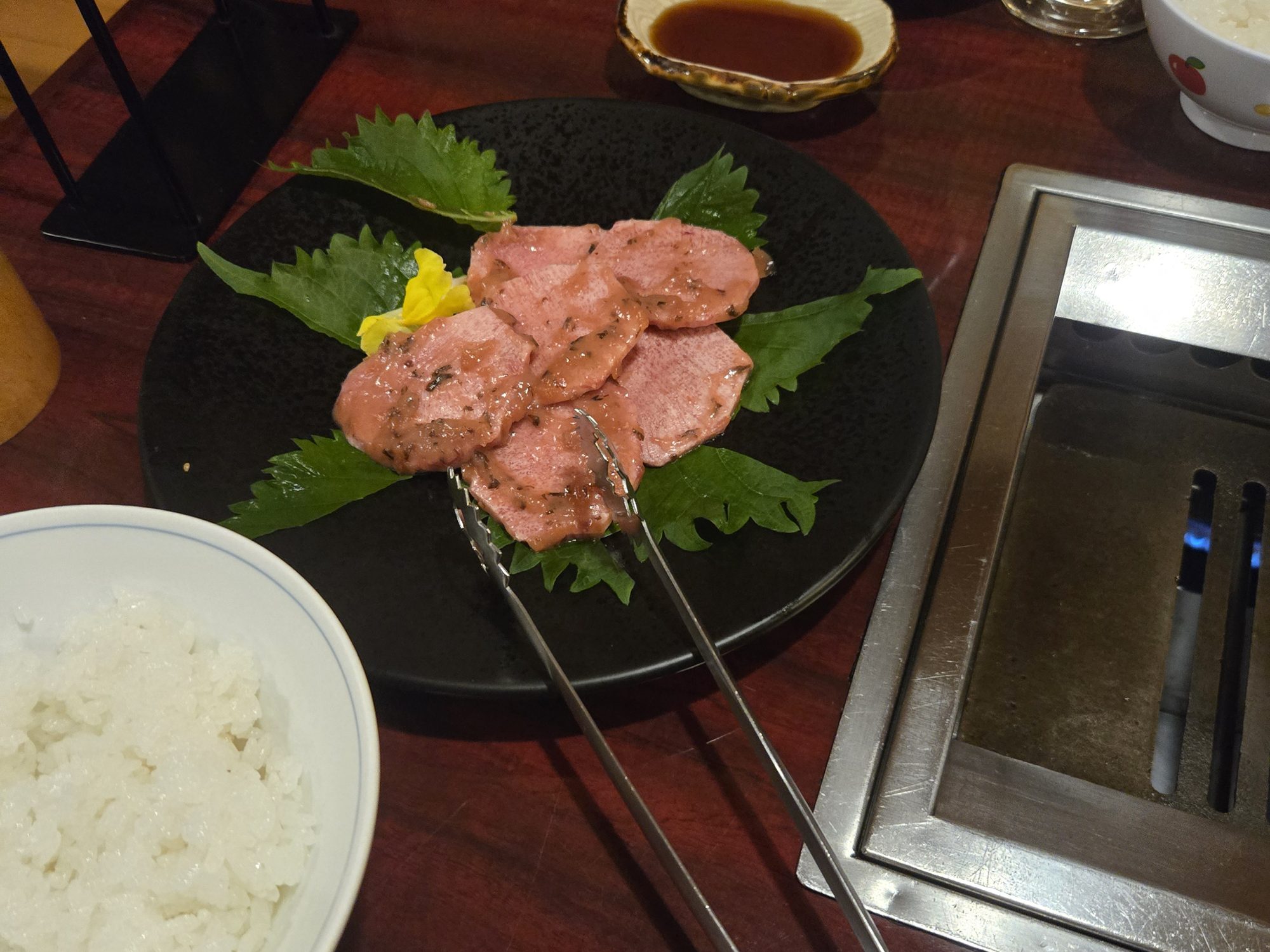
What a recent evening at Rashomon looked like. On a Friday in October 2026, one of us took our 4-year-old twins there just after 6:30pm without a reservation. The tables at the front were full of office workers, but the zashiki area at the back tends to be kept for families with kids, and that evening it also had a family with a baby of about one and a family with two elementary-school-age kids. Staff bring kids’ plates, spoons, and forks if you ask. Each table has scissors, which helps more than it sounds: you grill the meat yourself, then cut it into small pieces for the kids right at the table. We ordered ume tan-shio (salted beef tongue with plum), premium kalbi, premium loin, harami, liver, rice, a green onion jeon (a Korean-style savory pancake), Korean seaweed, and kimchi. The jeon is a big portion, and the three of us couldn’t finish it. The staff are used to kids and answered ours kindly when they chatted to them. A small jelly dessert comes with the meal, so let staff know when you’ve finished eating, and at the register kids get candy and adults get gum.
Tempura: A Calmer, Mid-Range Sit-Down Option
Tempura restaurants split into two tiers that look similar from outside but aren’t the same category of dinner:
-
Fast tempura-rice-bowl chains (tendon shops) serve a bowl of rice topped with tempura, ordered at a counter or ticket machine, over in twenty minutes; closer to the quick-dinner tier this guide is one step above, and a fine backup on a night you don’t want the slower format.
-
Sit-down tempura restaurants serve a fixed course, piece by piece, at a table or counter, with the meal built around pacing rather than speed; this is the format worth booking when you actually want an evening out.
What a family-friendly sit-down tempura dinner looks like, even with a baby
A real, verifiable example: Aoi Marushin in Asakusa, a long-established tempura restaurant a few minutes from Sensoji, lists both tatami-floor and table-style private rooms on its own site, plus a children’s dish option on the menu. Its standard tempura teishoku (set meal), an appetizer, an assortment of tempura, soup, rice, and pickles, runs ¥2,600, with a premium version at ¥4,000 and a couple of other set formats in between (a kakiage-topped rice bowl set at ¥3,200, a sushi-and-tempura set at ¥3,500). The restaurant also offers a full kaiseki-style course from ¥6,500 up to ¥12,000 for a more elaborate meal; that tier leans closer to a celebration dinner than an everyday one, while the ¥2,600–4,000 set-meal tier is the one that matches an ordinary family evening out.
The format works at ages well below “old enough to eat tempura,” too. Our own family took our twins to Tsunahachi, the tempura restaurant at Takashimaya, when they were under a year old and not yet eating solid food; the restaurant made room beside the table for the double stroller, and both kids slept through the entire meal while we ate a full course. A quiet, seated, piece-by-piece format turns out to suit a sleeping baby better than a livelier restaurant would.
One other long-established option worth knowing about for the same reasons is Sansada near Kaminarimon Gate. Its official site lists banquet-hall seating and smaller private rooms, though seat reservations generally run from 16:00 and a private room typically requires a minimum order plus a service charge; confirm the current room type, timing, and children’s options when booking.
The general pattern holds beyond Asakusa too: a casual tendon (tempura-rice-bowl) chain meal is priced close to a quick lunch, well below this guide’s sit-down tier, while a proper sit-down tempura course runs from roughly ¥2,600 at the accessible end past ¥10,000 at a well-regarded specialist restaurant. Check which tier a specific restaurant falls into before booking it as a family dinner; private-room availability is common enough at family-oriented shops in the sit-down tier to be worth specifically filtering for, and it’s worth asking about stroller space at the table if you’re bringing a baby who’s still napping through mealtimes.
Finding a Restaurant With a Private Room or Booth Seating
This matters more in Tokyo than it might elsewhere, for a specific reason: a large share of independent Japanese restaurants, a small ramen counter, a family-run tempura shop, a tucked-away izakaya-style yakiniku spot, are built around counter seating or tightly-packed small tables, genuinely close quarters by the standards a family used to a booth back home would expect. A restaurant that’s a great choice for two adults on a date can be a real squeeze for four people, a stroller, and a toddler who needs room to fidget.
The terms worth knowing
-
Koshitsu: a fully private room, either Western table-style or tatami floor seating, usually behind a door
-
Han-koshitsu: a semi-private booth, partitioned from the main dining room but not a fully enclosed room, a useful middle ground, often with no extra room charge
-
Zashiki: a tatami floor-seating area, which may or may not be behind a door; ask specifically if you want a private one
-
Tēburu-seki: standard table seating, the term to ask for if you’d rather not sit on the floor with young kids
How to actually search for one
Booking platforms treat “private room” as a real, filterable feature, not something you have to dig for in photos. Tabelog, Hot Pepper Gourmet, and Ikyu.com Restaurant all let you combine a private-room filter with a kids/family filter directly in the search; for example, Tabelog’s own combined private-room-and-kids-OK search for yakiniku restaurants in Tokyo returns results specifically matching both conditions at once, rather than requiring you to check each listing individually.
Practically, this means: don’t rely on a restaurant’s general reputation or a generic “family-friendly” tag; search specifically for koshitsu or han-koshitsu alongside a kids-related filter, and check the listing’s own seating photos before booking, since “private room” can mean anything from a full tatami suite to a curtained-off table for four.
For the mechanics of actually completing a booking once you’ve found a restaurant, including which platforms work without reading Japanese, see our How to Book Restaurants in Japan guide.
What Kids’ Set Availability Looks Like
A kids’ set meal, okosama setto in Japanese, isn’t a universal menu item the way a kids’ meal is at a Western chain restaurant. It’s common at family-oriented yakiniku and tempura chains, inconsistent at independent restaurants, and essentially guaranteed at neither format by default. What you’ll actually find varies:
-
Yakiniku chains are the most consistent: Gyu-Kaku, Anrakutei, and similar chains all carry either a dedicated kids’ set or a menu of individually-priced kids’ dishes, as covered above.
-
Sit-down tempura restaurants are hit-or-miss. Aoi Marushin lists a children’s dish option, but this isn’t guaranteed at every tempura restaurant, especially smaller, more traditional shops built primarily around an adult tasting-course format.
-
Independent restaurants generally may or may not have one; it’s genuinely worth asking rather than assuming either way.
How to check or ask before you go:
-
Search booking platforms for a “kids’ menu available” filter, alongside your private-room search.
-
Call or message ahead and ask directly whether they have a kids’ set. You can ask this in English at most family-oriented chains, or use the phrase “Okosama setto wa arimasu ka?” if you’d rather ask in Japanese: it’s a completely normal question, since Japanese families ask the same thing when booking.
-
If there’s no dedicated kids’ set, ask whether a smaller portion or a shared adult dish is possible. Some restaurants used to family diners will accommodate this even without it being on the printed menu, but it’s not guaranteed, especially at a restaurant built around a fixed course.
Reservation Norms for This Tier of Dinner
Unlike a quick dinner where walking in unannounced is completely normal, this tier leans more toward advance booking, for a practical reason: private rooms and family-sized tables at popular restaurants are a limited resource, and they’re the first thing to be reserved on busy nights.
-
Private rooms at yakiniku and tempura restaurants are frequently reserved in advance, particularly tatami-floor and larger family rooms; these suit the group sizes and occasions (birthdays, family gatherings) that tend to book them early, so treat advance reservation as the safer default rather than something you can count on finding open.
-
Standard table seating at chain yakiniku restaurants is more forgiving; many chains take walk-ins for regular tables even when their private rooms are full, so a walk-in strategy is realistic if you don’t specifically need a private room.
-
Traditional, smaller tempura restaurants, the kind with limited seating and a course-based menu, tend to lean most heavily on reservations of everything in this guide, given how little spare seating they carry. Treat these the way our How to Book Restaurants in Japan guide treats any traditional restaurant: book ahead, and mention your children’s ages when you do, since seating type (tatami vs. table) and pricing both depend on it.
If you’d rather not commit to a reservation and just want to be seated quickly, standard-table chain yakiniku is the most walk-in-friendly option in this whole guide.
Common Mistakes
-
Assuming a “private room” is automatically available without booking. Popular yakiniku and tempura restaurants’ private and tatami rooms are a limited, bookable resource, particularly on weekends; reserve ahead rather than assuming you’ll find one open.
-
Handing a toddler the tongs and stepping back. The hot grill surface, and cross-contamination from raw-meat tongs touching food that’s ready to eat, are the two real risks. Have an adult do the grilling, keep raw-meat tongs separate from eating chopsticks, and seat young kids away from the grill rather than right next to it.
-
Assuming any tempura restaurant is the same price bracket. A tendon bowl chain and a sit-down tempura course restaurant both involve “tempura” but sit at very different price points; check which tier a specific restaurant falls into before booking it as a family dinner.
-
Ruling out a sit-down restaurant just because the baby is too young to eat. A quiet, seated tempura course can work well with a sleeping baby in a stroller parked beside the table; it’s worth asking whether there’s room for a stroller rather than assuming the format only works once a child is eating solid food.
-
Skipping the private-room filter and just searching “family-friendly.” That general tag doesn’t guarantee a private room or booth; search specifically for koshitsu or han-koshitsu alongside a kids filter on booking platforms.
-
Assuming every thicker or fattier-looking cut is off-limits for a young child. Whether a cut works depends on how thin it’s sliced and how well it’s cooked at least as much as which cut it is; thin-sliced tongue, for instance, is generally easier to bite through than a thicker cut. Thin slicing doesn’t remove choking risk on its own, though, so cut everything small based on your own child’s chewing ability, and check it’s cooked through, rather than ruling out or clearing cuts by name alone.
FAQ
Is yakiniku safe for young kids, given the hot grill?
Yes, with sensible precautions: keep a young child’s hands away from the grill surface, which stays hot for a while after cooking stops, and have an adult in your group do the actual grilling rather than the child. The other real risk is hygiene, not heat; keep raw-meat tongs separate from the chopsticks anyone eats with, and make sure meat is cooked all the way through before serving it to a young child.
What’s the difference between koshitsu and han-koshitsu?
Koshitsu is a fully enclosed private room, usually behind a door. Han-koshitsu is a partitioned but not fully enclosed booth, more private than the open dining room, often without an extra room charge. Both are worth searching for by name on booking platforms rather than assuming from a “family-friendly” label.
Do yakiniku restaurants have kids’ menus?
Family-oriented chains generally do: Gyu-Kaku prices individual kids’ dishes from ¥198–528 tax included, Anrakutei has a dedicated kids’ yakiniku set for ¥506, and Jyujyu Karubi prices its all-you-can-eat course free for preschoolers and a flat ¥1,099 for elementary-age kids. Smaller independent yakiniku restaurants vary; ask directly if it’s not posted.
How much does a sit-down tempura dinner cost?
It depends heavily on the restaurant tier: a fast tendon (tempura rice bowl) chain is priced closer to a quick lunch than an evening out, while a proper sit-down tempura course restaurant runs roughly ¥2,600–12,000 per adult depending on the course and restaurant, a standard set meal at the lower end of that range, a fuller kaiseki-style course at the top. Check which tier you’re booking before assuming a price.
Can we take a baby who isn’t eating solid food yet to a sit-down dinner?
Yes, and a tempura course is a particularly good fit for it. Our own family took our twins to a sit-down tempura restaurant under a year old, had the restaurant make room beside the table for the stroller, and ate a full meal while both kids slept through it. Ask about stroller space when you book.
Do we need to reserve a private room in advance?
For a weekend or a group that specifically wants a tatami or family-sized private room, yes; these are a limited resource at popular restaurants and tend to get reserved early. A standard table at a chain yakiniku restaurant is far more walk-in-friendly if a private room isn’t essential to your evening.
What cuts of yakiniku meat are easiest for kids?
Thin-sliced kalbi or chicken are common starting points; one restaurant’s published kid-friendly guide describes kalbi as moderately fatty but tender, and thin-sliced tongue as easier to bite through than a thicker cut. Thin slicing helps, but it doesn’t remove choking risk on its own, so judge by your own child’s chewing ability, cut everything small, and check it’s cooked all the way through, whatever cut you choose.
Should we do the grilling ourselves, or can staff do it for us?
The realistic default is that an adult in your group does the grilling and serves the kids’ plates; that’s simply how most families manage the format, ours included, and it keeps young hands away from the hot surface without relying on anyone else. At some restaurants, particularly smaller family-run ones, staff may be willing to help if you ask, but don’t count on it as standard service everywhere.
Plan Your Japan Trip
Also useful:
-
Sitting Down for Lunch in Tokyo with Kids: Ramen, Teishoku & More
-
How to Book Restaurants in Japan When You Don’t Read Japanese
-
Quick Lunches in Tokyo with Kids: Gyudon, Udon & Food Courts
Information checked: 2026/10