

TL;DR
-
Our own family celebrates almost entirely at lunch, not dinner, and it’s the single biggest thing that makes “special and kid-friendly” possible at once. Lunch courses at the same restaurants that run an intimidating-looking dinner menu are often dramatically cheaper, less formal, and easier to book, and every restaurant below is one we’ve actually taken our kids to over lunch for a birthday or anniversary
-
The age-based approach that’s worked for us: at 0, bring the stroller inside and let the baby sleep through the meal; at 1, order from the adult menu and let the baby try a little of what’s soft enough to eat; from 2, order an actual kids’ menu. Nearly every restaurant we asked was willing to work with this once we explained the situation when booking, which is really the core lesson: call and ask rather than assume a restaurant is or isn’t an option
-
This is the “we’re celebrating something” dinner, one tier above a normal nice dinner out. For an everyday sit-down dinner with kids, yakiniku, tempura, a solid neighborhood restaurant, see our Sitting Down for Dinner in Tokyo with Kids guide instead; this one is specifically for a birthday, an anniversary, or a “we only get one night (or lunch) like this” occasion
-
Kaiseki age policy genuinely varies by restaurant, not just by “how fancy it is.” At Hotel Chinzanso Tokyo’s Miyuki, a real kaiseki, sushi, and teppanyaki restaurant with 72 seats and 5 private rooms, the sushi counter at dinner is restricted to guests 7 years and older, while the same restaurant separately sells a children’s kaiseki-style bento (¥3,800 for preschool–lower elementary, ¥5,400 for upper elementary) at table and private-room seating. One restaurant, two different rules depending on which seat and menu you book. By contrast, kaga-kaiseki ryotei Akasaka Asada, which our own family has used for a lunchtime celebration, offers 11 fully private tatami rooms and explicitly markets plans for milestones like Okuizome (a baby’s first rice-eating ceremony) and Shichi-Go-San
-
Teppanyaki gives a kid something to actually watch, which a quiet multi-course kaiseki meal doesn’t. The food is cooked and often narrated at your own table rather than served in a sequence of small, formally presented courses. Our own family has used the counter at Mikasa Kaikan’s Ginza flagship teppanyaki restaurant, Yamato, for a lunchtime celebration with a 3-year-old, and the live cooking is exactly what held their attention through the meal
-
Chinese restaurants are a genuinely overlooked option for this tier, and two we’ve used ourselves show why. Keio Plaza Hotel’s Cantonese restaurant Nanen has a ¥3,800 kids’ set and 7 private rooms, and let us bring a stroller in for our 1-year-old when we asked; Reika Seirankyo near Gaienmae is a quieter, upscale option for a couple’s anniversary with kids along. Neither gets mentioned as often as kaiseki or teppanyaki in most guides to this tier, despite being genuinely workable with young kids
-
Private rooms are the practical answer to “can we get both, special and kid-friendly.” Grand Hyatt Tokyo’s teppanyaki restaurant Keyakizaka has one private room (Kurumi, up to 6 guests, plus a room charge); Hotel Chinzanso’s Miyuki has 5 rooms seating 2–10; ANA InterContinental Tokyo’s Japanese restaurant Unkai has 8; Akasaka Asada has 11. A private room removes two specific frictions of a shared dining room with kids, other diners’ reactions to noise, and your own awareness of being watched
-
A kids’ course menu at an upscale restaurant is not the same thing as kids being welcome at every seat in the restaurant. Confirm which specific seating (counter vs. table vs. private room) your child’s age is cleared for; don’t assume a hotel’s general “kid-friendly” reputation applies to every room inside it
Why This Is a Different Question Than “Where to Eat Tonight”
A regular family dinner out and a celebration dinner (or lunch) solve for different things. For a regular night, the question is mostly logistics: can we get seated quickly, is there something the kids will actually eat, is it not too loud. Our Sitting Down for Dinner in Tokyo with Kids guide covers that ground.
A celebration meal adds a harder constraint: it has to feel special, and it has to actually work with kids at the table. Those two goals can be in real tension in Tokyo specifically, because a meaningful share of the city’s most “special occasion” dining, quiet, multi-course kaiseki restaurants with expensive tableware and a handful of counter seats, is built around an adults-focused pace and atmosphere that some restaurants simply don’t extend to young children, while others genuinely do. The rest of this guide is about telling those two apart before you book, not after you arrive, and about the one shift that made the biggest practical difference for our own family: doing it at lunch.
How Our Own Family Actually Does This
Every restaurant in this guide’s “real examples” is one our family has actually taken our kids to for a birthday or anniversary, and in every single case it was lunch, not dinner. Lunch courses at the same restaurants that run an intimidating dinner menu are usually a fraction of the price, less formal, and considerably easier to book on short notice, and none of the age-appropriate flexibility below has ever required a restaurant we specifically sought out for being “kid-friendly.” It’s come from asking.
The approach that’s worked consistently as our kids have grown:
-
At 0 years old, we’ve asked the restaurant to let us bring the stroller in with the baby asleep inside, and eaten a full course while they slept through the whole thing. This has worked at a sushi restaurant, a Cantonese restaurant, and a kaiseki ryotei, none of which advertise themselves specifically as baby-friendly.
-
At 1 year old, we’ve ordered from the regular adult menu and let the baby try small amounts of whatever was soft enough to eat, rather than expecting a dedicated kids’ course to exist yet.
-
From 2 years old, restaurants have generally had, or been willing to put together, an actual kids’ menu, and that’s what we order.
The restaurants we’ve used this way include a teppanyaki counter (Yamato, at Mikasa Kaikan’s Ginza flagship, when our kids were 3), a sushi restaurant with a private room near Shinjuku Gyoen (Takumi Tatsuhiro, when our kids were newborns), a soba restaurant serving omakase courses also near Shinjuku Gyoen (Hanazonocho Yabe), a kaga-kaiseki ryotei in Akasaka (Akasaka Asada, at age 2), a Chinese restaurant near Gaienmae (Reika Seirankyo), and Keio Plaza Hotel’s Cantonese restaurant Nanen (at age 1). None of them turned us away or made the visit feel improvised; every one of them simply asked what we needed and worked with it once we called ahead and explained. That’s the pattern worth taking from this section more than any specific restaurant name: ask directly, rather than guessing from a restaurant’s general reputation.
Best Options: Matching the Occasion to the Format
| Your situation | Lean toward | Why |
|---|---|---|
| Baby who isn’t eating solid food yet, any occasion | Whichever format you’d otherwise choose, at lunch | Ask the restaurant to make room for the stroller and let the baby sleep through the meal; our own family has done this at a sushi restaurant, a kaiseki ryotei, and a Cantonese restaurant, and none of them treated it as unusual once asked |
| Toddler or preschooler, any occasion | Teppanyaki, in a private room if the budget allows | The live cooking show holds a young kid’s attention in a way a slow multi-course kaiseki meal generally doesn’t; a private room removes the worry about other diners |
| Elementary-age kids, milestone birthday | Hotel Japanese restaurant with a dedicated kids’ course (kaiseki-style or teppanyaki) | Several hotel restaurants sell a genuine kids’ tasting menu at this age rather than a plain kids-plate; ask specifically when booking |
| A couple’s anniversary, kids along because there’s no sitter | A Cantonese restaurant with a kids’ menu and private room, or a view restaurant confirmed as no-age-restriction | Keio Plaza’s Nanen and similar Chinese restaurants read as genuinely special for the adults without requiring kids to sit through a slow-paced multi-course meal |
| A couple’s anniversary, want it to feel like date night | Book the sitter and go without the kids, if kaiseki or a quiet counter-seat restaurant is the goal | Some of Tokyo’s best “special occasion” dining is built around a quiet, adults-paced experience that a young child won’t enjoy either; better as a date night than a family outing |
| Extended family celebration (grandparents included) | A private tatami room at a kaiseki ryotei with a kids’ course | A ryotei like Akasaka Asada, with 11 private rooms, solves seating, noise tolerance across generations, and a menu that works for both a toddler and a grandparent in one room |
| Budget-conscious but want it to feel special | Any of the above, at lunch instead of dinner | This is the single biggest lever: the same restaurants that run an expensive, formal dinner course often price lunch dramatically lower, with a shorter, more toddler-friendly course length |
If your situation doesn’t map cleanly onto one row, a family with both a toddler and a 9-year-old is the common case, teppanyaki in a private room is a reasonable default: it doesn’t carry the counter-seat age restrictions that show up at some kaiseki restaurants, and a private room works for both ends of the age range at once.
Kaiseki with Kids: The Real Rules
Kaiseki, Japan’s traditional multi-course meal built around seasonal ingredients served in a deliberate sequence, is genuinely a mixed bag for families, and it’s worth being upfront about that rather than pretending every kaiseki restaurant works with kids.
Some restaurants restrict young children, and it’s not arbitrary
Age limits, stroller access, dress expectations, and private-room rules are set by each restaurant. Check the restaurant’s own booking page before paying a deposit, and contact it directly when the wording only says “children welcome” without defining ages or seating conditions.
This isn’t universal, and it isn’t only about preschoolers specifically; it varies restaurant to restaurant and often by seat type within the same restaurant. At Hotel Chinzanso Tokyo’s Miyuki, a kaiseki, sushi, and teppanyaki restaurant with 72 seats and 5 private rooms, the sushi counter specifically is restricted to guests 7 and older at dinner, a narrower, seat-specific rule, not a blanket ban on children in the restaurant, according to the restaurant’s own page.
Which venues genuinely do welcome families
The honest counterpoint: a real slice of Tokyo’s kaiseki-tier dining is set up specifically for families, and not only inside large hotels. Hotel Chinzanso Tokyo publishes an official kid-friendly hotel page, and at Miyuki specifically, the same restaurant with the 7-and-up sushi counter above, the kids’ menu is a proper multi-course children’s bento: ¥3,800 for the “Kibo” tier, aimed at preschool through lower-elementary kids, or ¥5,400 for the “Hikari” tier, for upper-elementary kids, each built around a small course sequence, hamburger, tamagoyaki, tempura, and a sushi selection, plus a rice-and-miso course, not a plain kids’-plate afterthought.
Our own family’s experience at Akasaka Asada, a kaga-kaiseki ryotei with roots going back to 1659, points the same way from a different kind of restaurant: it isn’t part of a hotel, and it still runs 11 fully private tatami rooms and explicitly plans for family milestones (its own booking pages offer plans for occasions like Okuizome and Shichi-Go-San, alongside birthdays). We took our own 2-year-old there for a lunchtime celebration and ordered from the adult menu at that age, and the private room made the noise question a non-issue. Weekday lunch at Akasaka Asada starts from ¥7,700 per adult for its multi-tier bento course, plus a service charge and, if you’re in a tatami room, a room charge, but that’s still well below its dinner course pricing, which is part of why we, and presumably other families, gravitate toward lunch here specifically.
Beyond specific restaurants, the split shows up at platform level. Ikyu.com, a reservation platform covering a large share of Japan’s higher-end restaurants, lets you filter Tokyo restaurants by two separate categories: “infants welcome” and “elementary-school age and up only.” That filter existing at all is a useful confirmation: this split is a real, bookable category on the platform rather than something true of only the specific restaurants named above, and checking it before you fall in love with a specific restaurant saves a disappointing phone call later.
The practical takeaway: don’t assume either way. A kaiseki restaurant built around family milestones, whether a hotel restaurant or an independent ryotei like Akasaka Asada, is a meaningfully different bet than a small, independent, counter-seat-only shop, and even within one restaurant, one seat type (a sushi counter, for instance) can carry a different age rule than the table seating a few meters away.
What a Japanese family is often actually celebrating at one of these dinners
Part of why hotel kaiseki restaurants and ryotei like Akasaka Asada build kids’ menus and private rooms this specifically is that they’re not just hosting birthdays; Japan has its own set of family milestones that regularly bring three generations to a private dining room together, and knowing they exist explains a lot of what you’ll see on a restaurant’s plan list. Hotel Chinzanso’s Miyuki, for instance, sells a randoseru gratitude ceremony plan: a formal little ceremony, held in a private kaiseki room, where the grandparent who traditionally gifts a child’s first school backpack (randoseru, for the start of elementary school) presents it to the child in front of a gold folding screen, the child says thank you, the family takes a photo, and everyone receives a wooden ema (prayer plaque) to dedicate at the hotel’s on-site shrine, priced at ¥19,000 per adult (minimum 4 adults) plus the ¥3,800/¥5,400 children’s bento. Akasaka Asada’s own plan list runs a similar logic around occasions like Okuizome (a baby’s first rice-eating ceremony) and Shichi-Go-San.
None of this means you need a specific ceremony to book a table; most guests at these restaurants are there for an ordinary birthday or anniversary. But it’s a useful signal for what “special occasion dining with kids” actually covers in Tokyo: these restaurants aren’t retrofitting an adults’ format for children, they’re built to host a wider range of family milestones than “birthday dinner” alone, which is part of why the infrastructure, private rooms, dedicated kids’ courses, photo-friendly staging, tends to be more developed here than at a comparable Western fine-dining restaurant.
Teppanyaki: The More Kid-Engaging Choice
Teppanyaki, steak, seafood, and vegetables grilled in front of you on a flat iron griddle, usually by a chef narrating the cooking as part of the meal, solves a problem kaiseki doesn’t: it gives a kid something to actually watch and react to for the length of the meal, rather than asking them to sit quietly through a sequence of small, formally presented courses. Our own family has taken this route with a 3-year-old at the counter of Yamato, Mikasa Kaikan’s teppanyaki restaurant at its Ginza flagship, over lunch, and the live cooking held their attention through the whole meal in a way we hadn’t managed at a quieter restaurant at the same age. That particular location is built around counter seating rather than private rooms; Mikasa Kaikan’s Azabu-Juban branch of the same restaurant offers table seating and a private room as well, if that matters more for your group.
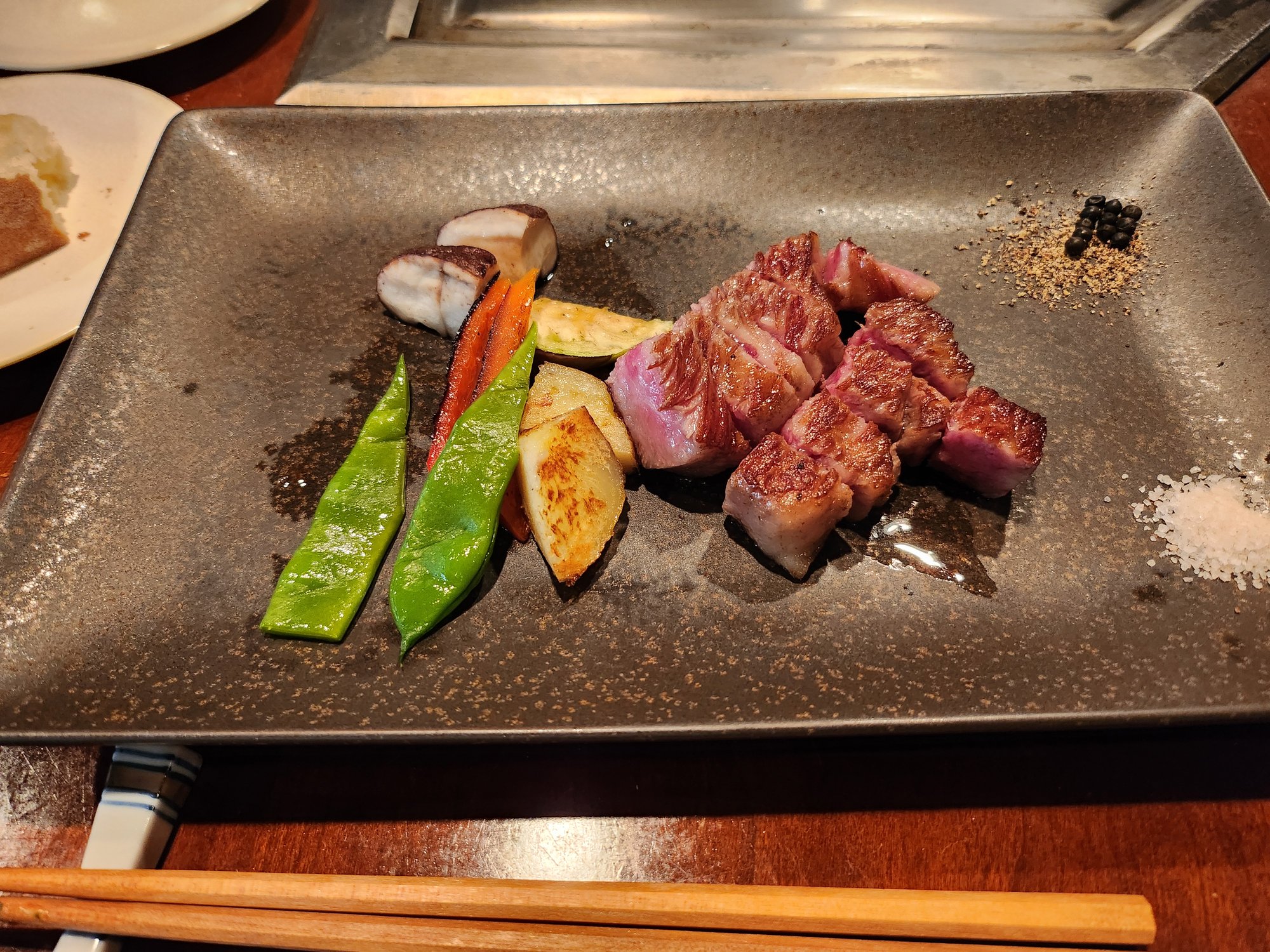
This shows up in how some hotels build these rooms, too. Grand Hyatt Tokyo’s teppanyaki restaurant Keyakizaka has one private room, Kurumi, seating up to 6, with its own teppanyaki table and a separate room charge (¥7,700 at lunch, ¥15,400 at dinner), and Hotel Chinzanso’s Miyuki (which also runs a teppanyaki menu alongside its kaiseki and sushi service) has 5 private rooms seating 2 to 10. The exact private-room inventory varies a lot by restaurant, from one room to several, so it’s worth checking the specific number and capacity rather than assuming.
Unlike a sushi or kaiseki counter, we didn’t find teppanyaki restaurants in this tier publishing the kind of explicit minimum-age rule Hotel Chinzanso’s Miyuki states for its sushi counter, which isn’t proof no teppanyaki restaurant restricts young kids, just that it doesn’t appear to be the norm the way it is at some sushi and kaiseki counters. Confirm directly when you book rather than assuming either way.
A hot griddle close to the seating is still worth a moment’s thought if your child is at the age of grabbing things or doesn’t sit still; ask about seating distance and whether a private table is available, rather than assuming counter seating is the only option.
Chinese Restaurants: The Overlooked Option
Most guides to celebration dining in Tokyo jump straight to kaiseki, teppanyaki, and hotel view restaurants, and skip Chinese restaurants entirely, which is a gap, because two of the restaurants our own family has actually used for a celebration fall into exactly this category.
Keio Plaza Hotel’s Cantonese restaurant, Nanen, has been open since the hotel itself opened in 1971, and it runs a genuine kids’ set (¥3,800) alongside table seating and 7 private rooms, so a small child doesn’t have to disrupt the rest of the dining room. We took our own 1-year-old there, brought the stroller in, and ordered a small amount for them alongside the adult menu; the restaurant handled it without any friction. Ask about stroller access and same-day kids’ orders when you book, since our experience is one data point, not a published house policy.
Reika Seirankyo, a couple of minutes’ walk from Gaienmae Station, is a quieter, more upscale choice built around Shanghai-influenced modern Chinese cuisine, with both fully private rooms and a spacious main floor available. It reads as genuinely special for a couple’s anniversary without the slow, formal pacing of a kaiseki restaurant, and our own family has used it for exactly that kind of occasion.
Neither restaurant markets itself primarily as “family-friendly” the way a hotel kaiseki restaurant sometimes does, which is likely part of why this category gets overlooked in most English-language guides to this tier. Asking directly about a kids’ menu, stroller access, and private-room availability, the same approach that works everywhere else in this guide, has worked at both.
View Restaurants: The Adults-Feel, Kids-Along Option
A restaurant with a real city view, a high hotel floor, most commonly, solves the “make it feel special” problem without leaning on either kaiseki’s formality or teppanyaki’s theater. The atmosphere itself does the work.
Park Hyatt Tokyo’s New York Grill, on the 52nd floor, illustrates what this looks like on paper: the hotel’s own restaurant FAQ states no age restriction applies to its restaurants, while its bars restrict guests under 20. If seating location matters, add the request when booking, but treat it as a preference rather than a guarantee.
Other hotel view restaurants likely follow a similar logic; a high floor and a view do a lot of the “special occasion” work on their own, which can make the actual food format underneath more relaxed than a ground-floor kaiseki restaurant at a comparable price. That’s a reasonable expectation rather than a confirmed rule across every property, though, so the same question applies as everywhere else in this guide: call and confirm the age policy and seating options for the exact time slot you want, rather than assuming a hotel’s general family-friendly reputation extends to every one of its restaurants.
Kids’ Courses and Private Rooms: How to Actually Get Both
The restaurants that solve “special and kid-friendly at once” tend to share two features, and it’s worth asking about both specifically when you call:
- A dedicated kids’ course, not a simplified kids’ plate. Hotel Chinzanso’s Miyuki bento (¥3,800/¥5,400, described above) is one real example; ANA InterContinental Tokyo’s Unkai sells its own celebration-specific children’s set meal, priced at ¥8,800 per person, as part of a dedicated celebration plan rather than its everyday menu. Ask whether a restaurant has something like this, and at what age it starts, since it’s often built for early-elementary age and up rather than toddlers. Our own experience suggests it’s just as normal to skip this entirely at younger ages: order from the adult menu at 1 year old, and let the kids’ menu question wait until it’s actually relevant.
- A private room (koshitsu), or a semi-private one, booked specifically, not assumed. A private room is what actually resolves the tension between “special” and “kid-friendly”; it removes two specific frictions of a shared dining room with kids, other diners’ patience, and your own awareness of being watched. Private-room inventory varies a lot by restaurant, Keyakizaka has one (Kurumi, up to 6 guests), Miyuki has 5 (seating 2–10), Unkai has around 8 (a mix of tatami and table private rooms), and Akasaka Asada has 11, so request one by name when you book and confirm the capacity, rather than assuming a “private room” means the same thing everywhere. Expect it to cost more or carry a minimum spend.
If you want a birthday plate, a dessert with a message, or a small in-room celebration touch, ask when you book, not when you arrive. Park Hyatt Tokyo’s restaurant FAQ, for instance, states it can prepare a celebration cake with 3 days’ notice, a concrete example of how much lead time to plan for, though its policy on outside food is otherwise narrow (it permits brought-in baby food for small children, but doesn’t address outside cakes or flowers one way or the other). Treat “can we bring our own cake” as a question to ask each specific restaurant rather than something to assume is fine.
Reservation Etiquette at This Tier: What’s Different From a Normal Booking
Our How to Book Restaurants in Japan guide covers the general mechanics, which platforms work without Japanese, how to use a hotel concierge, what to write in a booking email. Two things specifically shift once you’re booking a celebration-tier restaurant rather than a casual one, on top of that general advice:
A confirmed online booking isn’t always instant here. A portion of higher-end restaurants on Ikyu.com run what the platform calls a “request reservation” rather than instant confirmation; the restaurant reviews your request and confirms afterward, sometimes by phone. It’s a lighter version of the phone-call etiquette this tier has traditionally run on. Not every restaurant at this level works this way, so don’t assume a booking is locked in until you see an actual confirmation.
Cancellation policies tend to be stricter, and it’s worth checking the specific terms rather than assuming a casual restaurant’s more forgiving norms apply. One commonly cited example fee structure for course-based dining runs free up to about 7 days out, 30% at 3 days out, 50% the day before, and 100% on the day of, but the exact tiers are set by each restaurant, not standardized. For context on the stakes involved: Japan’s restaurant industry as a whole is estimated to lose roughly ¥200 billion a year to no-shows and late cancellations, which is part of why this tier generally isn’t casual about the policy, though the specific percentages above are an illustrative example, not a rule you can assume applies to any given restaurant.
The one thing worth adding to whatever booking method you use from our general guide, and the single most useful thing our own family has learned from doing this repeatedly: say your children’s ages up front and ask specifically whether there’s an age restriction for the seating you want, whether lunch pricing and courses differ from dinner, whether a kids’ course is available, and whether a private room can be arranged. As the kaiseki section above shows, the same restaurant can carry different rules for different seats, and a hotel’s general “family-friendly” reputation doesn’t guarantee every restaurant inside it follows the same policy. In our experience, restaurants that aren’t marketed as family-oriented at all have still said yes once asked directly.
Common Mistakes
-
Assuming this has to happen at dinner. Lunch courses at the same restaurants are routinely cheaper, shorter, and easier to book than dinner, and it’s how our own family has done nearly every celebration meal in this guide. If a restaurant’s dinner menu looks intimidatingly formal, check its lunch offering before ruling it out.
-
Assuming any kaiseki restaurant will be fine with a toddler because “it’s just a nice dinner.” Some genuinely restrict young children by seat type or age, for reasons the restaurant itself will usually explain if you ask (breakable tableware, a quiet room shared with other paying guests). Call ahead and ask specifically, rather than finding out at the door.
-
Booking a counter seat by default. Sushi and some teppanyaki counters are exactly the seating type most likely to carry an age restriction (Hotel Chinzanso’s Miyuki sushi counter, for one concrete example, is 7-and-up at dinner); a table seat or private room in the same restaurant may have a completely different rule.
-
Not asking about a private room until it’s already fully booked. Private rooms at this tier are genuinely limited inventory, from just one room (Grand Hyatt’s Keyakizaka) to a handful (5 at Miyuki, 8 at Unkai, 11 at Akasaka Asada), and they’re one of the most reliable ways to make a celebration meal both special and kid-workable. Ask when you first call, not as an afterthought.
-
Overlooking Chinese restaurants entirely. Kaiseki and teppanyaki get most of the attention in guides to this tier, but a Cantonese restaurant like Keio Plaza’s Nanen can offer a real kids’ set and private rooms, often with less formality than a kaiseki restaurant, once you ask.
-
Treating a high-end restaurant’s cancellation policy like a casual restaurant’s. A no-show or late cancellation at this tier can cost 50–100% of the course price per person, not a token fee. If your plans are genuinely uncertain, ask about the specific cancellation window before you commit, or choose a restaurant with a more flexible policy.
-
Assuming a hotel’s general “kid-friendly” branding covers every restaurant inside it. A hotel can genuinely welcome families at its casual dining room and still run a stricter age policy at its flagship kaiseki or sushi counter restaurant. Confirm per restaurant, not per hotel.
FAQ
Can we bring a toddler to a kaiseki dinner in Tokyo?
It depends entirely on the restaurant, and sometimes on which seat within it. Some kaiseki restaurants, especially small independent ones with counter seating, restrict young children; others, including hotel-based kaiseki restaurants and independent ryotei like Akasaka Asada, actively welcome families and sell dedicated kids’ courses or offer private tatami rooms. Ask about the specific seating and age policy when you book rather than assuming either way, and consider lunch, which tends to be cheaper and more toddler-friendly in length than dinner.
Is it better to book lunch or dinner for a celebration with young kids?
For our own family, lunch has been the clear default. The same restaurants that run a formal, expensive dinner course often price lunch significantly lower, with shorter courses and a more relaxed atmosphere, and it’s how we’ve managed celebrations with kids from age 0 through toddlerhood without the meal feeling rushed or out of place.
What age do kids need to be for a sushi or kaiseki counter?
There’s no single national rule, and it genuinely varies by restaurant. As one concrete example, Hotel Chinzanso Tokyo’s Miyuki restricts its dinner sushi counter to guests 7 and older, while still offering table seating and a kids’ course for younger children elsewhere in the same restaurant. Always confirm the specific restaurant’s policy directly.
Is teppanyaki a safer bet than kaiseki for a young child?
It’s often an easier fit, in the sense that the live cooking at the table gives a young kid something to watch rather than asking them to sit quietly through a sequence of small courses. Our own experience with a 3-year-old at the counter of Mikasa Kaikan’s Ginza flagship teppanyaki restaurant backs this up: the theater of the grill held their attention through the whole meal. It isn’t automatically calmer, though; you’re seated close to a hot griddle and other diners unless a private room happens to be available at that specific restaurant (not every teppanyaki location has one), so ask about seating specifically.
Are Chinese restaurants a realistic option for a special occasion with kids?
Yes, and they’re worth considering alongside kaiseki and teppanyaki rather than as a fallback. Keio Plaza Hotel’s Nanen has a ¥3,800 kids’ set and private rooms, and accommodated our stroller when we asked; Reika Seirankyo near Gaienmae is a quieter, more upscale option for an anniversary with kids along. Both have worked well for our own family, and neither markets itself specifically as “kid-friendly,” so it’s worth asking directly rather than ruling the category out.
How do we get a private room at a special-occasion restaurant?
Ask for it by name when you first call or email to book; don’t wait until you arrive. Private-room inventory is genuinely limited and varies a lot by restaurant, from a single room at some to around 8–11 at others, so it’s worth asking early, especially for weekends and around holidays.
Do these restaurants take online reservations, or do we need to call?
Many can be found through booking platforms like Ikyu.com or TableCheck, but a real share of higher-end restaurants don’t auto-confirm online the way a casual restaurant does; they run a request-based process where the restaurant confirms afterward, sometimes by phone. Our How to Book Restaurants in Japan guide covers the platforms and email etiquette in detail.
What happens if we need to cancel a celebration dinner reservation?
Expect a stricter policy than a casual restaurant. One commonly cited example structure runs free up to about a week out, then rising in stages (a partial charge a few days before, up to the full course price if you cancel the day of or don’t show), but the exact tiers are set by each restaurant, not standardized, so check the specific policy shown at booking rather than assuming a casual restaurant’s more forgiving norms apply here.
Can we bring a baby who’s still just sleeping through meals?
Yes; this is exactly the situation our own family has handled most often, at a sushi restaurant, a kaiseki ryotei, and a Cantonese restaurant. Ask whether the restaurant can make room for a stroller beside the table, and treat the meal as something you’re doing for yourselves while the baby naps through it, rather than something the baby needs to participate in yet.
Plan Your Japan Trip
Also useful:
Information checked: 2026/09