

At a Glance
| Entry | Free: the park itself, the lawns, and Crystal View · Tokyo Sea Life Park (aquarium): ¥700 adult / ¥250 junior high / free elementary and under · Giant Wheel: ¥800 age 3+ / ¥400 age 70+ |
| Nearest station | Kasai-Rinkai-koen Station (JR Keiyo Line / Musashino Line), about 1 minute to the park entrance, 5–8 minutes’ walk on to the aquarium |
| Getting there | Direct on the JR Keiyo Line: 13–14 min from Tokyo Station, no transfer · from Shinjuku or Shibuya, about 40–50 min with 1 transfer (via Tokyo Station or Shin-Kiba) |
| English support | Mixed: the aquarium has decent English signage; the park itself is more Japanese-only |
| Strollers | Easy across the open park (flat, wide paths) · noticeably tighter inside the aquarium building, where three exhibits involve stairs |
| Baby facilities | Two nursing rooms inside the aquarium (a “mamaro” room on 2F, and a women-only room in the rest house by the main gate), diaper-changing stations throughout |
| Typical visit | Half a day for the park plus the aquarium · a full day if you add the beach, the playground, or pair it with Tokyo Disney Resort (3 minutes away by train) |
Is It Worth It?
Short answer: yes, especially as a cheap, low-effort half day, and the exhibit our kids reacted to most wasn’t the one everyone talks about.
We visited with our twins, and the thing that made the day work was treating it as two separate experiences: a huge, free, stroller-friendly park you can wander at your own pace, and a single indoor aquarium building that’s worth having a rough plan for going in. The famous exhibit (the giant tuna tank) really is impressive. But the moment that actually got a reaction out of our kids was the seabird pool, watching common murres and tufted puffins launch off the rocks, glide for a second or two, and then vanish underwater to “fly” through the water instead of swimming. It’s a strange, wonderful thing to watch a bird do, and feeding time is when it happens. It’s worth timing your visit around rather than stumbling onto by luck.
Kasai Rinkai Park is also large enough that it doesn’t read as “one attraction.” Between the park train, the beach area, the lawns, and the aquarium, we didn’t try to do everything in a single visit, and we’d suggest picking two or three rather than rushing the whole grounds.
By age:
-
0–2 (baby/infant): The park itself (flat paths, open lawns, wide sightlines) is genuinely easy with a stroller. Inside the aquarium, plan to switch to a carrier for a few sections (see Navigating with a Stroller below).
-
3–6 (preschooler): A strong fit. Old enough to enjoy the seabird feeding, ride the park train happily for 25 minutes, and run around the playground or the sloped lawn behind Crystal View.
-
7–10 (primary school): Can handle the walk between zones on foot and take in more of the tuna tank’s backstory: the aquarium is where bluefin tuna were first successfully kept and bred as a shoal in a land-based tank, and that kind of detail lands better with an older kid than a toddler.
What to Expect
The Park Train: The Easiest Way to See the Whole Park
Kasai Rinkai Park is 80 hectares, genuinely too big to casually stroll end to end with young kids. The Park Train, a train-shaped tram, loops the full 3.1 km grounds in about 25 minutes, and we’d recommend riding at least one lap early in your visit: it’s a relaxed way to see the whole layout before deciding where to spend your time on foot, rather than guessing from a map. Adult fare is ¥400 (junior high age and up, under 70), ¥200 for ages 3 through elementary school and for seniors 70+, and free for children under 3. It runs a fixed loop with several stops; you can get off anywhere, though most of what we saw riding was people staying on for the full circuit. It doesn’t run on Wednesdays.
Note that the park itself has no regular closed day, according to the park’s facility information; it’s open year-round. The Wednesday closure applies to individual facilities inside it, like the Park Train and the aquarium, not the grounds.
Tokyo Sea Life Park: the Tuna Tank, and the Real Surprise
The aquarium’s signature exhibit is a 2,200-ton donut-shaped tank where a school of bluefin tuna (kuromaguro) circles continuously: the aquarium’s own materials on the Pacific bluefin tuna describe achieving the first successful land-based group-rearing of bluefin tuna here in 1989, with the first successful in-tank spawning following in 1999. It’s a genuinely impressive thing to stand in front of: the aquarium cites past measurements of up to around 80 km/h for these fish (though it notes estimates vary), and the scale of the tank makes that kind of speed visible.
But the exhibit our kids actually talked about afterward was the seabird zone: common murres and tufted puffins, birds that “fly” underwater rather than just swim. At feeding time, they launch off the rocks, glide briefly through the air, then dive and porpoise around the tank chasing food. It’s genuinely strange and wonderful to watch, and a very different reaction from kids than “big fish going in a circle.” Feeding happens twice a day, according to the aquarium’s seabird feeding schedule, at 11:45 and 16:00, each session running about ten minutes with a keeper talking through what’s happening. The 16:00 slot is close to the aquarium’s last-admission cutoff, so if you’re aiming for that one specifically, don’t leave your visit until the very end of the day.
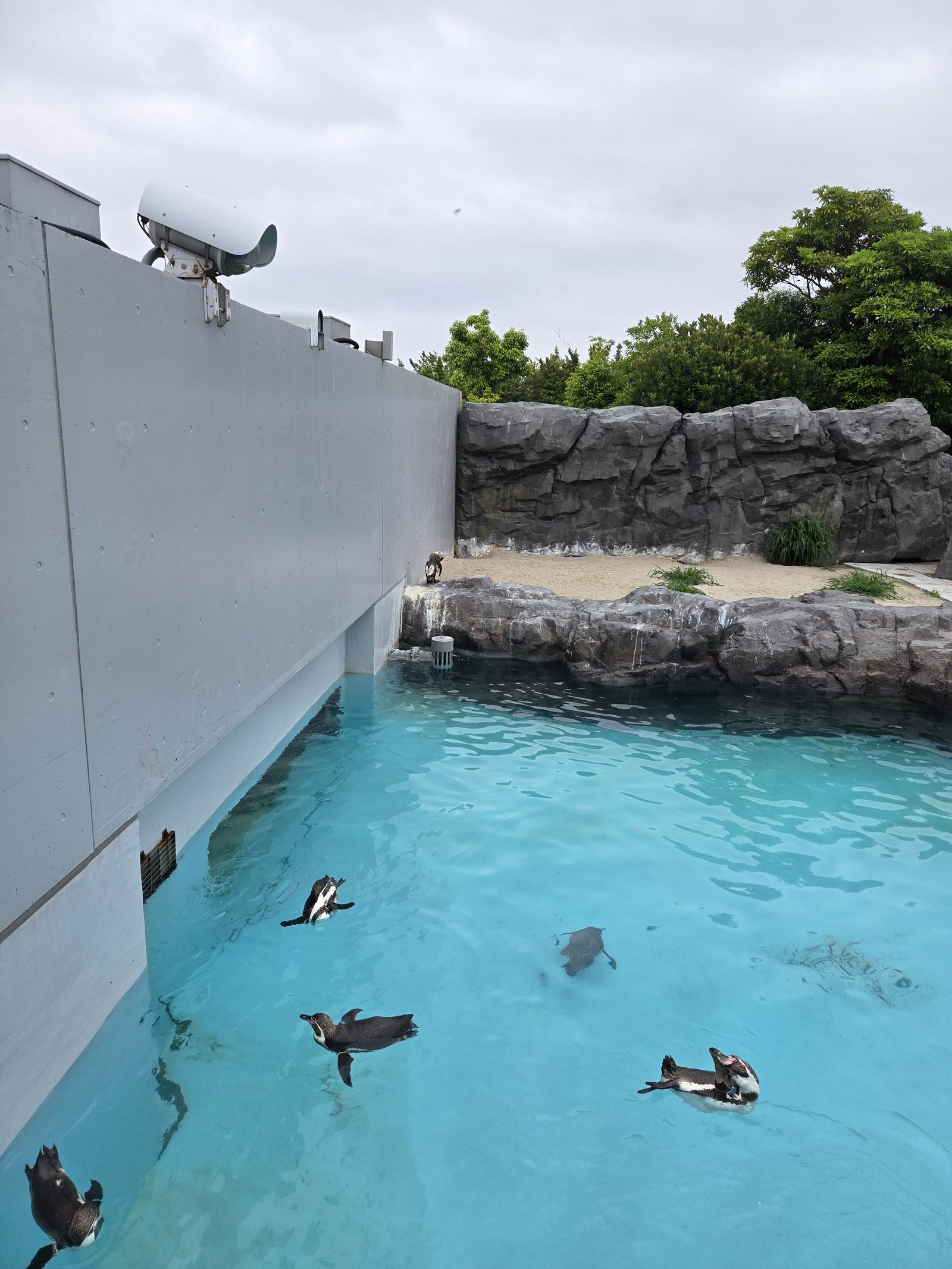
Admission is ¥700 for adults (high school and up), ¥250 for junior high students (free with proof of Tokyo residency or enrollment), ¥350 for 65+, and free for elementary-age children and younger. Hours are 9:30–17:00, with last admission at 16:00. The regular closed day is Wednesday (the following day if Wednesday falls on a holiday), plus the New Year period (Dec 29–Jan 1), but the aquarium opens on some Wednesdays too, so check the official opening-day calendar for your specific date rather than assuming every Wednesday is out.
The Giant Wheel: Still Running
Kasai Rinkai Park also has its own Ferris wheel, the “Diamond and Flower” Giant Wheel, one of the largest in Japan at 117 meters tall (worth flagging because it’s easy to confuse with Odaiba’s Palette Town Ferris wheel, which permanently closed in August 2022 as part of that area’s redevelopment). Kasai’s wheel is a separate ride and is still operating, per the Giant Wheel’s official site: roughly 10:00–19:00 on weekdays and 10:00–20:00 on weekends and holidays, ¥800 for ages 3 and up, ¥400 for seniors 70+. It closes for maintenance on the third Wednesday of most months (all of February, and the fourth and fifth Wednesdays of January instead), shifting to the next day if that Wednesday is a holiday. On a clear day you can see Mt. Fuji and the Tokyo skyline from the top.
Nishi-Nagisa, the Lawn, and Crystal View
Nishi-Nagisa (“west beach” in Japanese), the man-made, bow-shaped beach reached by a footbridge from the main park, is technically part of a separately managed facility, Kasai Kaihin Park, rather than Kasai Rinkai Park itself (worth knowing since its hours and rules differ slightly). It’s open roughly 9:00–17:00 (later on summer weekends), with a barbecue area, an open plaza, and restrooms. Swimming is only permitted in a designated area during the mid-July to late-August “sea bathing” period; outside that window it’s a place to walk on sand and look at the bay rather than get in the water. Higashi-Nagisa (“east beach”), the eastern tidal flat, is a bird sanctuary with restricted public access.
Crystal View, a glass observation rest house designed by architect Yoshio Taniguchi, is free to enter and sits behind a sloped lawn, the Observation Plaza, that’s a genuinely pleasant spot to spread a picnic blanket, throw a ball around, or let kids run down the slope while you take in a view of the whole park.
For younger kids who want more structured play, the western side of the park has Wakuwaku Hiroba (roughly “Excitement Plaza” in Japanese), a fenced playground designed for younger children. It is separate from the park’s waterfront areas, so decide whether playground time or the aquarium and seaside are the priority before crossing the large park with tired legs.
Navigating with a Stroller
Outside, in the park itself, stroller movement is easy: wide, flat, paved paths throughout, and this matched what we found moving around with our own kids.
Inside the aquarium building, it’s a different story. The building can get crowded, and the layout is narrower and more constrained than the open park outside, a genuine contrast worth planning around rather than being surprised by. A few specific, practical things, per the aquarium’s own guidance for visitors with infants and strollers:
-
Strollers are allowed inside, but there’s no dedicated stroller-parking area beyond the space near the ticket counter, and no stroller rental: bring your own if you want one.
-
Three parts of the aquarium involve stairs that a stroller can’t take: part of the “Penguin” area, an upper passage in the “Tokyo Sea” zone, and the “Bioluminescent Creatures” section. A staff-provided stroller/wheelchair route map exists to help you route around these (worth asking for at the entrance). Our own experience matched this: switching to a carrier for the indoor portion was simpler than working around the stairs with a stroller.
-
On a crowded day (weekends, holidays, and especially free-admission days), the indoor spaces feel noticeably tighter than the walk from the station suggested. A weekday visit makes a real difference.
For general Japan-wide stroller strategy, see our stroller guide.
Family Tips
Catching Both Seabird Feedings
Feeding at the seabird pool happens twice (11:45 and 16:00), and the second slot lands close to the aquarium’s last-admission cutoff. If watching the murres and puffins “fly” underwater is a priority (it should be; this was the part our kids talked about most afterward), build a plan around catching at least one of the two sessions rather than treating the seabird zone as something to glance at in passing.
Eating at the Aquarium’s Own Cafeteria as a Solo Parent
The aquarium runs its own self-service cafeteria. Like most food-court setups, you order first and then find a table: manageable with two adults, since one can order while the other holds a table. With one adult and a small child, it’s genuinely trickier, because you can’t hold a table and stand in an order line at the same time. The workable approach: keep your child with you in the line rather than leaving them alone at a table (a carrier helps if they’re small enough), and aim to eat outside the busiest midday stretch (weekend late-morning arrivals tend to stack up around lunch), so you’re not also competing for a free table the moment you’re ready to sit.
Ride the Park Train Early, Not Last
We’d suggest riding the Park Train near the start of your visit rather than the end. It gives you a real sense of the park’s scale and layout in 25 minutes, which makes it easier to decide afterward whether you have time and energy left for the beach, the playground, or a second stop at the aquarium, instead of discovering how big the park is on foot after you’re already tired.
Common Mistakes Families Make
1. Expecting to push a stroller through the whole aquarium
The park outside is easy with a stroller; the aquarium building isn’t. Three areas involve stairs, and there’s no proper stroller parking beyond the entrance. Plan to switch to a carrier for the indoor portion.
2. Arriving at the aquarium in the mid-afternoon and missing both feedings
Seabird feeding happens at 11:45 and 16:00. Arrive too late in the day and you risk seeing the tuna tank but missing the exhibit that actually held our kids’ attention longest.
3. Underestimating the park’s size and skipping the Park Train
At 80 hectares, Kasai Rinkai Park is too large to casually wander with young kids in tow. A 25-minute loop on the Park Train early in your visit saves a lot of tired legs later.
4. Assuming every Wednesday is a lost cause
The Park Train reliably doesn’t run on Wednesdays, but the aquarium opens on some Wednesdays despite its usual weekly closure: check the official calendar for your date rather than ruling the day out automatically. The park itself is open every day of the year regardless.
5. Assuming the Giant Wheel has closed
It hasn’t. That’s a different ride from Odaiba’s Palette Town Ferris wheel, which closed in 2022. Kasai’s own wheel is still running on its normal schedule.
FAQ
Is Kasai Rinkai Park free?
The park itself (the lawns, the playground, and Crystal View) is free. Tokyo Sea Life Park (the aquarium) charges ¥700 for adults, ¥250 for junior high students, and is free for elementary-age children and younger. The Giant Wheel and Nishi-Nagisa’s barbecue facilities are separately paid or fee-based extras.
Is the Kasai Rinkai Park Ferris wheel still open?
Yes. It’s a different, still-operating ride from Odaiba’s Palette Town Ferris wheel, which permanently closed in 2022. Kasai’s “Diamond and Flower” Giant Wheel runs its normal weekday/weekend schedule.
What’s the best thing to see at the aquarium with kids?
The bluefin tuna tank is the famous one and worth seeing on its own merits. But don’t skip the seabird zone: watching common murres and tufted puffins “fly” underwater at feeding time (11:45 or 16:00) was the highlight for our kids.
Is Kasai Rinkai Park stroller-friendly?
The park itself, yes: wide, flat, paved paths throughout. The aquarium building is the exception: three sections involve stairs, there’s no stroller rental, and stroller parking is limited to the area near the entrance, so plan to switch to a carrier once you’re inside.
How do I get to Kasai Rinkai Park from central Tokyo?
Take the JR Keiyo Line to Kasai-Rinkai-koen Station: 13–14 minutes direct from Tokyo Station, no transfer. The station sits right at the park entrance; the aquarium is another 5–8 minutes’ walk inside the grounds.
How much time should we plan for a visit?
Half a day covers the park and the aquarium at a relaxed pace. A full day is realistic if you add the beach area, the playground, a longer stay, or pair it with a stop at Tokyo Disney Resort, which is only one stop (about 3 minutes) away on the same JR Keiyo Line.
Is the aquarium closed on any particular day?
Its regular closed day is Wednesday (the following day if Wednesday is a public holiday), plus the New Year period from December 29 through January 1, but it does open on some Wednesdays, so check the official calendar before ruling a specific date out.
Getting There
Kasai-Rinkai-koen Station is served directly by the JR Keiyo Line and JR Musashino Line, with the park entrance about a minute’s walk from the ticket gates.
| From | Line | Journey time (approx.) |
|---|---|---|
| Tokyo Station | JR Keiyo Line (direct) | ~13–14 min |
| Maihama (Tokyo Disney Resort) | JR Keiyo Line (direct) | ~3 min |
| Shibuya | JR/Rinkai Line via Shin-Kiba (1 transfer) | ~40 min |
| Shinjuku | JR (1 transfer via Tokyo Station) | ~40–50 min |
Use Suica or PASMO: tap in, tap out. For general Tokyo train navigation with kids, see our Tokyo trains guide.
Nearby and How to Combine
Kasai Rinkai Park works well as a standalone half-day, but its most direct pairing is right next door on the same train line: Maihama, the station for Tokyo Disney Resort, is just one stop and about 3 minutes away by JR Keiyo Line, with no transfer needed. If a Disney day is already part of your trip, Kasai Rinkai Park is a low-effort, largely free way to spend a calmer morning or afternoon on the same line, without building a separate travel day around it. Our Maihama and Disney planning guide covers tickets, Disney hotels, and how the two parks compare for young kids.
If you’re staying central and don’t want to build a whole day around Kasai, it also works as a half-day add-on for a family already spending time in eastern Tokyo, given the direct, transfer-free run from Tokyo Station.
Information checked: 2026/08