
TL;DR
-
A standard taxi won’t have a car seat installed, and the law reflects that. Road Traffic Act Article 71-3 requires child restraints in private vehicles, but a specific enforcement-order exemption covers passengers riding in taxis and hired cars, so no seat will be provided by default. A few taxi companies run reservation-only kids-taxi services with a seat if you book ahead, but holding a child in your arms instead is not a safe substitute
-
GO is Japan’s most-used taxi app, covering all 47 prefectures with full English support. It accepts foreign phone numbers and credit cards, no Japanese SIM needed, though our own family leans on S.RIDE just as much for its faster dispatch and more consistent pricing
-
Uber in Japan mainly dispatches licensed professional taxi drivers, same as GO: open your existing Uber app and it books a regular metered taxi through a different backend. A small “Japan-style rideshare” program using non-taxi drivers under taxi-company supervision also exists in a few areas since 2024, but it’s not what most visiting families will encounter
-
If you can’t immediately find or flag a taxi, head for the nearest taxi stand (major stations and many hotels have one) rather than waiting on a random street corner; it’s the most reliable way to get one quickly
-
S.RIDE and DiDi are solid English-language alternatives to GO, worth having as a backup if one app has no cars available. Install GO regardless of which app you book with, since its GO Pay feature also lets you pay cashlessly in a street-hailed taxi
-
A base Tokyo fare (23 wards, plus Musashino and Mitaka) starts at ¥500 for the first 1km (reduced from 1.096km after an April 2026 revision), then roughly ¥100 per 232m. A short family hop across a neighborhood commonly runs ¥800–1,500, plus a small per-ride app fee on top
-
You don’t need to speak Japanese to get anywhere. Booking apps use a map pin for your destination, and street-hailed taxis navigate from GPS once you show a destination
-
An unfolded double stroller essentially doesn’t fit a standard sedan. In our own experience with a twin stroller, a regular street taxi is a no; a jumbo taxi (larger van-type) is the only option that works, so call ahead or book one if you’re travelling with a double stroller, big luggage, or more than three people
Why Taxis Matter for a Family Trip
Trains are Japan’s default for families: cheaper, often faster, and famously reliable. But taxis fill in exactly the gaps where trains don’t work well with kids: a meltdown at 9pm with a hotel 25 minutes away, a suitcase-heavy airport transfer, a sleeping toddler you don’t want to wake for a train transfer, or a destination that’s a 15-minute walk from the nearest station in the rain.
The good news for visiting families is that Japanese taxis are clean, safe, metered honestly, and, thanks to a wave of English-friendly apps over the past several years, no longer require you to read or speak Japanese to use them. The friction that used to exist (explaining an address to a driver who doesn’t speak English, not knowing the fare in advance, not being able to hail one at all outside a taxi stand) has mostly been solved by the apps this guide covers.
This guide is about making taxis a useful backup tool for your trip, not a whole transport strategy. For the day-to-day, our Tokyo trains guide and IC cards guide remain the cheaper default.
The Car Seat Question, Answered First
This is the question that surprises almost every visiting parent, so it’s worth answering before anything else: standard Japanese taxis don’t carry a child car seat, and the driver won’t supply one on the spot. A small number of taxi companies run reservation-only “kids taxi” or child-rearing support services with a seat installed, but you have to arrange that directly with the company in advance; it isn’t something GO, Uber, S.RIDE, or DiDi let you filter for when booking.
Road Traffic Act Article 71-3, paragraph 3 requires a private vehicle carrying a child under 6 to use an appropriate child restraint device. A specific exemption in the Act’s enforcement order (Article 26-3-2, paragraph 3) removes that requirement for passengers riding as fare-paying customers in taxis and licensed hire cars (chauffeured cars booked in advance through an operator, rather than a metered taxi you hail on the street). It doesn’t extend to a self-drive rental car, where the normal private-vehicle rule still applies.
We found this out the way a lot of parents probably do: trying to book a taxi with a car seat to bring our newborn home from the hospital at one week old. A quick search turned up the legal exemption, and for lack of a better option at the time, every taxi ride since has been the child held in arms rather than restrained in a seat of their own.
We don’t want to present that as a safe way to ride, because it isn’t one. The National Police Agency’s own guidance on child car seats is explicit that a single adult seatbelt isn’t built to restrain two people: in a crash, an adult can’t hold onto a child by arm strength alone, and a belt that catches the child at all can injure their neck or abdomen instead of protecting them. The legal exemption means a taxi won’t turn you away for arriving without a seat; it says nothing about whether holding a child is safe. If we were arranging this again, we’d look first for one of the reservation-only kids-taxi services, or bring a portable, vehicle-rated child harness of our own, rather than default to holding the child on the ride.
Step-by-Step: Booking a Taxi with an App
Step 1: Pick an App Before You Land
GO is the first app most guides point to. Its official English service is available across all 47 prefectures and accepts international credit cards and Apple Pay. Coverage still varies within each prefecture, so check the pickup screen rather than assuming a car will be nearby everywhere.
In our own day-to-day use, though, S.RIDE gets picked more often: dispatch tends to be faster, and the pricing has felt more consistent, without the extra charges GO sometimes adds when you’re booking in a hurry. We still use GO, but mostly for its GO Pay feature on street-hailed rides rather than for booking ahead; we’ve been reconsidering switching our scheduled bookings over to S.RIDE too.
Uber is worth keeping installed if you already use it at home; your existing account and payment method carry over with no extra setup. Uber’s main service in Japan (“Uber Taxi”) dispatches licensed professional taxi drivers through a familiar app interface, functionally the same regulated taxi you’d get from GO. Since April 2024, Japan has also allowed a limited “Japan-style rideshare” program in specific areas and time slots, where ordinary drivers use private vehicles under a taxi company’s supervision. Uber and a few other apps plug into this in a handful of cities, but it’s a small fraction of rides and not something most visiting families will encounter by default.
S.RIDE and DiDi can be useful backups where they operate. Before your trip, check each official app’s current service area, language support, and accepted payment methods rather than assuming the setup is identical to GO.
Step 2: Set Your Pickup and Destination by Map Pin
All of these apps work the same way at their core: drop a pin (or search a place name in English) for where you are and where you’re going, and the driver navigates from GPS, not from you explaining an address out loud. This is the single biggest change from the old “hail a cab and hope the driver understands your pronunciation” experience; you don’t need any Japanese for an app-booked ride.
Step 3: Confirm the Fare Estimate and Payment Method
Each app shows an estimated fare range before you confirm, and lets you register a credit card so you’re not fumbling for cash at the end of the ride. Cash is accepted by regular taxis if you’d rather pay that way. Note that app bookings typically add a small pickup/app-usage fee on top of the metered fare, and GO specifically charges non-Japanese-registered accounts a ¥200 international service fee, a minor add-on, but worth knowing so the final receipt isn’t a surprise.
Step 4: Watch for the Car and Match the Plate/Model Shown
The app shows the car’s license plate, model, and color, plus a live map of it approaching, useful with kids in tow so you’re not scanning every taxi that passes.
Street-Hailing Without an App
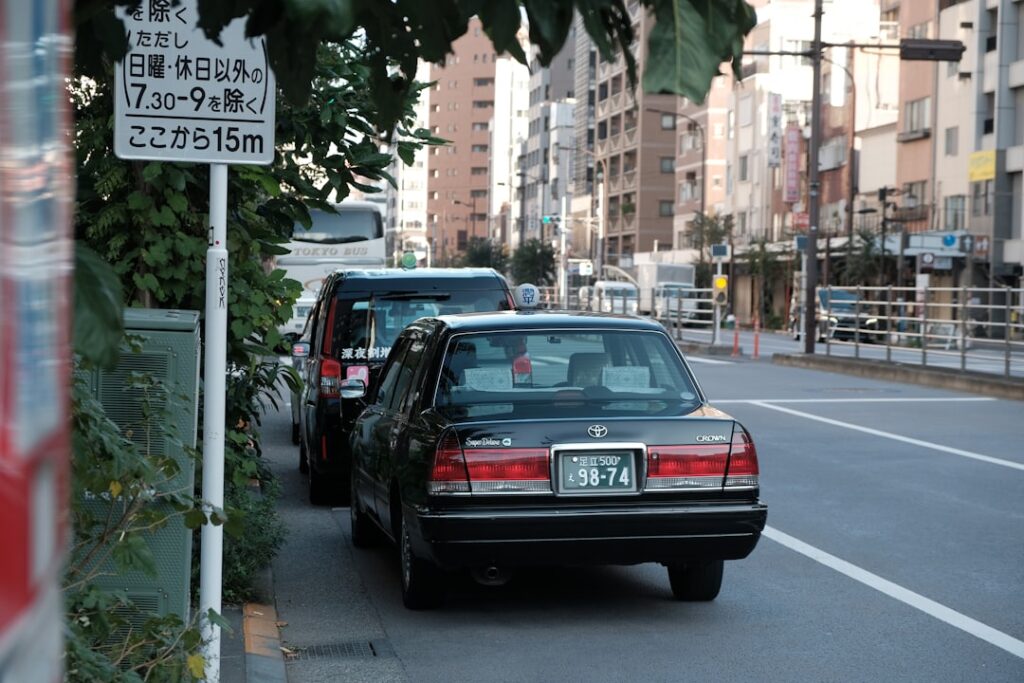
You don’t strictly need an app. Japan still has plenty of taxis you can hail directly, and taxis are equipped with GPS navigation the driver can use once you show or say your destination.
We live near a main road in central Tokyo, so street-hailing is our default, not the backup; we book through an app mainly on rainy days or when we need a pickup at a fixed time from home. App bookings carry a pickup fee for the driver coming to meet you, so for anything close by, street-hailing usually works out cheaper. Our twins have picked up on the routine, too: they know the lit red light on the roof means a taxi is free, and now raise their hands along with us when we’re trying to flag one down.
-
If you’re near a station or hotel, head for the taxi stand first. A marked taxi rank with a queue of waiting cars is the easiest, most reliable way to get one: no guessing whether an approaching cab is free, and no competing with other pedestrians for the same passing taxi. This is our default recommendation over street-hailing whenever a stand is nearby.
-
If there’s no stand nearby, raise your arm to hail a passing taxi, same gesture as most countries. Look at the light on the roof and the indicator color in the windshield first: a lit rooftop sign generally means available, unlit means occupied (colors and exact conventions vary a little by company, but this general pattern holds nationwide).
-
Doors open and close automatically. Don’t reach for the rear door handle; the driver operates it. This catches almost every first-time visitor off guard once, harmlessly.
-
Show a place name, a hotel business card, or a pinned map location on your phone. Drivers are used to this and will type it into their in-car GPS.
-
Install GO even if you plan to mostly street-hail. GO Pay lets you pay a street-hailed taxi cashlessly: register a credit card in the app ahead of time, then scan a QR code or tap “GO Pay” on the in-car tablet at the end of the ride, no booking through the app required. It’s available for street-hailed taxis in most of the country (35 of 47 prefectures as of mid-2024), so installing GO is worth doing purely for the payment convenience, independent of whether you ever use it to book a ride.
What a Ride Actually Costs
Taxi fares in Tokyo’s 23 wards, plus Musashino and Mitaka, were revised on April 20, 2026, the first change since 2022, with an overall increase of 10.14%. The listed base fare didn’t go up; instead, the distance and time it covers shrank, per the Kanto District Transport Bureau’s published revision:
| Before April 2026 | After April 2026 | |
|---|---|---|
| Base fare | ¥500 | ¥500 (unchanged) |
| Base fare covers | First 1.096 km | First 1 km |
| Additional distance rate | ¥100 per 255m | ¥100 per 232m |
What this means in practice for a family (fares outside this core Tokyo area vary by region):
| Trip type | Typical fare (central Tokyo, daytime, no traffic) |
|---|---|
| Short hop across a neighborhood (1–2 km) | ¥800–1,300 |
| Across a district (3–5 km), e.g. hotel to a nearby attraction | ¥1,500–2,500 |
| Late-night ride when trains have stopped, moderate distance | ¥2,500–4,000+ |
Traffic and time of day matter more than distance alone: taxis also charge a time-based fee when moving below 10 km/h in heavy traffic, so a short trip through a jam can cost more than the distance suggests. There’s also a modest late-night surcharge (typically applied roughly 10pm–5am) added on top of the metered fare.
A taxi split between 3–4 family members can work out close to or cheaper than train fares for a short trip, especially with luggage or after a long day, though it depends on your specific fare and how many children ride at a discounted or free child train fare, so it’s worth a rough mental comparison rather than assuming it’s always cheaper.
Do You Need a Bigger Taxi?
Standard Japanese taxis are mid-size sedans, comfortably fitting 3 adults plus a folded stroller and a couple of suitcases in the trunk, but it’s worth knowing the limits before you’re standing on a curb with a family of five.
-
Most sedans seat 3 passengers comfortably (4 at a squeeze without much luggage room). A family of four with bags will often need to ask for a larger vehicle.
-
A double or twin stroller, unfolded, generally doesn’t fit a standard sedan at all. This has been our own family’s experience consistently: whenever we’re out with the twin stroller, we take the train instead of a taxi, and the only time the stroller has gone in a taxi with us is a jumbo taxi arranged for an airport transfer.
-
“Jumbo taxi” is the term for larger van-type taxis that seat 6–9 passengers with real luggage space, useful for bigger families or an airport transfer with multiple suitcases and a stroller.
-
Toyota JPN Taxi, the boxy, distinctively-shaped taxi you’ll see everywhere, has a lower step-in height and a fold-out ramp designed for wheelchair users; it also happens to make loading an unfolded stroller noticeably easier than a standard sedan trunk.
-
Availability varies by company, region, and time of day, and not every app lets you filter for one directly. The most reliable way to get a jumbo taxi is to call a local taxi company or ask your hotel concierge to book one in advance, rather than counting on hailing one on the spot.
-
Don’t assume you can just courier your stroller ahead instead. We once planned to send our stroller home from the airport through a luggage-forwarding counter so we wouldn’t have to carry it, and were told on the spot that it wasn’t something they could ship that way. We ended up needing a jumbo taxi instead of the plain sedan we’d budgeted for. If a stroller is part of your airport transfer, plan for the vehicle that can carry it rather than assuming you’ll ship it separately.
Common Mistakes Families Make
1. Trying to open or close the rear door yourself
The driver controls it remotely. Stand back and let it open before you and your kids climb in; pushing on a moving automatic door is the single most common tourist fumble with Japanese taxis.
2. Assuming a standard taxi will have a car seat, or that holding your child is a safe substitute
Most taxis won’t have a car seat to offer; the legal exemption is specific to hired vehicles, not an oversight. But the exemption isn’t a safety endorsement: the National Police Agency’s guidance is clear that an adult seatbelt isn’t designed to restrain two people, so holding your child in your arms doesn’t protect them in a crash the way a car seat would. If a car seat matters for your trip, look into a reservation-only kids-taxi service, or bring your own portable, vehicle-rated child harness, rather than plan on holding your child for the ride.
3. Not having a backup app installed
GO covers the large majority of situations, but occasionally shows no nearby cars, especially in a sudden downpour when everyone wants a taxi at once. Having S.RIDE or DiDi installed as a second option avoids standing in the rain re-refreshing one app.
4. Assuming a standard taxi fits your whole family plus luggage, or your stroller
A family of four with an airport-sized suitcase each often doesn’t fit comfortably in a standard sedan, and an unfolded double stroller usually doesn’t fit at all. If you know your group is large, your luggage is bulky, or you’re travelling with a double stroller, request a jumbo taxi in advance rather than discovering the mismatch curbside, and don’t assume a luggage-forwarding service will let you skip carrying it.
5. Forgetting the late-night surcharge when planning a budget
A taxi taken after roughly 10pm costs more than the same route earlier in the day. If you’re weighing “one more train” versus a taxi home at 11pm, factor the surcharge into the comparison, not just the daytime fare table.
FAQ
Do I need to speak Japanese to take a taxi?
No. Booking apps (GO, Uber, S.RIDE, DiDi) all work by dropping a map pin for your destination, so the driver navigates from GPS rather than from a spoken address. Even for a street-hailed taxi, showing a place name, hotel card, or a pinned location on your phone is enough; drivers are used to this and will enter it into their in-car navigation.
Is it true taxis don’t have car seats?
Mostly, yes. An enforcement-order exemption to Japan’s Road Traffic Act removes the child car-seat requirement for passengers in taxis and licensed hire cars, and a standard taxi you hail or book through GO, Uber, S.RIDE, or DiDi won’t have one installed. A small number of taxi companies run reservation-only kids-taxi services with a seat, but you need to arrange that directly with the company in advance. Whichever way you ride, holding a child in your arms isn’t a safe substitute for a seat; a self-drive rental car is a separate situation where the standard car-seat rule still applies.
Which app should I install first?
GO, for its dominant coverage and full English support with no Japanese SIM or bank account required. In our own experience S.RIDE is worth installing right alongside it, since it’s often faster to dispatch and has felt more consistently priced day to day. Keep Uber as a backup if you already have an account; it dispatches the same licensed taxis through a familiar interface.
How much should I budget for a taxi with kids?
In central Tokyo, a short 1–2 km neighborhood trip typically runs ¥800–1,300 as of 2026; a longer cross-district trip runs ¥1,500–2,500, plus a small app/pickup fee if booked through an app. Late-night trips (roughly 10pm–5am) add a surcharge on top. Splitting the fare across 3–4 people can work out close to train fares for a short, luggage-heavy trip, depending on how many children in your group ride the train at a discount.
Can taxis fit a stroller?
A folded stroller generally fits in the trunk of a standard sedan. An unfolded double stroller is a much tighter story: in our own experience it essentially doesn’t fit a standard sedan at all, and a jumbo taxi (larger van-type), booked in advance through a taxi company or hotel concierge, is the realistic option if you need the stroller and a taxi at the same time. Don’t count on shipping the stroller separately through a luggage-forwarding service as a workaround; it isn’t always possible.
What if I can’t find or flag a taxi?
Head for the nearest taxi stand rather than continuing to wait on a street corner; major stations and many hotels have one, and it’s the most dependable way to get a taxi quickly, especially with kids waiting. If you’re street-hailing away from a stand, raise your arm for a passing taxi with its rooftop light on.
Do taxi drivers expect a tip?
No. Tipping isn’t customary in Japan and isn’t expected for taxis, restaurants, or hotels generally. Pay the metered fare shown and that’s the complete transaction.
Is Uber the same experience as at home?
Mostly not. Uber’s main Japan service books a licensed taxi rather than a private rideshare driver. The app interface and your existing account carry over, so it feels familiar, but you’re getting the same regulated taxi you’d get from GO or a street hail in the large majority of cases. A limited rideshare program exists in a few areas since 2024, but it’s not the typical experience.
Plan Your Japan Trip
Also useful:
Information checked: 2026/09