
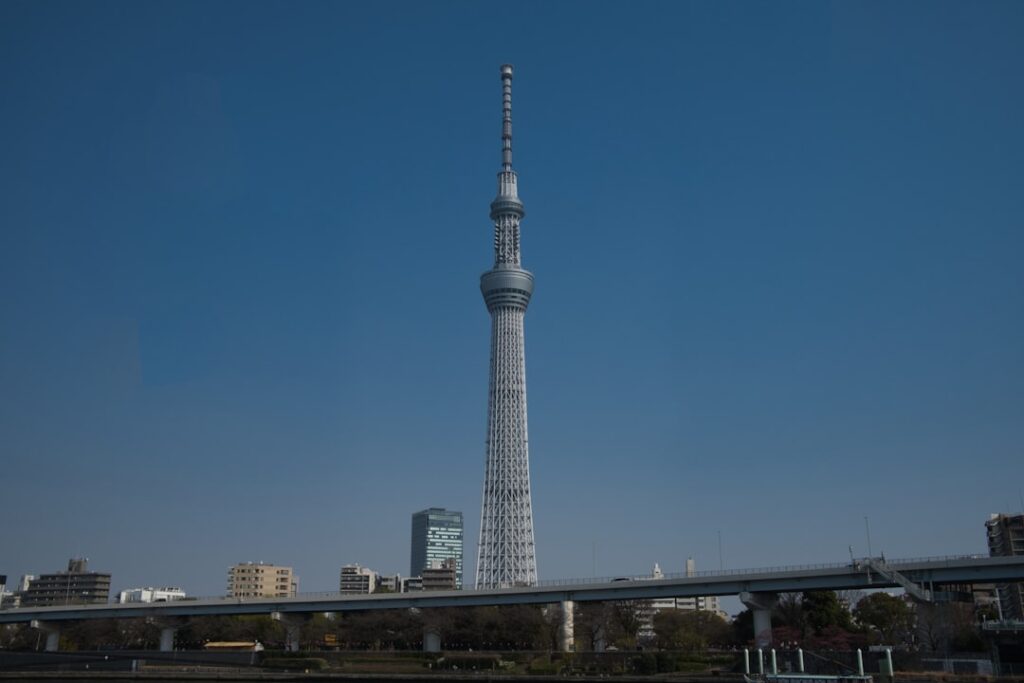
TL;DR
-
Treat it as a set, not a single attraction: Skytree’s observation decks + Sumida Aquarium + Tokyo Solamachi mall together make a full family day; going up the tower alone undersells the trip
-
Buy tower tickets online in advance rather than queuing on the day: Tokyo Skytree moved to date-based dynamic pricing in April 2026, and a same-day ticket at the counter adds a ¥500-per-ticket window fee on top
-
Honest take from a Tokyo dad of twins: the view itself isn’t necessarily the highlight for young kids. Our own kids visited around midday and weren’t especially moved by it. Evening timing seems to make a real difference (see below)
-
Food is one less thing to worry about: Tokyo Solamachi’s food court and dozens of restaurants mean there’s a good chance everyone finds something they’ll eat, without needing to plan ahead
-
Time your visit around the seasonal decorations if you can: koinobori (carp streamers) fill Solamachi Hiroba around Children’s Day in spring, and a large Christmas tree and illumination take over the plaza in winter
-
Don’t go out of your way for a Solamachi Hiroba plaza event with young kids: these can get extremely crowded, and they’re not worth restructuring a family day around
-
A combined ticket with Sumida Aquarium exists and is worth checking before buying tower and aquarium tickets separately
At a Glance
| Entry (Tembo Deck, 350m) | Adults from ¥1,800 · Ages 6–14 from ¥900 · Free for preschoolers (age 5 and under, plus 6-year-olds not yet in elementary school) · dynamic pricing by date |
| Entry (Tembo Deck + Tembo Galleria, 450m) | Adults from ¥3,000 · Ages 6–14 from ¥1,500 · Free for preschoolers, same age rule as above |
| Hours | Weekdays 10:00–22:00 · Weekends/holidays from 9:00–22:00 (last entry 1 hour before close) · check the official day-by-day calendar, as some dates extend further |
| Nearest stations | Tokyo Skytree Station (Tobu Skytree Line): direct · Oshiage Station (Tokyo Metro Hanzomon Line, Toei Asakusa Line, Keisei Oshiage Line): connected underground |
| English support | Good: English signage and ticket counters throughout the tower and Solamachi |
| Strollers | Yes: a barrier-free elevator route runs from the station concourse through Solamachi to the 4F entrance without a step; the standard walking route briefly crosses outside |
| Baby facilities | Nursing rooms on multiple floors of Solamachi (near the 3F food court and on 6F), plus free stroller rental at several points in the mall |
| Typical visit | Half a day if you pair the tower with Solamachi and Sumida Aquarium; 1–1.5 hours for the tower alone |
As of 2026/08 · Source: official Tokyo Skytree and Tokyo Solamachi sites / personal family visit
Is It Worth It?
Short answer: yes, but plan it as a Skytree + Solamachi + Sumida Aquarium day, not a tower-only trip.
This is where we’ll be upfront, as a Tokyo-based family who has actually taken our twins there: the tower itself (going up to the observation deck) isn’t necessarily the big, exciting moment for young kids that it might be built up to be. Our kids visited around midday, and while the Tokyo view is genuinely impressive, they weren’t especially moved by it. We suspect that’s partly about timing: a flat, hazy midday cityscape reads very differently to a small child than the same view at sunset or after dark, when the city lights up (more on this below). If your main goal is “wow the kids,” the tower alone may not deliver that on its own.
What does deliver, consistently, is the combination: Sumida Aquarium’s penguin pool and jellyfish tank at the base of the tower, and Tokyo Solamachi’s food court and shops around it, give the day enough variety that a flat or unmemorable few minutes on the observation deck doesn’t sink the whole visit. Treat the tower as one stop among several rather than the entire point of the trip, and the day works well for almost any age.
By age:
-
0–2 (baby/infant): The tower itself is manageable with a stroller or carrier (elevators are step-free throughout), but there’s little for a baby to actively engage with at 350m up. Solamachi’s nursing rooms and the aquarium’s dim, low-stimulation jellyfish tank are the more baby-friendly parts of the day.
-
3–6 (preschooler): Sumida Aquarium is likely to be the highlight of the day at this age, not the tower. The penguin pool in particular holds attention far longer than the observation deck does. Keep tower time short and build the day around the aquarium and a Solamachi meal.
-
7–10 (primary school): Old enough to actually take in the view and enjoy picking out landmarks, which tends to make the tower feel more worthwhile at this age than for a toddler. Good candidates for the higher Tembo Galleria (450m) if the family budget allows.
-
11+ (older kids/tweens): Similar to above, with more patience for a longer visit; old enough to appreciate an evening or sunset visit for the view, and to enjoy Solamachi’s shops on their own.
What to Expect
Tembo Deck and Tembo Galleria: What You Actually See
The Tembo Deck (350m) is the standard observation floor, with glass-walled views across Tokyo and a section of glass flooring that’s a reliable, if brief, thrill for kids. The Tembo Galleria (450m) is the smaller, higher upgrade: a spiral glass corridor that climbs toward the tower’s highest publicly accessible point. It’s a genuinely different experience from the Tembo Deck, but for younger children the extra height doesn’t necessarily translate into extra excitement; it’s more of a treat for older kids and adults who want the full climb.
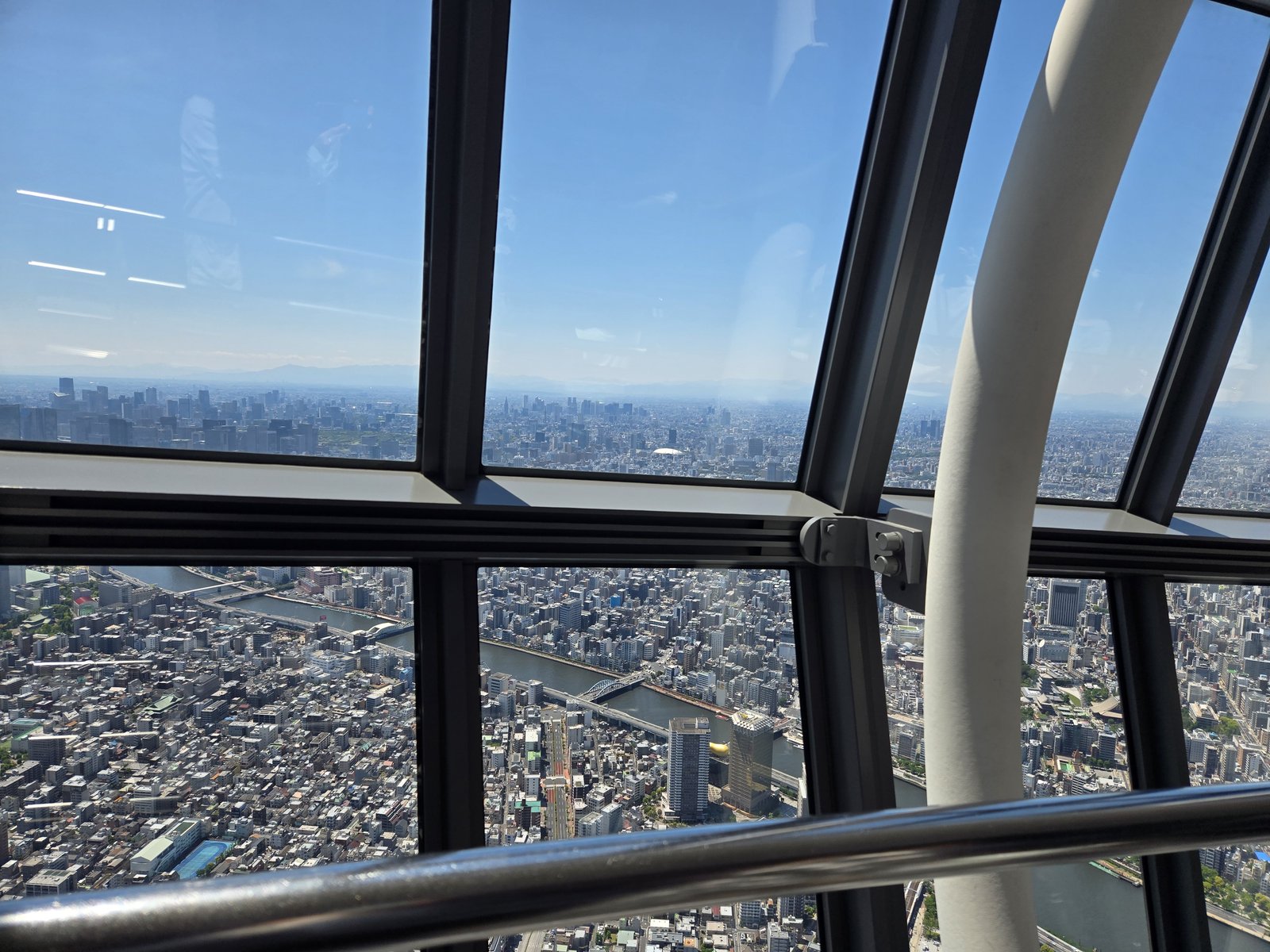
On timing: go later in the day if you can. We only have our own firsthand data point for a midday visit, and it fell flat for our kids, so take the rest of this as reasonably well-supported inference rather than something we’ve tested ourselves at night: online visitor accounts describe a fairly consistent pattern, where daytime gives a clear, map-like view that’s good for photos on a clear day, while the view after dark reads as the more striking of the two: Tokyo’s lights spread out in every direction rather than a hazy skyline. The often-recommended approach is arriving in the mid-to-late afternoon and staying through the light change into evening, so you get both the daytime view and the night view on a single ticket. If a flat midday visit is what soured it for our own kids, an evening visit at least has a real, well-documented case for landing better.
Crowding runs the opposite way to the view advice, and it’s worth checking the official day-by-day congestion forecast for your travel dates rather than relying on a fixed rule, since it shifts with season and events. As a general pattern, weekday mornings tend to be the quietest window for getting up without a wait, while sunset is often the busiest, with real waits for the elevator possible on weekends. If avoiding a queue matters more than catching sunset exactly, the last hour or so before closing is sometimes a quieter way to still catch the night view, but check the forecast for your specific date rather than assuming this holds every time.
Sumida Aquarium
Sumida Aquarium sits inside Tokyo Solamachi at the base of the tower and is worth building into the day as more than an afterthought: for many families with young kids, it ends up being the part they remember most clearly, more than the tower itself. The signature exhibit is a large, open-plan penguin pool viewable from two floors, alongside a jellyfish tank designed to be viewed from directly above. Plan for roughly 1.5–2 hours.
We’ve covered the aquarium in full detail (including current admission prices, hours, stroller access, and a side-by-side comparison with Ikebukuro’s Sunshine Aquarium) in our dedicated guide: Best Aquariums in Tokyo for Kids: Sunshine vs Sumida. If you’re deciding whether to add the aquarium to your Skytree day, that’s the place to check current prices and plan your time.
A combined “Skytree Enjoy Pack” ticket bundling tower admission with Sumida Aquarium (and in some versions, the Konica Minolta Planetarium) is sold at the tower’s ticket counters and can work out cheaper than buying the two separately; it’s worth asking about at the counter or checking the official site before buying tower and aquarium tickets one at a time.
Tokyo Solamachi: Food and Shopping
Tokyo Solamachi is the shopping mall wrapped around the base of the tower, and it takes a lot of pressure off the “will everyone find something to eat” question that comes up on most family outings. The 3rd-floor food court (Solamachi Tabeterasu) alone has around a dozen counters spanning Japanese, Western, Chinese, and dessert options, and the wider mall adds dozens more sit-down restaurants across its upper floors. Whatever a picky eater in your group wants, it’s likely available somewhere in the building, one of the easier food logistics of any Tokyo family outing, even without booking anything in advance.
Baby facilities are spread through the mall: nursing rooms are available near the 3rd-floor food court and on the 6th floor, and free stroller loans (from around two months of age) are available at several points, including near the food court information counter.
Seasonal Decorations Worth Timing a Visit Around
Two seasonal displays are worth planning around, based on our own recommendation as a Tokyo family:
Koinobori (carp streamers) around Children’s Day. In the weeks leading up to Children’s Day (May 5), Tokyo Skytree Town runs a koinobori festival: roughly 1,000 carp streamers hung around Solamachi Hiroba and elsewhere in the complex, including some designed after fish species from the aquarium’s own tanks. In 2026 the festival ran April 10 through May 6. Exact dates shift slightly year to year, so check the official Tokyo Skytree Town event page close to your travel dates, but a visit anytime from early April through Golden Week has a good chance of overlapping with it.
Christmas tree and illumination in winter. From around early November through Christmas, the whole of Tokyo Skytree Town is lit with hundreds of thousands of lights, Solamachi Hiroba gets a large character-themed tree display, and a Christmas market with imported German-style huts sets up nearby. In the most recent season (2025), the event ran November 1 through December 25, with special lighting on the tower itself and Christmas-themed photo spots inside the Tembo Deck. If you’re visiting Tokyo in November or December, it’s worth checking whether the current year’s dates overlap with your trip.
Solamachi Hiroba Events: Worth Knowing, Not Worth Planning Around
Solamachi Hiroba, the plaza area at the base of the tower, regularly hosts organized events: character meet-and-greets, promotional campaigns, markets, and occasional idol or entertainment events. Our honest recommendation, from experience: don’t build a family visit around one of these specifically. They can draw extremely large, tightly packed crowds, especially anything involving a popular character or talent appearance, and navigating that with young kids in tow is more stressful than it’s worth. If you happen to be there and something low-key is going on, it’s a nice bonus to stumble into, but checking the events calendar and planning a trip around a specific plaza event is not something we’d recommend for a family outing. The seasonal koinobori and Christmas displays above are a different story: they’re ambient decorations you walk through rather than scheduled events with crowds converging on a stage.
Family Tips
Buy Tower Tickets Online Before You Go
As of April 2026, Tokyo Skytree uses date-based dynamic pricing for individual tickets, and buying at the 4th-floor ticket counter on the day adds a ¥500 window-issuance fee per ticket on top of whatever that day’s price is. Advance web tickets (and convenience-store tickets, available at 7-Eleven multi-copy machines) avoid that fee and let you walk past the ticket counter queue entirely (useful with tired kids in tow). This is one of the simplest ways to save both money and time on a family visit.
Consider the Combined Ticket if You’re Doing Both
If Sumida Aquarium is part of your plan (and we’d recommend it is), check the combined “Skytree Enjoy Pack” ticket options at the counter or online before buying tower and aquarium admission separately; the combined pricing is usually cheaper than the sum of the two.
Don’t Expect the Tower Alone to Wow Young Kids
Set expectations accordingly, especially for kids under about 7. The observation deck is a nice, calm 20–30 minutes, not necessarily the trip’s highlight: that’s more likely to be the aquarium’s penguins or a food court meal everyone actually enjoys. See “What to Expect” above for our take on why an evening visit has a better shot at landing than a midday one.
Take the Barrier-Free Route from Oshiage Station With a Stroller
The standard walking route from Oshiage Station’s B3 concourse up to the tower’s 4F entrance briefly crosses an outdoor stretch just before the entrance: fine on a dry day, less fun in rain or with a sleeping baby. If you’re pushing a stroller, look for the barrier-free elevator route instead: it runs from the station concourse up through Tokyo Solamachi and connects directly to the tower without a step or an outdoor crossing. It’s clearly signed, but worth knowing to look for before you arrive rather than discovering it partway through the standard route.
Common Mistakes Families Make
1. Treating the observation deck as the whole trip
Building a visit entirely around going up the tower and leaving right after tends to undersell the experience, especially with young kids. Pairing it with Sumida Aquarium and a Solamachi meal makes for a much more satisfying half-day.
2. Visiting at midday expecting the view to be the highlight for young children
A clear midday view is genuinely nice, but our own experience (and the general pattern in visitor accounts) suggests it’s not necessarily what impresses a small child the way a lit-up evening skyline can. If the view is the main draw for your family, weight your visit toward late afternoon into evening.
3. Buying tower tickets at the counter on the day
Same-day counter tickets carry a ¥500-per-ticket window fee on top of the day’s dynamic price, and can mean a real queue during busy periods. Buying online in advance avoids both problems.
4. Planning a visit around a Solamachi Hiroba event
Character events and promotional appearances at the plaza can draw very large, tightly packed crowds: not an environment worth seeking out with young kids. Let a low-key event be a bonus if you happen to be there, not a reason to plan the day.
5. Not checking the combined aquarium ticket before buying separately
If Sumida Aquarium is on your list, ask about the combined “Skytree Enjoy Pack” ticket before buying tower and aquarium admission one at a time; it’s often the better value.
FAQ
How much are Tokyo Skytree tickets for kids?
As of 2026, the Tembo Deck (350m) starts from around ¥900 for ages 6–14, with adult tickets from around ¥1,800; the combined Tembo Deck + Tembo Galleria (450m) ticket starts from around ¥1,500 for ages 6–14 and ¥3,000 for adults. Preschoolers (age 5 and under, plus 6-year-olds who haven’t yet started elementary school) enter free at both. Tokyo Skytree moved to date-based dynamic pricing in April 2026, so the exact price depends on the day you visit: check the official site for your specific dates.
Should I book Tokyo Skytree tickets in advance?
Yes. Buying online (or at a convenience store) in advance avoids the ¥500-per-ticket window-issuance fee charged for same-day counter tickets, and lets you skip the ticket-counter line entirely, a meaningful advantage with young kids.
Is the Tokyo Skytree observation deck worth it with young kids?
It’s a pleasant, calm 20–30 minutes, but on its own it’s not necessarily the highlight of the day for younger children: our own family found a midday visit fell a bit flat with our kids. Pairing it with Sumida Aquarium and a Solamachi meal, and if possible visiting later in the day for the evening view, gives young kids a lot more to engage with.
Is Sumida Aquarium worth visiting with the Skytree?
Yes: for many families with young kids, it ends up being the more memorable part of the visit. It sits directly inside Tokyo Solamachi at the tower’s base, so no extra travel is needed. See our full Sumida Aquarium guide for current prices, hours, and stroller access details.
Is Tokyo Skytree stroller-friendly?
Yes, if you take the right route. A barrier-free elevator path runs from Oshiage Station’s concourse through Tokyo Solamachi directly to the tower’s 4F entrance without a step; the standard walking route works too, but briefly crosses outside just before the entrance. Free stroller rental is also available at several points inside Solamachi.
Where can I eat near Tokyo Skytree with kids?
Tokyo Solamachi’s 3rd-floor food court has around a dozen casual options, and the wider mall adds many more restaurants across its upper floors: realistically enough variety that every member of the family finds something they’ll eat without needing to plan ahead.
When is the best time of day to visit Tokyo Skytree with kids?
Weekday mornings (around 10:00–12:00) are the quietest for getting up the tower without a wait. For the view itself, however, late afternoon into evening tends to be the more memorable time for kids, since the daytime cityscape gives way to a lit-up night skyline, even though sunset is also the most crowded window. If avoiding a wait matters more than catching sunset exactly, the last hour before closing is sometimes a quieter way to still catch the night view.
Getting There
Tokyo Skytree sits directly above two connected stations in Sumida-ku, both linked to the tower by short, step-free routes (see the stroller tip above on which exact route to take).
| Station | Lines | Distance/Time |
|---|---|---|
| Tokyo Skytree Station | Tobu Skytree Line | Directly connected, a few minutes on foot |
| Oshiage (Skytree-mae) Station | Tokyo Metro Hanzomon Line, Toei Asakusa Line, Keisei Oshiage Line | Connected via underground concourse and shuttle elevators to the tower’s 4F entrance |
| From | Line | Journey time (approx.) |
|---|---|---|
| Asakusa | Tobu Skytree Line / on foot via Sumida River Walk and Tokyo Mizumachi | 3 min by train / 15 min on foot |
| Otemachi (5-min walk from Tokyo Station) | Tokyo Metro Hanzomon Line (direct) | ~15 min |
| Shibuya | Tokyo Metro Hanzomon Line (direct) | ~25 min |
| Ueno | JR + short transfer, or Tobu Skytree Line via Asakusa | ~20–25 min |
IC card: Use Suica or Pasmo throughout; no need for paper tickets on any of the connecting lines.
Nearby and How to Combine
Tokyo Skytree pairs naturally with Asakusa, a 3-minute train ride or a pleasant 15-minute riverside walk away via the Sumida River Walk and Tokyo Mizumachi (flat, stroller-friendly, and with Skytree visible for most of it on a clear day). See our full Asakusa with Kids guide for what to combine it with on that side of the river. Given how much there already is to do at the Skytree/Solamachi/aquarium combination alone, most families will get more out of treating this as its own half-day rather than trying to add a third destination on the same day.
Information checked: 2026/08