
TL;DR
-
“Kids stay free” in Japan almost always means a child sharing an existing bed with a parent. A child who needs their own bed, or an extra bed, is usually charged. At the per-person hotel we used in Okayama, that charge was the full adult rate
-
Check how the hotel prices before comparing totals. Some hotels quote per room, so a co-sleeping child adds nothing. Others quote per person, so every child who uses a bed or a meal can add a line to the bill. The booking form tells you which one you’re looking at
-
Japanese booking sites ask what each child needs, not only their age. Ikyu and Rakuten Travel split children into two elementary-school bands and four preschool options built from two questions: does the child need bedding, and does the child need meals? Jalan uses a similar setup with one elementary category
-
Children are sorted by school stage, not by birthday. In Japan a child starts elementary school in the April after turning 6, so a 6-year-old can fall on either side. When in doubt, ask the hotel which category to use
What We Actually Paid
In May 2026 I took our twins, then 4, on a trip to Fukuoka and Okayama: one adult, two preschoolers, two back-to-back hotel nights. Here’s what the bills looked like.
| Hilton Fukuoka Sea Hawk | Korakuen Hotel (Okayama) | |
|---|---|---|
| How it priced | Per room | Per person |
| What we booked | Twin Deluxe, 1 adult + 2 children | Hollywood Twin (22–24 sqm), 1 adult + 2 children, breakfast buffet plan |
| How the kids were priced | I entered both children in the Hilton app. I don’t remember the price moving when I added them | Adult ¥11,980 + preschooler with meals and bedding ¥11,980 + preschooler with meals only ¥0 (from the booking confirmation) |
| Total for the night | ¥27,722, tax included | ¥23,960, tax and service included |
| Booked through | Hilton’s own app | Ikyu, a Japanese booking site |
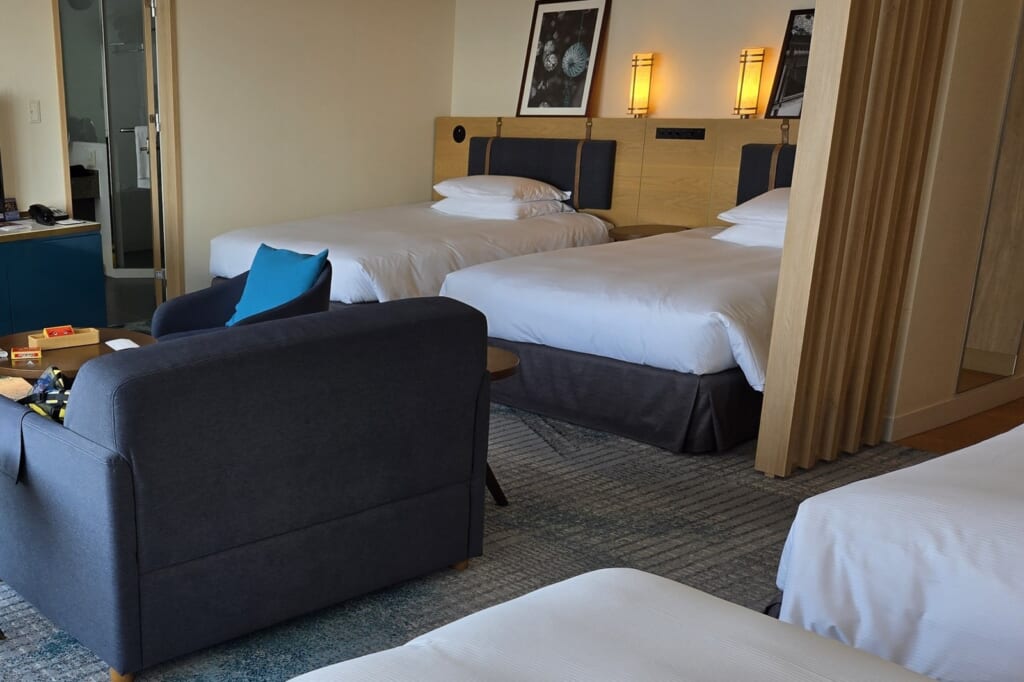
Our Hilton stay came with perks from Hilton elite status, including a free upgrade to a family room with four beds, so treat it as an example of how per-room pricing works rather than what that price normally buys. The Korakuen Hotel line is the more useful one: one twin was billed at exactly the adult rate, and the other was free with breakfast included.
These two bookings show the two pricing systems we ran into, and the first detail I now check when booking anywhere.
How to Tell Whether a Hotel Prices per Room or per Person
Brand is a weak guide here. Some international chains price per room and some Japanese hotels do too; Japan’s tourism agency notes that even among ryokan, the traditional inns where per-person pricing is most common, some now set a room rate. The booking screen is more reliable:
-
Change the number of adults from one to two. If the total roughly doubles, the hotel prices per person, and a child using a bed will likely be charged as well
-
Look for a meals-and-bedding question for each child. If the form asks whether a child needs bedding or meals, children are priced by what they use
-
Look for a price breakdown by guest type. Our Ikyu confirmation listed the adult, each child category, and a price for each. A per-room quote shows one room total instead
Per-room pricing doesn’t automatically mean children are free. Room capacity, extra beds, cribs, and breakfast can still carry their own rules. The Tokyo Disney Resort hotels are a clear example of the per-room model: their published room rates allow up to two children of elementary-school age or younger to stay at the same price. On our stays at Disney Ambassador Hotel, one twin slept on the room’s trundle bed and the other shared a bed with a parent. The trundle bed is a one-person bed that counts toward the room’s capacity, so it can’t be shared.
The Child Categories on Japanese Booking Sites
When I booked Korakuen Hotel on Ikyu, the guest count had separate boxes for male and female adults, two elementary-school bands, and four preschool options. Rakuten Travel uses the same six child categories. Jalan uses one elementary-school category with similar preschool options. This is the guest count from our own booking confirmation, as Ikyu shows it in Japanese:
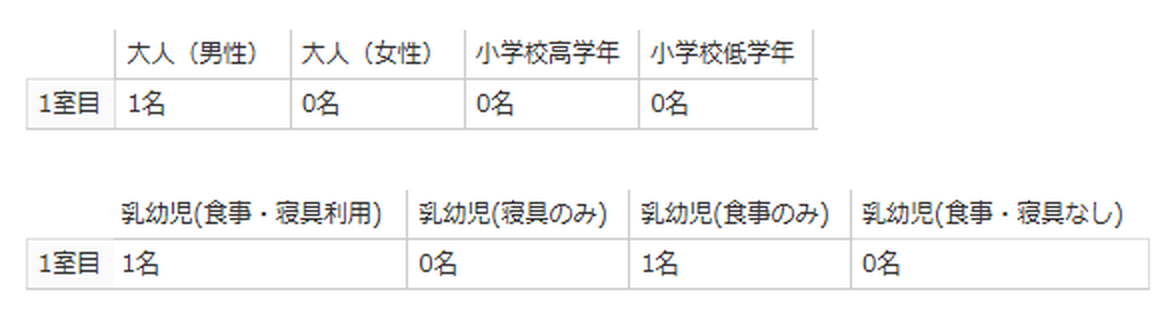
Here are the six child categories in English, in the order they appear:
| Category | What it means on the booking form | What it cost on our Korakuen plan |
|---|---|---|
| Elementary, upper grades | Grades 4–6, roughly ages 9–12 | Not used |
| Elementary, lower grades | Grades 1–3, roughly ages 6–9 | Not used |
| Preschooler, meals + bedding | Not yet in elementary school; own bed and own meals | ¥11,980, the same as the adult rate |
| Preschooler, bedding only | Own bed, no meals | Not used |
| Preschooler, meals only | Shares a bed, eats the plan’s meals | ¥0, breakfast included |
| Preschooler, no meals or bedding | Shares a bed, no meals | Not used |
The four preschool options come down to two questions: does the child need their own bed, and do they eat the meals included in the plan? The last two rows are the co-sleeping options. Whether they’re free is up to the hotel and the plan. Ours charged nothing for “meals only,” but many hotels charge for a child’s meals, and some charge a small fee even with no meals and no bedding. Picking a category with bedding usually means a child rate, and at some hotels that’s the adult rate.
On international sites like Booking.com, you’ll usually enter each child’s age instead. The hotel’s “Children and beds” section explains its age cutoffs and cot or extra-bed rules, and entering every child’s age is what brings up the correct price and occupancy. The meal-and-bedding matrix above is much less common there, so check the final price breakdown before you pay.
Where Co-Sleeping Gets Complicated
Within “free when sharing a bed,” the hotels set four conditions:
-
The cutoff. The most common are “not yet in elementary school” and “through elementary school.” Even hotels in the same chain can differ. Our budget hotel guide compares five major Japanese chains, and they split roughly down the middle
-
How many children per bed. One per bed is the usual rule
-
Whether a free child counts toward room capacity. At some hotels, a child who costs nothing still takes up a place
-
Whether breakfast is included. At Korakuen Hotel it was, for free. Plenty of hotels charge for it
Here’s how this played out for us. Our twin room had two beds, and the Ikyu form wouldn’t accept one adult plus two co-sleeping children. The form didn’t say whether the limit came from a one-child-per-bed rule, the room’s capacity, or the plan itself. So I booked one twin as a preschooler with meals and bedding, and the other as a preschooler with meals only. The Hollywood twin, two single beds pushed together, worked fine for the three of us, but we paid for two full guests.
If you’re one adult with two young kids, or two adults with three, expect this situation in a per-person hotel. A per-room hotel with a large bed, or a family room, is often the simpler booking.
A Short Note on Ryokan
Ryokan more often price per person, and since dinner and breakfast are usually included, child rates are often set as a share of the adult rate. Japan’s tourism agency describes rates of around 50% or 70% of the adult rate depending on age at some ryokan, with many not charging for very young children (under about 3) and treating 12 and up as adults. Each inn sets its own table. Our guide to family ryokan near Tokyo covers choosing one.
Step-by-step: Booking a Room with Kids in Japan
This is the order I go through now when booking with the twins:
- Enter every child in the search, with the category that matches how they’ll sleep. On a Japanese site, I start with a co-sleeping category for each preschooler. Rakuten Travel doesn’t let you change the guest count online; as a rule you cancel and rebook, unless the hotel agrees to handle it directly. Get the count right the first time
- Look at the total, then switch one child to a category with bedding. If the total jumps, you’re on a per-person plan and you can see exactly what a separate bed costs
- If the form rejects your combination, try a room with more beds or a family room before giving up on the hotel
- Read the plan’s child notes. Look for the co-sleeping cutoff, the number of children per bed, and whether a child’s breakfast is charged
- Compare the same plan type across hotels. A breakfast plan and a room-only plan at the same hotel can price children differently
- Save the confirmation that shows the per-guest breakdown. Ours listed each category and its price, which is what you’ll want if anything is questioned at check-in
Telling the hotel about every child also helps on arrival. At Hilton Fukuoka Sea Hawk I’d entered both children, and the room was ready with amenities for three. At Korakuen Hotel, children’s items were at a lobby station for guests to pick up, so we didn’t need to ask for anything. If a hotel’s own plan asks you to list free children in the notes field instead of the guest count, follow that.
If no category fits, contact the hotel before booking. A short message like this is enough:
We are 1 adult and 2 children (ages 3 and 6). Could the 3-year-old share a bed with me at no charge? Which category should we book the 6-year-old under, and is breakfast charged for each child? Thank you.
FAQ
What age do kids stay free at hotels in Japan?
It depends on the hotel. The most common cutoffs are “not yet in elementary school” and “through elementary school,” and in both cases free usually means sharing an existing bed with a parent. Check the property’s own rule, since hotels in the same chain can differ.
Is my 6-year-old a preschooler or an elementary-school child?
Japanese booking sites sort children by school stage, and Japanese children start elementary school in the April after their sixth birthday. A 6-year-old from abroad can fit either category, so ask the hotel which one to use before booking.
Why did my child cost the same as an adult?
At a per-person hotel, a child with their own bed and meals is often priced as a full guest. That’s what happened to one of our twins at Korakuen Hotel. Choosing a co-sleeping category, where the hotel allows it, is usually the way to a lower rate.
Can two children share a bed with one parent for free?
Usually not. One co-sleeping child per bed is the common rule, and some hotels count every child toward the room’s capacity. With one adult and two young kids, look for a room with more beds or a per-room hotel with a family room.
Is breakfast free for a child who stays free?
Sometimes. Our Okayama hotel included it at no charge, but many hotels charge for a child’s breakfast separately. Check the plan’s child notes, or book room-only and buy breakfast on the day.
Do I need to tell the hotel about a child who is staying free?
Yes. Use the method the hotel asks for: the child count on the booking form, or the notes field if the plan says so. Hotels use the count to prepare bedding and amenities, and some count every child toward room capacity.
Plan Your Japan Trip
Also useful:
Information checked: 2026/10